Bringing a new baby home is a monumental milestone, but the period after birth is often met with startling silence. Welcome to the fourth trimester—a beautiful yet overwhelming season. If you're navigating sleep deprivation and hormonal shifts, you aren't alone. But you can do more than just survive; you can thrive in the fourth trimester. This post breaks down top insights from Fourth Trimester Show host Sarah Trott. Discover how to shift your mindset by treating recovery as a job, build a support village, set visitor boundaries, and proactively protect your mental health.
---
Listen to the podcast here
Thriving In The Fourth Trimester With Sarah Trott
We are so grateful to have Sarah Trott with us, who is the host of an amazing podcast, the Fourth Trimester Podcast. Without further ado, I'm going to welcome you to the show, Sarah, and ask you to introduce yourself a bit.
Thank you so much, Dr. Kate. I am delighted to be on your show. You've been on mine as a guest. I love that we're going full circle with this. To tell you a bit about me. I am Sarah Trott. As you mentioned, I'm the host of the Fourth Trimester show, where over the course of the last decade, I've interviewed hundreds of perennial professionals to help families prepare for a healthier, more supported, more informed start to life with a new baby.
Through those conversations with perinatal psychiatrist, obese, doulas, lactation consultants, and pediatricians, and the authors of The First Forty Days. You name it. My focus has been on translating all of that information and the evidence-based expertise that they share into practical tools that parents can use right away in their everyday life. One of the things that I love about doing this work is I love sharing information that helps parents, caregivers and everyone who listens to feel more informed and more empowered and less alone, honestly, in this uniquely transformative time in their lives of becoming parents.
That is so amazing. I'm just excited.
I love your show. I love that you have resilience in the title, honestly. I don't think we talk about resilience certainly in the context of the fourth trimester nearly enough.
That's such a good point because having a baby or bringing a new baby home is a huge transition. I'll tell you on the other side of it, as a mom of twin boys. My husband and I weren't fully equipped with what it would mean. We just settled in and did it. That was a whole journey in itself. Everybody's journey looks different. I love what you're talking about here in terms of equipping folks with the tools and practical strategies to optimize their well-being within their own unique context as a new parent or whatever that looks like for them.
It is unique for everybody. It's this unique moment in time and then it's different for every parent in their own experience. Hopefully, everyone reading takes that away. This is just like a meta comment here. There's no right way to do this. It is going to be different for everyone. What I'm going to share is going to be something that you can take away and think about this discussion. Make it right for you or what's right for you and your family. There's no perfect formula that anyone can follow, like ten steps to perfection. It doesn't exist.
That is such an important point that you're making. Everybody's context looks different. Strategies and tools that we can put out there will be applied and implemented in different ways. It will look different for everybody. The fact is, there are foundational tools and strategies that we can all put into practice and have if they are ready as we're making this monumental transition into parenthood.
Well said.
What are some of these tools and strategies?
Shifting The Postpartum Mindset: Prioritizing Recovery Over Productivity
For our conversation, I was thinking through all of these conversations. I pulled together five of the most valuable takeaways. All of those discussions I've had with perinatal professionals over the years focusing on our theme of resilient parenting in the fourth trimester.
I love that. Let's jump in.
Five things you can do for a more resilient fourth trimester. The first one is about a mindset shift. It's about lowering your bar and your expectations on productivity for this time period, for the first month to a year plus maybe on what productivity looks like. You can raise the bar on recovery. What that means is treating recovery as a job. It means treating it like it is something that's productive. That's hard because it's rest. Sometimes, you think you're resting. You're not doing anything, but this is the big shift that you need to think about.
Recovery deserves the same commitment as work. Raise the bar by treating it as something productive and worth investing in.
This is a job and I've heard this point being made by OBs and other professionals who have medical backgrounds. Also, certainly Physical Therapy folks as well who also have medical backgrounds but are focused more on the physiology of recovery. With all of this they've said, “They're a couple things that can happen. One is doing too fast too much too soon and going too fast.” It means you could potentially go backwards in your recovery and re-injure yourself or you could elongate the overall time period of your recovery.
That means you might take your productivity back up to where it was but your energy level and your physical strength isn't where it needs to be. You might always carry along not being 100% for a long time or potentially indefinitely. It is important for you and the people that you're caring for to give yourself the time and space to recover.
That is such an important point and so hard to do. It is a mindset shift. Managing our expectations of ourselves as we're giving ourselves time to recover. That recovery piece is such a vital piece and so difficult to do within the context of limited sleep and all of that. The other thing that pops out at me in what you're saying is that with pre-baby, we might have had a list of ten things on our to-do list in the morning. Check them all off. By the end of the day, the new baby comes home. We might just get one thing checked off our list and that's okay. That's okay within the context of what now is but so hard to wrap our heads around that in the moment. I know it was for me.
If you put self-care and rest, it's one more thing on your to-do list or like we've talked about. If you put time for resilience, self-care on your to-do list. It's going to fall by the wayside, which is why these things are part of your day. They're part of your existence. They're not just something on your to-do list.
That is excellent and very important.
Building An Intentional Support Village And Combatting Isolation
1) We're going to say, treat your recovery as a job. Stop acting like you didn't just give birth. Your to-do list can wait. 2) Thinking about how to enable some of that. A couple of my subsequent points are how you enable that because the reality is those things still exist. You're still going to have needs. At home, you’re still going to have needs. Number two on the list is building your support system. Thinking about building your village or your support ecosystem, however, you want to think about that.
You just gave birth. The chores, messages, and to-do lists can wait. Recovery matters too.
Being thoughtful about who you're going to have around you to give you support. One of the big myths here is that being resilient is about being independent. Being self-sufficient about proving yourself in some way like, “I've got this. I don't need any help. I can get through this hard thing.” Maybe you can. Maybe you can go through some of those amazing, but also challenging times in a lot of ways and be just fine. The goal ideally isn't to be just fine or to survive. Your goal is to thrive. Your goal is to be well-resourced, be nourished and supported.
There are a number of people out there professionally and also friends and family who can and probably want to step in and support you in a lot of ways. The practical takeaway here is that it’s okay to ask for help. It's a strength. Think about who those lists of people are. Sit down and document who your OB is and your pediatrician. Find a lactation consultant who you like. You never know how some of that stuff is going to go. Finding someone who you could chemistry with beforehand.
That also goes for a talk therapist, too. Find these individuals who you like and who you trust. Have their phone numbers on the ready so that once the baby comes along. If you need these resources, you've got them to hand. The other resources I want to add to your list are Postpartum Support International. If you need someone to talk to anonymously, they have text and calls. They provide emotional support. It's brilliant.
Certainly, think about who your one person is for your panic call. Say you're in a pinch and you need someone to help you straight away. Who would that person be like? Think about that. Talk to that person like, “Could you be my speed dial person if something comes up and I need someone to come over and have that person?” Other folks who could be useful to identify. I would say join or find a group that you want to join like a new parent group.
I personally am a big fan of in-person parent groups. I got a lot of value out of a group. It was a group of women who had babies all around the same age early. We would go on gentle walks. They were facilitated by a woman who would talk about mythology, womanhood and parenthood. It was such a brilliant infusion of companionship, meeting people who are going through the same thing and sharing support and receiving support.
Also, a break from what the normal day looked like. There's so much value in that. I know there's a lot of value that can come out of virtual groups, too, if you don't have access to something like that. Having people around you who are in a similar time period of life is valuable because it can help fight off feelings of isolation.
That is such important advice and so true. I remember when our twins were born. We were moving around a lot with my husband's job. We’re landing in new towns from time to time but often when they were born to three. Having that social support from mom’s groups or toddler playgroups. One of our very favorites was the little gym in a neighboring town. The baby's got to play and start getting a sense of their body integrity and ability to move around. Us moms sat with our Starbucks and we chatted.
It's been a cool connection to see evolve over time because our kids are teenagers now. We've since moved a bunch. We're not living in the same town anymore. but I'm still in touch with those guys. We've got the same foundational memories in that way. I remember how powerful that was. The one hard thing for me though was I had twins. Sometimes, if a playgroup in this mom's group that I was a part of, I had a hard time getting there because I couldn't carry both baby carriers at the same time into the house.
I didn't want to leave one but a boy in the car while I was carrying the other one in. That became a little bit more difficult in the winter. In the summer, it was doing more exactly what you said, going on walks, meeting in town or at the bookstore. I could not agree more that the power of social support is key. Asking for help and connecting with folks in your community or otherwise that can support you is so very important. Asking for help is a major strength. Easier said than done, but so important.
Resilience is not about doing it alone. It's about being surrounded by people who can support you and being willing to receive that help. Also, I don't want to fail to mention. You can hire professional help who can be there in your home. Some people don't know what a doula is, but I would highly recommend looking into a postpartum doula. They are non-medical professionals who provide practical, social, and emotional support.
True resilience isn’t isolation—it’s being surrounded by support and allowing yourself to receive it.
They are a wealth of knowledge. If you need help in some area, they have seen it all. They have seen in-laws and feeding issues. They know who to call. They all have a role of decks of people who you can help you towards if you need support. In addition to family and friends who can step in and help you. Planning ahead for who are all those folks, who are all the players, and then put it on a list. Stick it on your fridge, save it in your phone, and then you it's there.
A very important option for folks because any type of support from an expert like that is invaluable.
Mitigating Cognitive Load And Establishing Boundary Control With Visitors
One of the other themes that has come up in all those conversations with the various professionals I've talked to is about to the point of accepting help. It’s reducing your cognitive load a little bit and thinking about how to operationalize that help. Say, you've got your list of 3 or 4 friends or people at the church or whoever has said they want to help you. You don't know how to make it happen, like how to connect those dots.
A simple thing to do could be to make a list of all the things that you would be willing to have folks do for you. For instance, walk the dog or do a meal train or whatever that looks like. Put it in a shared spreadsheet so people can then go on and look at your schedule and say, “Sure, I'll take Tuesdays and Thursdays,” and like sign up. Having a system around some of that can go a long way because it reduces the stress out of planning. It lets people help you when they say, “I'd love to do something. What can I do?” You say, “I have something I can share with you. You can have a look at it and see if there's anything that works.”
That is such a great idea because it's true. There are a lot of cognitive loads in that planting and like, “My neighbor said they wanted to help but what would be helpful at this point?” Letting them self-schedule or self-select in terms of, “Here are the things I need help with,” and what they feel they'd be best suited for. I love that. That's gold. That’s wonderful advice.
That one's come up a number of times especially because you don't think a lot about what it's going to be like afterwards. You don't know until you're in it but think about all the things that a visitor could do. By the way, on the point of visiting. Visiting when you have a new newborn baby, especially in the first 30-40 days is not about you, the parent or the caregiver in the home entertaining. It's not about having this clean visitor friendly House where people come in and then you serve them tea and you entertain them. That is not appropriate in their fourth trimester. It isn’t.
The fourth trimester is for recovery and support—not for parents of a newborn to entertain guests.
I could not agree more.
I've done a whole episode on visiting and having boundaries and what that looks like. It is okay if someone wants to bring you a meal to say, “You can drop it off outside at around 5:30 and give me a text. Thank you so much.” The help doesn't have to be like you receiving people into your home. You might also have some feelings or anxiety around especially with babies being so early and their immune system development having a lot of people around. You might not even want that. It's completely up to you and you do not have to apologize. You can let visitors come in when you are ready.
I love that advice. That really resonates with what our experience was because our boys were six weeks early and it's true. Their immune systems are not fully developed. We brought them home. We were very fortunate that they were only in the NICU for six days. They came home but they were very small. Their due date hadn't arrived yet. I was very cognizant of germs and very concerned about all of that. I held off on taking them to many places where we were doing that socializing thing.
I was taking them on walks outside on our own, but we didn't engage with other babies or the little gym until they were 8 or 9 months old because I was worried about that. Technically, I think I could have brought them in two months but I was not quite ready. I felt a little bit badly about that. It was like, “Was I doing the right thing?” What you're saying here is, it's okay to set these boundaries and you need to do what feels best to you and hat you feel is best for your babies. Some people might have been a bit more relaxed about the germ thing. That's not my disposition or my personality. I know that about myself, so I set the boundary.
You do what is right for you. That whole thing about self-judgment, the way we inflict it on ourselves is so hard. You think, “I should be taking them or my friends are going or whatever it is.” I would encourage everyone to let that go.
That's it. Let it go and focus on optimizing within your own context and what you believe is right within you as mom, as parents, and all of that. I love the advice that you're offering there. That's amazing.
Proactive Mental Health Management And Nervous System Regulation
That takes us to the next bucket of stuff that I've heard repeated countless times by the perinatal professionals I've talked to. Which is about being proactive with your emotions and your mental health. This one's big. There's a real practical way to do some of this stuff. The goal, in general, is to not wait until you're in crisis mode. Being proactive about your mental and emotional health during a tender time and a time of huge hormonal flux and change for identity. All these things that are happening for you, helps you to provide yourself with necessary self-care.
It helps protect you longer term. That's a good foundation for you and your family because often, mother or mom, you're the emotional bell weather in the house. When you're taking care of this for yourself, you're taking care of it for everyone around you. It's important. I love some of the points I've heard. One of the best pieces of advice I've heard is to pre-book a therapy session. A talk therapy session with someone before you have your baby. Book it for month two.
Dr. Kate, I'd love you to chime in on this one, too. When's the right time? Sometimes it's hard to get on someone's schedule. Pre-booking it guarantees that you've got a spot around at the right time. You can book it as a virtual session so you are not leaving your home. You're not leaving your baby. It feels a lot safer and it's a higher chance of it happening.
I love that. That's very important because having a proactive stance on caring for one's own well-being and what might be necessary. If that two-month mark comes and you feel like, “I don’t really need to talk to a therapist.” Maybe make the connection regardless because as you mentioned, it’s hard to get appointments. To have a touch point in place, assuming that you make a good connection with that particular person. You might not need to see them again for several months or a year even. At least there's somebody that you can reach out to again if the need arises.
I love that idea because I don't think that that's something that many will automatically go towards because it's like, “I don't need therapy. I don't need that help but that too.” That's not about weakness. That's about strength and putting the pieces in place that can help you to be at your best. I see lots of folks in my practice who are doing just fine but they want to optimize something or they want to move in a certain direction or shift gears or get used to something new. Bringing a new baby home is something new.
You've probably talked to a lot of new parents going through this change. What a cool time to talk about identity and maybe it's baby number two. That's another identity show or baby three or something went plus.
You’re managing your older children to your other kids' reaction to the baby. All the feelings can come up with that and how to create that stable modulated baseline within the home. That would be a great thing to talk with a therapist or a coach about. To have that as something that's on your radar is a powerful thing in terms of optimization. I don't think it's necessarily automatically on a lot of folks' radars unless there's an issue. Flipping that script is very important.
It's not always a perfect love match with the first therapist you talk to. Spending the time up front before you have the baby to find someone you click with is nice. Whatever job or tasks that exist before you have a baby, feels ten times harder. You have a baby because you're sleep deprived. You have all this new responsibility. Finding the time becomes a lot harder to do stuff like that. It could easily fall off the list out of necessity.
I would encourage you to do it before. Find the right person and get it booked. If you have a partner, think about scheduling time. It doesn't have to be super formal but agree like, “Once a week, let's check in with each other. How's it going? How could we do things better? Let's talk about whatever feelings are coming up,” so that you have that touch point with them in a proactive way.
We're moving so fast through life in general and then a new baby comes in. We're moving even faster or we've got even more distractions. It’s so easy to lose sight of the importance of those touch points with our partner, our spouse, or what have you. I love that because being intentional carving out that time will strengthen things long-term. Not only between you and your partner, but also for the entire family system and the way things are evolving with a new baby at home. That's spot-on as well.
Other things we talked about is joining a parent group. Again, that's also emotional support. I've had people talk a lot about this idea of normalizing mood fluctuations. There are a lot of feelings that happen at once. Sometimes, that can be surprising for the person in their own body of like, “In the last half an hour, I felt joy. I've wept. I've felt exhausted. I've felt anxious. I felt more love than I've ever experienced in my life. All these things are simultaneous.” It's an interesting time for a lot of parents to experience that but that's okay.
Normalizing that experience is so important. Also, another important reason to have a touchpoint with maybe a therapist or a coach or someone like that is to talk through some of those experiences or feelings hitting all at once. That's an important piece for some if those feelings become too strong in some way, but it’s a normal experience. It happens. Often, it’s very surprising to folks.
For instance, this whole show, Resilient Parenting. It’s a good time to think about being proactive and learning about resilient parenting. Tuning in to a show like this one. Learning what that means. I know when you were on my program, we talked a lot about the idea of regulating the nervous system. That is for sure proactive mental emotional self-care. Your learning skills are like simple stuff. Not always, but there are a lot of tools that you shared that were just things that you can integrate into your day.
That is very important and not to look at it as more things to throw on your to-do list. Try to have a simple integrated strategy or tool to modulate your stress response. We don't want to start our day with a new baby. The challenge that's inevitably going to hit escalates us to the point of possible shut down.
I shared on your show, The Relaxation Response by Herbert Benson. It’s super simple coming up with that word or that phrase that you find soothing in some way and breathing and practicing on either side of the day to start to integrate what it feels like to be modulated. Being able to pull that up, pull it out of your back pocket anytime you might need it when a stressor hits during the day. It’s an excellent point because modulation for all of us is so important. It becomes even more important when we're new parents and there's a new baby in the house. All of that.
One final point I want to mention on emotional mental health productivity is something that someone shared. Which is to have your partner or whoever is going to be close with you carrying for you close during the first handful of months. Have them go to the Mayo Clinic. Have them learn a little bit about some of the signs of postpartum depression so that they can help look out for you for warning signs.
That is an excellent point. Thank you for sharing that.
Finally, number five, thinking through logistics and shared responsibilities with your partner if you have one. Having that conversation early before the baby arrives is all about aligning expectations. Don't have unspoken expectations that show up the night that's so hard. It will happen but you can avoid some of the bigger buckets like talking about how to divvy up baby responsibilities. Think about how we share these tasks. Who’s getting up at night? Is this 50/50? Who manages medical appointments? Who owns household tasks, cooking and cleaning? Do we outsource some of this stuff?
A regulated nervous system may be one of the greatest gifts a parent can give a child.
Again, to our very first point on the list. Lower productivity expectations so you have your number one job, which is recovery. What does good enough look like for your house? Maybe it's okay to not do laundry as often or let certain things go so that you can have the time and space for other stuff that you need.
Financial planning is a huge one. Have a conversation with a partner like if you're taking time off work or if you're going to have new child care costs or you want to outsource a cleaning person for a year to help lighten the load for yourself during a busy time in your life. Those are some of the conversations you can have early with a partner or other friends or family or people who are going to be close to you during that first year.
That is a nugget of gold as well. Often, we're moving so fast that we forget to do those things. We forget to focus on those areas. It’s so important in terms of optimization. I love that. This has been amazing, Sarah. I so appreciate you joining us, sharing all of this insight and wisdom with our readers. What's one final piece of advice you might have for our readers? Also, how can folks get in touch with you, learn more, listen to your podcast and all that good stuff?
There's so much. We touched on it a little bit, but one of the most powerful gifts you can give your child is a regulated nervous system. It truly is. Tuning to a show like this and learning some of these tools and giving your regulation to those around you is really valuable. Thank you for this show. This is amazing. For more about me, you can go to FourthTrimesterPodcast.com.
That's our website to find the program and other information. The show is available on Apple or Spotify or wherever you listen. If you do go to our website, we have a free guide you can download. Which has a lot of the Practical tips and other things that we've talked about here. Plus, a whole lot more. It's a template for planning your fourth trimester.
That's awesome. Thank you so much again for joining us there. I truly appreciated this.
Me, too. Thank you, Dr. Kate.
Important Links
About Sarah Trott

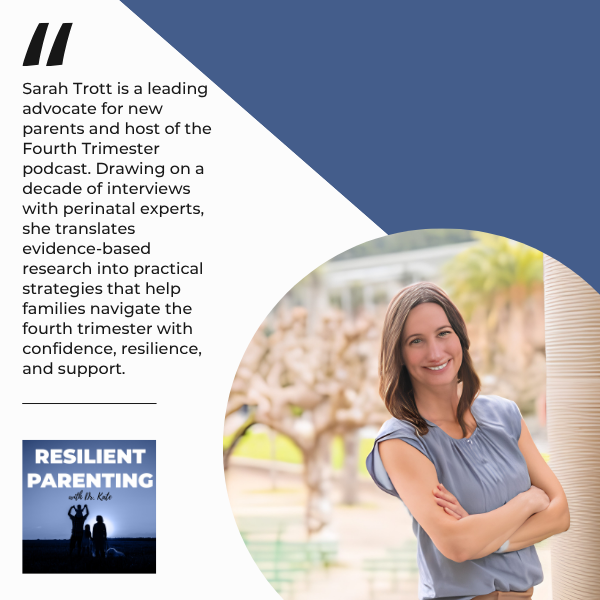
Sarah Trott is creator and host of the Fourth Trimester Podcast. She created the show after realizing that many of the questions she had about her own experience as a new parent were the same questions her postpartum doula Esther was asking some thirty years prior.
She is passionate about helping other parents find the resources and confidence they need on their parenting journey.
When she is not podcasting, Sarah works in tech and spends time with her husband and three daughters in the San Francisco Bay Area.