Resilient Parenting With Dr. Kate
If you’re a parent feeling stretched thin or constantly on edge, this episode of Resilient Parenting with Dr. Kate is your guide to staying grounded amidst chaos. Dr. Kate Lund, clinical psychologist and mom of twin teens, explores real-life parenting stress—from rejected breakfasts to lost sweatshirts and barking dogs—and shows how naming your emotions and using simple tools like breath, grounding, and temperature shifts can help you respond thoughtfully instead of reacting. By modeling emotional regulation and repairing moments when you snap, you teach your kids accountability, emotional intelligence, and resilience—all while reclaiming your own calm.
---
Listen to the podcast here
Resilient Parenting With Dr. Kate
Welcome to another episode of Resilient Parenting with Dr. Kate. I'm Dr. Kate Lund, a clinical psychologist, author of the new book, Step Away: The Keys to Resilient Parenting, a mom of twin boys and someone who has lost her cool over something wildly insignificant more than once. If you're reading while folding laundry, hiding in the bathroom or even lying in bed wondering why you feel so depleted even though you truly love your kids and your family. This episode is for you. We're talking about parenting stress in the middle of chaos. Not the hypothetical kind but in real life, someone's yelling, something is spilling and you're already late kind.
More importantly, what to do in your body and brain with that stress response gets hijacked. Let me paint a picture. It's a weekday morning and you've already done a lot. You’ve made lunches, answered emails, reminded your child three times to put on their shoes so that they're ready to leave for school and then it happens. They can't find the one sweatshirt that they insist they need. Another child is suddenly starving even though breakfast was rejected ten minutes ago. The dog is barking. The phone is buzzing and you can feel it, the tight chest, the shallow breath and the heat rising.
Understanding Stress As A Normal Human Response
Out of your mouth comes some version of something that surprises even you but it is sharper, louder and less patient than the parent you want to be. Afterward, the guilt starts to creep in. You think, “Why can't I handle this better? Other parents seem calmer. I know all the things I'm supposed to do. Why do I still get so stressed out and sometimes lose my temper?” I ventured a guess we've all been there. I know I have on many different occasions. Here's the truth and I want to say it clearly. The moment that this is all happening is not a failure of parenting. It's your nervous system on overload.
When your environment gets loud, unpredictable, and emotionally charged, your nervous system does what it’s designed to do: it protects you. Your heart rate increases, your thinking narrows, and your patience drops. This isn’t because you’re weak—it’s because you’re human.
Your brain can't distinguish between a real threat and a perceived overload. When your environment gets loud, unpredictable, and emotionally charged, your nervous system does what it's designed to do. It protects. Your heart rate increases, your thinking narrows and your patience drops. This isn't because you're weak. It's because you're human. Most parents are already somewhat dysregulated, sleep deprived, mentally overloaded, emotionally stressed and frankly stretched very thin and often, too thin.
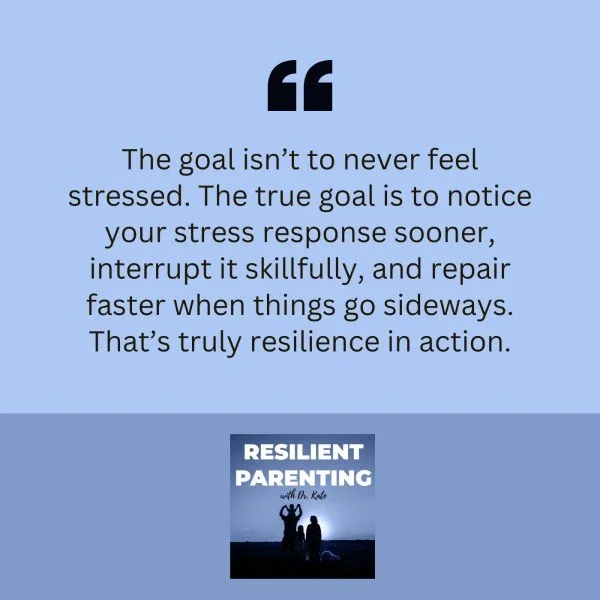
The goal isn't to never feel stressed. Let's face it, stress is real. Challenges are going to come up day in and day out. It's how we navigate through and beyond those challenges. How we show up for those challenges so that we can navigate through and beyond them is what makes all the difference. The true goal is to notice your stress response sooner and interrupt it more skillfully and then repair faster when things go sideways. That's truly resilience in action.
Interrupting & Regulating Your Stress Response
The first and most powerful tool is incredibly simple, name the state you're in. Even if you do it silently. Say something like, “I'm overwhelmed. My body is activated. This is stress and not danger.” Why does this work? It engages your prefrontal cortex, which slows reactivity and creates somewhat of a pause between the feeling that you're having and reacting. You're not trying to calm down instantly. You're trying to regain a choice in how you respond to the situation. Here's the bonus. Sometimes saying it out loud models emotional intelligence for your kids. “I'm feeling overwhelmed so I'm going to take a breath.” That's not a weakness. That's teaching. That's helping your kids to build a foundation for how they're going to respond to the stressors that are inevitably going to hit in their life as well.
Next, you want to regulate your body first and not necessarily your thoughts. When chaos hits, parents often try to think their way out of stress but stress lives in the body. It's not logical. A regulation has to start physically. Here are three quick tools that you can use at the moment. Try lengthening your exhale. Inhale for four and exhale for a count of six. Do it twice and this signals safety to your nervous system.
Not every moment needs a lesson. Not every behavior needs fixing. Sometimes resilience looks like, 'We’ll deal with that later.' That’s not avoidance—it’s wisdom.
Next, ground through your feet. Press your feet firmly into the floor. Feel the weight of your body and this pulls you out of a mental spiral, if you're in one. Third, change your temperature. Cold water on your wrist, for example, or a splash in your face can reset the central nervous system when it's aroused or when it's too activated. These aren't wellness hacks. It’s neurobiology in action. You're not calming down to be a better parent. You're calming down so that your brain can come back on line and you can respond in the way that you want to instead of reacting.
Next, I want you to try to shift from “stop it” to what's needed. Once you're slightly more regulated, try this reframe. Instead of saying to yourself, “This needs to stop.” Instead ask, “What's needed here?” Sometimes the answer is a boundary, a pause, less talking or a reset from you. Not every moment needs a lesson. Not every behavior needs fixing. Sometimes resilience looks like, “We're going to deal with that later.” That’s not avoidance. That's wisdom.
Repairing & Modeling Resilience For Children
I want to leave you with this. Your children don't need a calm parent all the time. They need a parent who can repair. If you snap, own it. Apologize simply and move forward. You can say something like, “I was overwhelmed and I didn't handle that very well. I'm working on it.” What this teaches is accountability. It teaches emotional intelligence and emotional resilience. Most importantly, it teaches humanity. If it feels very hard, please hear this. Your stress doesn't mean that you're failing. It means that you care deeply in a demanding role. Take one breath. Choose one small regulation tool and remind yourself, “You don't need to be perfect to be resilient. You just need to keep coming back.”