Raising Resilient Kids: An Honest Parenting Conversation With Tucker Stine

Raising resilient kids requires honesty, trust, and the courage to let them grow independently. Tucker Stine, CEO of Tucker Stine + Brand Architects and devoted father of two, shares how he transformed his own parenting style to help his children thrive. He reflects on navigating emotional baggage, embracing freedom-with-boundaries, and fostering sibling connections. From guiding kids through the transition to college to modeling emotional intelligence, Tucker offers practical insights for parents who want their children to face life’s challenges with confidence. His experience as both a professional mentor and hands-on dad provides a unique perspective on balancing career, family, and personal growth while raising independent, resilient kids.
---
Listen to the podcast here
Raising Resilient Kids: An Honest Parenting Conversation With Tucker Stine
Welcome, Tucker. Thank you so much for joining us on the show. I truly appreciate it.
I'm excited to see you again and happy to be here. I'm anxious for the conversation.
This is so exciting, too, because we've known each other for quite a while. You were my tedx coach. I think we started working in late 2018, perhaps. The talk was in early 2019.
That went by fast.
From Career Identity To Parenting Identity And The Space In Between
Crazy. Anyway, love the fact that you're one of my very first guests here. Just really was hoping you could kick us off with a little bit of an overview of who you are, what you do, and of course, your life as a dad.
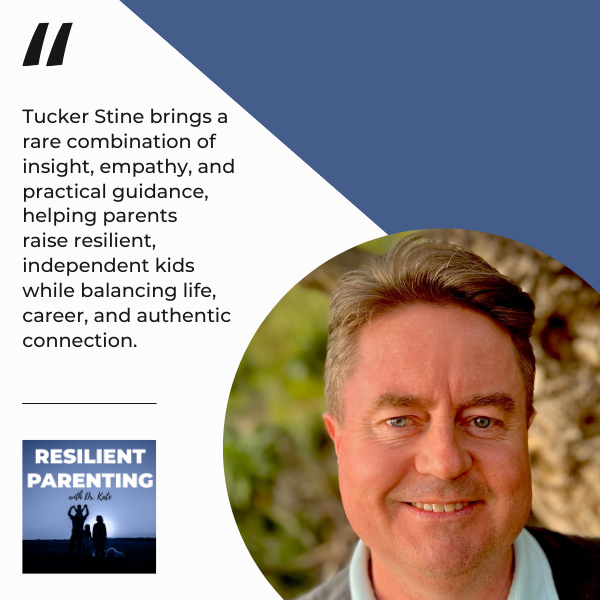
Absolutely. As you said, most recently a Speaker Coach, but my background is in branding and marketing. Lived the agency life for many years, but quickly realized that branding and selling products and things weren't my key thing in life. I loved branding people and ideas and bringing ideas to the stage, which for me has just been an absolute blast over the years. Most importantly, my favorite role is as a husband of many years, and the father of 2 incredible, crazy son and daughter.
About to be an empty nester on top of all of that. I'm in right in that, as we know, the sandwich phase of watching the kids grow and leave the nest, and now parenting parents. When you said parenting, it takes on a little bit of a different role these days when we think about parenting. We could discuss that a little bit more.
I have spent many years, now as a dad and as a husband, reinventing parenthood from where I was growing up with my own parents and how that's evolved over time. That's been fascinating for me to grow as an individual, but also as a dad. I'd be happy to talk more about that. That's me in a bit of a nutshell. Entrepreneur, dad, husband, navigating the crazy world of almost being an empty nester.
The Empty Nest Transition And Redefining Life After Kids Leave Home
It's intense. I can't tell you how much of that I relate to. We're pretty much in the same zone in terms of parenthood. My boys are about to leave the nest as well. It's an exciting time. It's a new time. Ted, my husband, and I are actively talking about not full reinvention, but how are we going to shift gears and focus on building aspects of our own lives beyond what we've been as parents. Obviously, we never stop being parents, but it just changes and it evolves.
We laugh because we're waiting for that day when we drop Emma off to college, and we sit on the couch and we're like, “Now what do we talk about?” It's like we have been solely focused on raising kids, and so much of your day and your conversation is around kids. There's a whole new redevelopment program for parents once the kids leave. Yes, whether it's reinvention, reimagining, whatever it is, we have a lot to talk about what that's going to look like.
At very least, it's a refocusing. It's so funny because, I don't know if you saw it, but there was an article on this very thing in the New York Times. I sent it to Ted. It was the funniest picture on the cover of this article was these people sitting in this cabin, and they were in these big easy chairs, and this dog was trying to climb up on one of the easy chairs and it was like, “The kids are gone. What next?” I was like, “Teddy, this is true. Refocusing, reinvention. This is not how we're going to look, because easy chairs are not allowed in the house.” Recliners, those are not a thing. It was hysterical, though, because it's a refocusing.
Retiring in your 50s is not happening. Sorry.
A hundred percent not happening. This evolution of our parenting journeys. I focus on this question a lot in my new book, Step Away. Really curious about what your process of optimizing your own sense of well-being has been over time as a parent, because we're giving so much all the time. Of course, there are those things, jobs and other responsibilities. I'm just curious how that looked for you, Tucker, over time, this optimizing your well-being.
Breaking Cycles: How Our Own Childhoods Shape The Parents We Become
I think it definitely merits a little bit of context, historically speaking. Obviously when two spouses come together, if you want to look at it as baggage or gifts, I always say you can look at it as a gift or you can look at it as baggage. We come from two different backgrounds. I came from a household from a parenting style that was very loving, but no confrontation. We didn't talk about feelings.
If there was something going on, it was very much internalized and you went to your room and you stayed quiet kind of thing. There was no my wife came from a background of if something's there, you talk about it. Sometimes probably too transparent. When we got together and talked about parenting style, we said there's going to be a balance of both because I think I was emotionally stunted to a certain degree, emotional intelligence, by not understanding how to communicate as a child-parent.
She was probably a little bit too much on one perspective. There's got to be a blending of both. Honestly, and full transparency too, speaking of transparency, it all came to a head for me. I'm 50 now, 10 years ago, when I hated my job, I wasn't in the right spot, I wasn't in the right mindset. I was eroding emotionally internally. It affected everything around me and most importantly, my marriage and with my kids. You wouldn't recognize me as I am now where I was when I was turning 40.
I think a big part of that was I had carried the baggage, not the gifts, the baggage of what I grew up with, which was don't talk about your feelings, don't raise your hand if you need help, and just deal with it. That didn't work for me. Malcoping mechanisms, very unhealthy coping mechanisms. I found myself in a very dark spot. My wife and I at the time were very concerned about the effect it would have on the kids.
The reality was honestly, the rock bottom became this birth of a whole new style of parenting for us that so far, knock on wood with two kids practically in college, has worked really well, which was you're always going to be a parent, but being able to have honest, vulnerable conversations about real life when they are young and old enough to understand is critical. We don't teach emotional intelligence, we don't talk about it. We try to put these bubbles around things.
You're always going to be a parent, but being able to have honest, vulnerable conversations about real life when they are young and old enough to understand is critical.
We joke now when we look back and say, “That was a really rough time in our household.” At the same time, I always say, “If I didn't go through that crap, our kids wouldn't be as resilient as they are today,” because they are more well-prepared and equipped with how to deal with real life than probably 90% of their friends. There's this new balance of we're not best friends, but we're not dictators. There's this balance in between of really connecting on a much deeper level so that there's a trust built right away that they can come to us with things. I never had that. I always say you got to look at the baggage to understand the gifts. That's the evolution of our parenting style and situation.
I hear you. That's intense. What a journey. Hitting that point. You make so many good points in that, in that one thing I believe in so strongly is this idea of connecting with our kids in an authentic, human way. Not being afraid to share the challenges that we're having in obviously a developmentally appropriate way, but in that authentic human context. Otherwise, if our kids see us as these perfect beings on this pedestal, they won't know that challenge is real, that it's okay to struggle and that it's possible to come back from that struggle. It sounds like that's the foundation that was laid in those moments, in those years.
Very much so. I always joke, I said the conversations that I have or that we have with our kids now never would have happened in our household. Not even close. Not necessarily in a bad way, but very much in a positive way. I had that situation where my dad didn't grow up with a lot of love. Swing the pendulum this way, lots of love.
At the same time, what came with that was a lot of bubble living. “I don't want you to feel anything. If there's a problem, not your problem, we'll take care of it.” He kept everything in this vacuum so that my sister and I never really knew what was going on. When I struggled 10 years ago, and he was 65 at that point, it's the first time that I ever heard my dad admit that he had failed at something.
He said, “I never told you this. I didn't resign. I was let go.” I was like, “That would have been nice to know about ten years ago when I thought my dad was absolutely perfect a thing.” Those are the things is when we start to let go of the perfection and start talking a little bit about, “I struggled with this,” our kids now come and say, “I'm struggling with this because I know you struggled with it too.’
Now we've leveled the playing field of trust and relatability and comfort and that thing so there's less of the pedestal and more of the open door. I think that's really helped us a lot because especially when our son Matt went to college 3,500 miles away from home, being able to have that level of honesty and transparency, I think, saved his freshman year because I think otherwise he would have really suffered in silence. I think that's definitely served us well.
He was able to come to you openly with, “Dad, mom, this is really hard. I didn't really realize that transitioning to college was going to be X, Y, Z.” That's such an important point because same thing here. We try to practice the same open-door policy, talking about challenges that we're having in a developmentally appropriate way so that the boys over time felt comfortable coming to us.
Same thing. One of our guys is off at boarding school now in Connecticut, 500 miles away. It has been a life-changing experience for him in a positive way. It's been amazing. His twin brother has been here finishing out high school. He's going to be going off to college. It's been a really great thing that that open-door policy has existed because William will call when he has a challenge.
He will let us know when he's struggling with something. We can problem-solve. We're not, just like you said, jumping in to solve the issues as they come up. In a developmentally appropriate way, there's a scaffolding, etc., etc., but letting our kids grapple a bit has been another thing that has been important here because if they don't have that experience early on and they always have me or Ted swooping in to fix whatever it is, that's not going to be very helpful long-term either.
Trust, Distance, And Why Independence Strengthens Family Bonds
No, for sure. We've definitely seen that evolve. I laugh too, because I look back at my relationship with my own parents when I went off to school. I also did the let's get as far away from home as possible, San Diego to Boston. Back then, we didn't have facetime and texting. It was like every Sunday at 5:00, you had an opportunity to call mom and dad. You never saw them, but you could talk to them.
I recall me feeling a lot closer to my parents once I had the distance. You get out of that comfort zone and you're looking for things that feel like home. It's like, “This doesn't feel like home right now.” I think Matt did and I think we all go through the a-hole phase, especially as boys, when we're separating, it's the preparation for separation.
He's now this delightful young human. We get along so well. Now we can see him as a peer when we need to, a child when he needs it, a friend when he needs it, a leader, all those kinds of things, we're able to see that. A lot of it too is we've had other family friends and parents. It's all about the strings. My dad always said careful of those strings because then the wings die.
Be careful of those strings because then the wings die.
We've always been this like let the wings go. Ironically enough, they're both eagles as the mascot. We've let the eagles fly the nest thing. The distance and the flight, has actually brought us closer together. It's one of the things I always encourage other parents that are going on, “I don't want my kid to go out of school. They have to be in state.”
I said, “They're more apt to connect with you and want to spend time with you the further they are away.” They look at you like, “I don't believe that thing.” We've got some friends that are the two hours away driving, never see their kids. We see our kids that are 3,500 miles away more than they see their kids just 2 hours away.
I think this idea of giving flight and letting them do what they need to do, that for us, and you go back to optimum well-being, that's freedom. For us, parenting can't feel like imprisonment or like feeling in these boxes and that thing. It's allowing the freedom has actually become a really great parenting style for us. Obviously, freedom with boundaries.
Of course. There's always boundaries.
That gives us a sense of well-being that's we're not always focusing our attention on helicoptering or worrying or getting on Life360 and saying, “Where are they right this moment,” kind of thing. That in itself has created a sense of well-being.
Yeah, I could not agree with that more. One thing that you were mentioning, the distance. Having William 3,500 miles away at this point, we were close when he left. I think we're the same level of closeness at this point, but it has really increased his closeness with his brother, which we've thought has been very cool because when they were here, they were leading these perpendicular lives, parallel, not really. Now that William is away, they're talking about all sorts of things. They talk at least once a day. William will call at dinner sometimes. Most of the conversation is focused between the two boys and it's just a really cool thing that we've seen evolve.
Celebrating Growth And Letting Kids Explore Independently
It is funny because so our kids are three years apart to the day. We have a boy and a girl, same birthday, can't even plan it any better than that. They grew up, it was cool for a while, then they went different tracks, different friends, different genders, all that thing. They were always at odds. We started noticing like these texting things going back and forth, and we're looking at, “Who are you texting?”
“I'm texting Matt.” “Since when?” “We text all the time. We facetimed last night.” All of a sudden, there's this connection between the siblings that they didn't have before. Allowing to have given them the space to have that relationship outside of the family is also important. It's not like, “What are you talking about?” It's like giving them the health and the space which also gives us the health and the space to be able to do the letting go per se.
I love that because that's exactly what we're seeing here.
My wife's always been concerned about having both kids so far. I wanted to get to a point where I wasn't grieving the loss of a child going to school. I was sharing the same excitement they were. That to me felt like victory as a parent where it wasn't this like thing that was anchoring me down or holding me back. It was this like, again, going back to flight, giving them the space and excited that they get to experience that journey. I think a big realization for me is to know that that I wanted to share in the excitement of that rather than the fear of it.
In hearing you say that, it's exactly what's happening here. We hear about the cool things that William's doing and we feel like he's getting these opportunities that he would not have gotten here from an academic as well as a sports. He rows, rowing perspective. It's just so cool. That's the thing that really brings us great joy at this point. Definitely feel the same way from his brother being home perspective for him, but hoping that he'll experience the same when he goes off to college. It's embracing the excitement piece, which fosters all of our well-being because if we're holding on too tight, everybody's not going to flourish.
I think to that going back to the joke where it was like kids are out of the house you sit down on the couch as like, “Okay, now what?” I think for us too is realizing that especially as we get closer and closer to full empty nest, that taking care of your relationship with your spouse is critical now because if it's not as intact as you think it is when the kids go off to school, that's not being a healthy parent either.
You start modeling bad behavior or you start to not pay attention to the number one relationship that you have. We're also finding too that in order to be good parents, we really have to be good partners. That's something that we've been really focusing a lot on too. Just the way in which we're connecting and certain levels and how we're treating one another or are we making the right time for one another.
In order to be good parents, we really have to be good partners.
Is all the time that we spend together also include children or is it all the things we decide to do are they based around kids' schedules? All this other thing that that's not going to be there a few months from now. That's been a big a-ha for us, even though it seems like a duh moment. It's an a-ha because it comes up it comes up so quickly. Being able to dedicate time to the marriage just as important to help create a healthy and optimum parenting style or connection with your kids.
Couldn't agree with you more on that either. We're on the same page here for sure. You mentioned that you guys had been married 26 years. We've been married 28, if you can believe that. It's just like crazy. You can say time flies but it's so fascinating too. The relationship ebbs and flows through the various stages of parenting and developmental phase that your kids are in and all of this. When the boys were born, infants, Ted was basically on the road like six days a week. It was a crazy time.
You got two at once.
It was a bit of a crazy time. I remember he would be coming home from these super long business trips, and I would have been alone with the twins. I put my career on hold for a minute. We'd be exhausted. There was this one time, this happened a lot, but there was this one particular story that stands out to me. He comes in. He had been away for like seven days or so. It was a Sunday.
Rare for him to come home on a Sunday. It was usually a Friday. Comes in, first thing he starts talking about are this next trip to China in three weeks. I'm like, “Seriously, no.” I lost my mind a little bit. It was one of those very rare moments where I lost my mind. I think it might have even been Mother's Day. I don't know, something like that.
To add insult to injury.
We're not even really huge Mother's Day people, but I think it was Mother's Day and we were supposed to take the boys for a picnic or something.
It's the principle.
I'm losing my mind. My dog at the time, Putter, gets up on the ottoman in front of this chair that Ted is sitting on, and she hugs him. Puts full paws around his neck and hugs him. It was a moment that punctuated what that time was like with a lot of those trips. He'd come home and be like, “Yeah, you know I had dinner at the restaurant bar, had a glass of wine, a really relaxing chicken sandwich. It was fine.”
Meanwhile I'm putting out fires in the kitchen. It wasn't that bad. Our boys were really good, but you get the point. Ebbed and flowed. Since that time, Ted has certainly gotten the memo and he's very engaged as a dad and very engaged here in the house. The relationship phases ebb and flow, and so now we're heading into a different one, a new one, which is going to be great.
Marriage, Career Choices, And Modeling Fulfillment For Your Kids
Our choices become very different obviously when we're parents. I made a decision years ago that I didn't want to be in the corporate world anymore or I needed a break, put it that way. At the same time, I was like, “I don't like the financial instability of being an entrepreneur. What am I thinking? Who am I to say that?” I was in this crossroads. What was supposed to be a temporary solution ended up becoming a permanent one.
I think we make these choices or we should be making choices based off of what's best for us as a family unit, not just because we're told that you need to be in the corporate world and you climb the ladder, you do all this I all I did was mimic what my dad did. I see other friends that did the same thing on Wall Street.
It's like you graduate business school, you get your MBA. You make all these decisions that have basically all your decisions have been made. Now you're going to be parents. Let's just throw that in there. Somehow you have to fit what you've already determined is your career path into parenting. You try to do that, it's going to fail every single time. I think that was another thing we had to think about was happiness and passion and how all this fits in.
It's like maybe we can make this a working arrangement work as both parents if we do you know part-time work here or we do contract work here or we just build our own consulting business where we can actually have the freedom to do what we want to do. I often encourage I have a lot of parents that are like, “How do you do it?” I said, “You just got to try it.”
Whatever's not working right now, it's not going to fix itself. Try something new. I had a couple of buddies of mine we lost a couple in in the World Trade Center, but the same ones that were on that path of, “I will fit my wife in, I will fit my kids in.” It just didn't compute that way. One of them is now a volunteer firefighter. We had a friend that had a heart attack at 42. One that just said, “I'm going to be a stay-at-home dad and my wife wants to go work for a while,” kind of thing.
The adaptability and being able to take risks, the term risk way back in the day was probably the scariest word I’ve ever heard in my life. I think now being able to look at it from a very different perspective, encouraged to have those conversations around risk and excitement and change is also really good for well-being. The current mold of societal perception of whether you are the breadwinner or not, this idea of there's this evolutionary climb into the heavens of the corporate world, those days are dead. I always encourage. I said we've found balance in being able to make careers a choice versus it being like driving all of our decisions.
“You guys are now the next generation of parenting. We're the dinosaurs. We've been pushed out. Now you're parenting us.”
You mentioned flexibility there as well as the ability to take a chance, take a risk, and both of those things are really important to be modeling, demonstrating for our kids and are so necessary to ensure that we're not caught in a place where we're unhappy, beaten down, burned out, like perhaps the folks who are trying to fit their families into their career on Wall Street. Lots of those guys, I would venture to say, are not happy, and it's a rough balance to strike, but such an important one.
These are the things that we're never taught. Can't blame anybody other than circumstances change, life change. I had the same conversation with my 80-year-old father. I was asking him some advice on something, and he looks at me and goes, “Son, I am not qualified to answer that because raising a kid today is not raising a kid in the ‘70s. I hate to tell you I don't have an answer for you. You're going to have to look for the answer yourself because one I'm not going to make up advice. The advice is probably not going to be accurate.”
“You guys are now the next generation of parenting. We're the dinosaurs. We've been we've been pushed out. Now you're parenting us.” That was a huge, unexpected collateral beauty of not knowing exactly but this idea of realizing that you're carrying the torch of something that the parents at some point they extinguish theirs and they're like, “You're the next generation of parenting.”
I love that insight from your dad because lots of parents, 80-year-old parents, would not go there. I love that. That's quite powerful.
I don't even remember what the ask was or what the question was. I just remember him laughing and goes, “I don't know how you raise kids these days. I don't have an answer for you.” You think about it, they lived through World War II babies and Vietnam and presidential assassination. You look at all of the things that our kids are going through now. He goes, “We didn't talk about mental health. We didn't talk about political division the way it is now.”
“We didn't have a 9/11 in our country. We didn't have all of these other social cultural issues that are driving so much division. We never had that. It was a much simpler time. We didn't have technology. We had none of this. You go back to the old days, please be home by dark. That was our parenting style. We did not want you in the house. We look back at it but nowadays, it's just a totally different way of looking at it.
Parenting has moved in the direction of making the complex simpler.
It's a whole different angle. It's so different. It's really quite stark how it's shifted. My dog Wally and I were visiting an assisted living here in town. It was fascinating. We came in right on the heels of the group had just watched a documentary on Martin Luther King and all of what was happening in the late ‘60s with that.
They were doing their reflection when Wally and I came in, and a lot of them were very feeling very sad, things were feeling very heavy for them in those moments. It was fascinating because a few of them piped up and started talking about what their life as younger teenagers, middle schoolers was around that time.
They were talking about being out at the baseball field until all hours of the night and would come in when they whenever and dinner would be there. Also talking about some of the social emotional issues, not treating certain peers very well and now feeling badly about it years later and how things evolved in certain ways. It was really fascinating to hear because what they were describing in many ways was a complex time, but a much simpler time given the complexities that have emerged since then. Really important point.
I think parenting has moved in the direction of making the complex simpler. It's not an easy task. It's just not.
Final Reflections: Identity Beyond Parenthood And What Comes Next
Tucker, this is amazing. I really am enjoying this conversation. As we're thinking about needing to wrap it up, I always ask my guests what are 2 or 3 things that define you outside of your life as a dad, outside of parenting?
I think what comes to mind first and foremost is being a person of trust and integrity. Outside of parenting obviously that's a big part of it. I'm very much in a space where I like to connect people. I think any way that I can find ways of doing that. I’ve made it a point where at some point somebody asked me said, “What are you most passionate about?” I used to say, “Do you mean in my career or personally?”
It was the first time that I actually said, “Hold on, the two are actually the same now,” which was really powerful for me to think about, focusing a lot on what I can do to bring to the world that's both professional and personal and I enjoy it. I think this idea of really helping people find an opportunity to share ideas that are more powerful than products and services.
That's what connected us is helping people really get to see their message out there. Outside of being a dad, I like to see myself as a human connector in that sense. It's what brings me probably the most joy, so I think that's a big thing. I would say outside of being a dad is being a really good husband and really working on that.
I don't have anything without the spouse on the other end that's being a part of all of this. That's definitely something over the years that has been both a a challenge but also an incredible opportunity, a blessing. I think that human connector and the and a trusted spouse are probably the two things that would define me the most. Everything else flows from that and being a good parent has those two qualities as well. That's how I would answer it. Also, being outside as much as I can.
Of course. I hear you. That sunny California weather. I absolutely love it. Tucker, thank you. Thank you so much for joining us here and we'll do it again. I would love to have you back because I think there's so much more to talk about.
We can unpack several series of things. College application process, empty nesting.
Maybe we'll hit those down the road.
Being a parent and an entrepreneur at the same time.
So much. We can do a series. I absolutely love it. Thank you, Tucker. Thank you so much.
Absolutely. Thank you for having me. It's always a pleasure to see you.
Important Links
About Tucker Stine

Tucker Stine helps conscious leaders and companies accelerate human impact by turning their stories into purpose-driven, equitable brands. He is a brand architect and executive speaker trainer with over 25+ years of success in building personal and professional brands and platforms for conscious leaders and inspired entrepreneurs.
Tucker has helped over 200 speakers and thought leaders take the global stage. His international clients have been featured on TED, Goalcast, Upworthy, The Today Show, the Sundance Film Festival and hundreds of podcasts, resulting in over 100 million views combined. All to take a powerful seat at the global table of conversation, one story at a time.
But most importantly, he is a husband of over 25 years and a father to two amazing kids who share the same birthday, three years apart.