Parenting With Transparency And Resilience With Grant Berardi

Modeling accountability serves as a foundational building block for raising resilient children who are not afraid to face failure or own their mistakes. Counselor Grant Berardi joins the show to discuss how parents can bridge the gap between "do as I say" and "do as I do" by being transparent about their own shortcomings and growth. By showing up as authentic, work in progress humans rather than perfect figures, parents create a safe space for their children to develop a healthy sense of self worth and resilience. This conversation highlights the importance of filling your own tank through creative outlets and movement, ensuring that you have the emotional capacity to remain present and intentional within the beautiful complexity of family life.
---
Listen to the podcast here
Parenting With Transparency And Resilience With Grant Berardi
Redefining The Role Model: Leading By Example And Owning Mistakes
We are so fortunate to have Grant Berardi with us. I’m grateful that you’re here, Grant, all the way from Australia. Tell us a little bit about who you are, the lens that you’re looking through, and all that good stuff.
Thanks for having me. I have been a counselor for the last couple of years. I always worked in caring fields. I was a youth worker when I was about nineteen, working with disadvantaged youth in and out of juvenile detention. I always had a heart for people, and that led me to my work. I’ve also always had a real heart for kids and families. I’m very passionate about leading by example as much as you can, warts and all, and owning when you do things well, but when you don’t as well because that’s crucial.
I run a show called Hi Struggling, I’m Dad!, which is a dad joke in the title. I am leading conversations about the ways that we get in our own way as parents. We’re people and we all have wounds. We all have shortcomings. It’s important that we learn from that, so our kids don’t have to carry our baggage into their lives. That’s important to me. That’s what we’re doing.
That’s amazing. You say so many important things in that. What pops out at me is admitting as parents or as people when we’ve made a mistake, or when perhaps things haven’t gone as well as we had hoped. I feel like that’s an important piece of this authentic human connection that we can form with our kids. It’s allowing them to see us as not perfect. We’re people. We’re human. That adds to that ability to connect with our kids on a human level, which is so important.
That’s exactly right. There are the stereotypical things that you may grow up with, depending on your generation and your culture. Sometimes, it’s that if you ask a question, that’s talking back. You’re like, “I’m just asking a respectful question.” It’s like, “No backtalk.” It can be a thing where you may hear something one way from your parents or from adults, and then it’s the, “Don’t do as I do. Do as I say.” That’s one of my least favorite quotes of all time because it’s not a good modeling of character.
It’s important as a parent, and it sounds like we’re saying a similar thing. You’re a better role model when you are owning everything. Whether that be your shortcomings, the things you do well, the things you do wrong or not as well or the things that you’re working on. Your kids see that and are like, “It’s not as daunting. I can get it wrong sometimes. I’m not putting this pressure on myself to be perfect as a kid because Dad is doing great, or Mom is doing well. They would never.”
If it’s okay to get it wrong, learn from it, and do better, or any of those sorts of things, then it’s okay. Growth becomes easier, and failure isn’t scary. That’s so powerful, to make something like failure not scary. There’s a fear of failure. I know that I’ve dealt with that. That will come up at times as well. That’s why I’m so passionate about it, too. I don’t want my kids and other kids to go through that.
The fear of failure is real for all of us.
It’s massive.
The earlier we can model for our kids and help our kids see that failure is inevitable and a part of life and daily experience. That’s an important building block for our kids early on, such that they start to have the foundation of resilience in place. As much as we can model that for our kids, the better. Clearly, we, as parents, are going to hit challenges and struggles, and we’re going to fail at points. That’s for sure.
The Parenting Tool Belt: Adapting To Your Child’s Unique Context
That’s exactly right. It’s something that doesn’t have to be a struggle to teach them something powerful early as well. It’s not like something that you need to unlearn and then relearn. It’s something that we can go, “I’ve dealt with that. This is where I used to trip up. I don’t want you to trip this up. This is how I think about it now.” We can teach them some of those traits.
Everything is a mixed bag. All kids and people are different. Some focus on one point more than the other. Some people get stuck, and that’s normal. It’s cool to see that in kids as well. I’m like, “I got it wrong, but if I do it like this next time.” They’re figuring it out as they go. I enjoy that. That’s why having this discussion space as well, what you’re doing with the show, and picking and choosing what could help, what helped different families, and different styles. Everyone is different. That’s the other thing.
Everything is a mixed bag. No two kids have the same parents, because it depends on where you are in life.
I love that quote where no two kids have the same parents because it depends on where you’re at in life. No two parents have the same kid, and the fact that kids learn and think differently, even though they’re in the same house. They can be in the same house. That’s unique and special, but it can be tricky as well. It’s important to get this tool belt of as many things that you can use as possible to cater to as best as possible.
I could not agree with you more. That’s what I was thinking as you were talking. You said it. There’s no one-size-fits-all approach in any of this. Parents are different from each other. We’re different in different situations and different circumstances. Perhaps across time that can happen. No two kids are the same. I’ve got twin boys, and they’re very different. I have different approaches and different angles to help each of them to thrive within their own unique context. I’m sure that’s a little bit of what you experience both at home and in your work. Is that true?
The twin boys are a great example of this. It’s so incredible that they can be so similar and so different. This is kids, young adults, people, and everything like that. I worked for an organization in Australia. It has become a lot more of a crisis line over the years. It’s a line for clients between 5 to 25, I believe. It’s office counseling. All ranges and all issues that come up. It can be a crisis. It can be that you’ve got to call the ambulance, or you’ve got to get paramedics and everyone out there straight away. It can be light and figuring out friendship stuff.
Everyone deals with things so differently. Even if it’s the same issue, it’s the way we process things as well. It’s so dependent on so many factors, like our dispositions, our genetics, our parents, how we grow up, and our culture. It all smatters together. Sometimes, a lot of people can have the same upbringing, but what they’re taking from it is very different. That can be a good or bad thing depending on how things are going for them. It is such a unique thing.
That’s why I like counseling, coaching, and working with people. It’s always interesting. That’s why I’ve always been a bit more generalist than just specializing in one spot or one particular niche. Even though I find some things maybe more interesting, it’s the fact that people are interesting. You learn so many different things in the way people process and action it. It’s always interesting. It never gets old for me.
It keeps us on our toes because everybody is coming from a different place and needs different things to thrive and flourish within their own unique context. That’s a big piece of it. Talk a little bit more about the types of folks that you work with, the approaches that you use, and all of that good stuff.
Historically, I’ve worked with very young kids. My youngest was around 5, and my eldest adult was around in their ‘70s. It’s so interesting because one will be a little kid, navigating certain things or how their parents speak to each other, and I’ve got this Vietnam war vet who’s going through things as well, dealing with grief and different situations. I know that it’s very unique for each person what hits them the most.
With some of this work, it has been a challenge. It’s important not to take it home with you, I find, because we’re giving so much of ourselves. If there’s no preservation of ourselves, that can be muddy water where we carry it very deeply. I know that can be a thing. It’s important not to blur that line where we’re giving so much. There’s got to be something left over for us.
You can give a lot, but there has to be something left for you and your family — otherwise, you burn out.
As far as clients, it is very general as far as all these different issues, different walks of life, and different age brackets. With this resilient parenting, I have found personally that it takes longer, and it is a bit more difficult to work with kids compared to adults. It’s purely because it’s a trust thing. The kids are learning to trust you. It can depend on the person. It can depend on the adult or another kid. I remember seeing this illustration where it was a circle and then a dot in the middle.
I had this mentor at the time saying, “With counseling adults, it can be a process. They’re starting from out here. Eventually, they go through the layers. They get to the point where they’ve shared, and they’ve been upfront and honest. With kids, a lot of the time, it can be that they circle it.” It’s the same distance that far, but it takes a bit longer when you’re circling it. Eventually, you’re building that relationship. That’s why it’s so crucial. I’m big on relationships. That’s a helpful thing, being a counselor and a therapist. It’s so crucial to have a great relationship with your client.
To be able to have that rapport and form that rapport over time. The other thing that you said that stuck out to me is this idea of caring for yourself amidst it and not taking it all home. How do you go about doing that? It sounds like you’re working with a lot of intensity with your clients. I’m curious.
Counselor Self-Care: Leaving Work At The "Tree"
It can be. When you’re navigating something for the first time, it is easy. It is easier to blur that line. I remember when I was quite young, and I was doing that youth work. That was very tricky because I found it easy to take things a bit more personally. As much as I’d have boundaries and all this stuff, it can be tricky and easier to take things personally.
When I started counseling, it was the same thing. It was easier to want to blur that line. Wanting to save can be tricky early, I found, because you love people. You want to do well by people and help them. It can be tricky to find that when you’re empowering them a little bit more. That was a very long time ago, having that line blurred.
Everyone works differently, but if I imagined it, it was almost as if this is my heart here, I can give everything up until there. I can give everything. I can give all the care, all the empathy, and all the understanding, but then there’s got to be something left over for me and my family. That’s the way I thought of it. I was like, “I can give up to this point. That last little bit, I also have to keep. Otherwise, I’m going to fall in a heap, or I’m not going to be who I need to be for the client, myself, and my family.”
I had a supervisor at that work I was talking to you about. She lives about 30 or 40 minutes from her work. It became a bit more bushland. She told me that she’s got a spot or a particular tree where she leaves everything. She leaves everything from work there, and then from there on, she’s Mom again. She’s the wife again.
It’s like a symbol.
That’s exactly right.
That’s powerful. On a practical level, how are you optimizing your own sense of well-being physically, emotionally, and spiritually? What are your go-tos on that level?
Filling Your Own Tank: Sleep, Movement, And Creative Outlets
I’m a work in progress. Sometimes, I nail it, and sometimes, I’m pretty rubbish. Something that is slept on is sleep. Sleep is crucial. That’s something that I could improve because it’s our biggest regenerative factor. That’s something that I need to work on. As far as how to support myself, there are a few different things, and they’re so important.
It’s the same thing with parenting in general. You’ve also got to have time for yourself. You’ve got to have times to fill your own tank, and it’s got to be with stuff that you love. If it’s the same, it can be with family. It can be activities that you love to do. It can be hiking. It can be bike riding or whatever it is. That’s crucial, but it’s also important to have that time for yourself. It’s important to find it.
You need time for yourself — time to refill your own tank.
For me, I found the gym important. Lifting weights, I found, is important. I fell into that. I was very disinterested for a lot of my younger life. I was into basketball strictly and didn’t lift until I was about 30. I then found how powerful it was, mental health-wise. It was incredible how good you felt with the endorphins, or doing something challenging, and then you complete it. You’ve done it, and you feel good. I find that important.
Journaling is helpful. I do find that even doing a bit of a brain dump and then clarifying that, or getting everything out on paper, is important. I find that crucial. I’m also pretty extroverted, so time with people is important when I can get it. We do have five kids, so there are a lot of people already. We do have 11 down to 1. As much as I can do that is good.
I’m also big on music, too. I’ve been in bands. I’ve always loved music. If I can do anything towards music or anything creative. It’s crucial for people to find a creative outlet, whatever that is. It can be writing, coloring, or their unique take on something. It doesn’t have to be strictly artistic. It can be anything. That’s crucial because it gives so much importance, creativity, and uniqueness that everyone has in something. If we can action it, awesome.
Even better. I love that. You hit on a lot of the central points in terms of passions, hobbies, and the power in those points that I make in my new book, Step Away: The Keys to Resilient Parenting. That’s a big piece of it. It’s a big piece of optimizing our own sense of well-being as parents and as people, and then being able to show up across the domains of our lives.
Whether that be social support, engaging in hobbies that may have gotten lost in the shuffle when we became parents, and that whole thing. Those are such important points. It’s easy to have these things get lost in the shuffle. You mentioned five kids from ages 11 to 1. It’s got to be a lot at times, or intense. Talk a little bit about that.
It depends on the kid. You can have one kid, and it feels like three kids. It can be that, depending on the differences between you and the child as well. We’ve got 3 girls and 2 boys. They’re all very different, but similar. It’s that sort of thing with all the uniqueness of everybody, their different takes on life, and everything. They’re all lovely. I’m a big fan.

Modeling Accountability: Being around your kids and trying to build resilience and be a good role model reflects back the areas where you can grow.
We do homeschool. It’s busier, still. There are trade-offs in whatever you choose and whatever you do. That was something that we wanted to try to go after and see how it worked for us. If we were not feeling like we were doing okay or the kids weren’t okay, then we’d look at something else, but that’s been going well.
It’s been nice, but challenging. Some days are easier than others. You’re like, “We are such a well-oiled machine. Everyone’s working so well. Everyone’s listening. This is incredible.” Other days, you’re like, “Have we ever spoken English before? We are speaking different languages to each other, and no one’s listening. It’s all synchronized.” It depends on that. It’s been lovely. It’s been awesome.
My passion for fatherhood and parenthood led me to make my own show. I’ve always wanted to be a parent. I’ve always wanted to be a dad. It’s so important to have parents who want to be parents, parents who want to be the best that they can be, not just for themselves, but for their family. To help people with that is something that I’m passionate about. That’s been nice.
It shows up as a mirror to yourself. I’m sure you can attest to this. Working with and being around your kids, trying to build resilience, be a good role model, and also own all the good and bad things, shines a mirror of all the stuff that we could do better. You’re like, “I could have handled that situation better. I’d do it this way next time. What do I need to account for?”
It’s the awareness and the reflection on those things that help us to become better in our role as parents and our role in life. I love what you said as well about this idea of adaptation and flexibility. If homeschooling, at some point, feels like it’s not working out, you’ll shift gears. For now, it sounds like it’s going great. Needing to flex from day-to-day. Some days are easier than others. Having that bigger picture or that bigger goal in mind feels like it’s very important.
Final Advice: Modeling Accountability Through Transparent Relationships
We’re all a work in progress. Some things, we’re great at naturally. Some things we can work at and get better at. It’s important to be aware of that for ourselves. Often, as people, but particularly as parents, when we’re doing something that’s important to us, we can be a bit harder on ourselves. It’s important to be gentle with it. Gentle gets thrown around. Some people say, “Be kind to yourself,” and that comes in here.
As long as you own everything. That can be the stuff you do well, the stuff you did wrong, and the stuff you want to get better at. If we only acknowledge what we do well, or we only acknowledge what we do wrong. We’ll have this lopsided view of ourselves, and our kids will learn that. They’ll learn, “When I mess up, I should let myself have it. I should say some things.” It’s because they’re seeing Mom and Dad do it.
If you only focus on what you do well or only on what you do wrong, you end up with a lopsided view of yourself.
We can go, “I did this well. I liked how I handled that. When such and such lost his temper, I felt angry. I remember I raised my voice. Next time, I’m going to watch out for this.” It’s that thing where it’s being fair to yourself. Your kids will see that it’s not daunting to get it wrong. They can be fair to themselves. They can own the good and the bad and grow regardless.
I love that. It’s modeling accountability. Modeling accountability is powerful stuff.
Accountability and ownership. It’s all in there. The whole premise of this is resilience. It’s so crucial to resilience. Ultimately, if we can only handle the good and teach our kids that they can only handle the good. That’s awesome for some things in life, but some things are going to hurt. If we can’t handle that also, we’re not equipped, and we’re not equipping our kids.
Modeling that for our kids is so important. As we’re thinking about needing to wrap it up, what would a piece of central advice be for parents who want to show up fully or want to show up resilient and strong for their kids and for everything in their lives? What would that piece of advice be?
Be transparent as much as is appropriate. We don’t have to overshare. It’s that transparency that builds a relationship with your kids. They go, “Mom and Dad are doing their best, and they’re doing their best in what they can do. They get it wrong, but they apologize when they get it wrong. They get it right, and they come alongside me and teach.” It’s not to be the friend. It’s not to not be the parent. It’s to be open and honest about things that are within their pay grade. We don’t want to shoot above their pay grade. We don’t want to overshare. That’s inappropriate.
Be transparent — as much as is appropriate. That’s what builds trust and connection with your kids.
It’s that thing where we’re teaching them. We’re teaching them all the time in how we handle things, approach life, and look at life. It’s such a gift to be able to do that. It’s not only to be transparent, but also to be the example or be the parent that you wanted to have. You may have had that parent. You may have had smatterings of mom’s kindness and dad’s patience, or maybe this wasn’t an experience at all. If we can try our best to be the example that we wanted to have or want to have, how powerful is that? That’s incredible.
We won’t be perfect, but if we can aim as closely to being that example, then that’s awesome. That’s something that we can always work on. As long as our kids know that we’re all a work in progress and they can grow, and that you can grow, regardless of age, that’s crucial. There’s that old saying of we can’t teach an old dog new tricks, or, “Now I’m too old for that. I’m too old for this.” We can all grow. It’s not like we stop. It always comes down to willingness. We’ve got to be willing. As long as we’re that, people will be great parents.
Open to growth within the context of a transparent, authentic relationship with our kids in a developmentally appropriate way, I love that. What amazing insights. I so appreciate you joining us here. This has been a great conversation.
Pleasure. Thanks so much for having me.
Important Links
About Grant Berardi

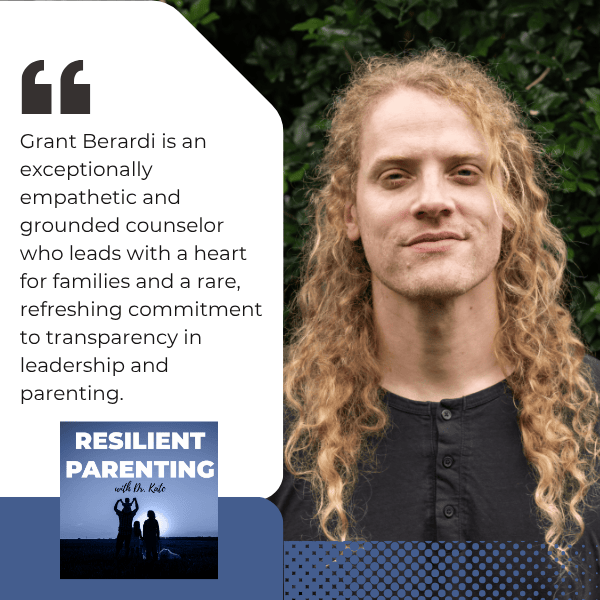
Grant Berardi is a counsellor, coach, podcast host, husband of 17 years, and a father of five. With over a decade of professional experience working with individuals and families, Grant helps growth-minded parents lead with courage, connection, and conviction, at home and in life.
As the host of the podcast “Hi Struggling, I’m Dad!”, Grant speaks directly to growth-minded parents who want to succeed in their personal and professional life, without burning out or losing connection with the people who matter most.
Grant blends psychological insight, practical strategy, real-life honesty, and challenges the cultural narrative that success must come at the expense of connection at home. His work also focuses on building men of integrity, fathers who create legacy through character, courage, and ownership.