Parenting Without The Pressure To Be Perfect With Dr. Rebecca Resnik

Good enough parenting provides a necessary shield against the relentless social media funhouse and the crushing pressure to achieve perfection in every domain of modern life. Dr. Rebecca Resnik joins the conversation to discuss how parents can step back from negative narratives and reclaim their power by focusing on their child’s unique strengths rather than pejorative labels. By moving away from the comparison trap and late-stage capitalism influences that thrive on anxiety, families can foster authentic connections and prioritize intentional, sacred moments over an endless to-do list. This dialogue offers deep compassion for the complexities of raising kids in the mid-2020s while highlighting the importance of self-compassion and movement as vital lifelines for well-being.
---
Listen to the podcast here
Parenting Without The Pressure To Be Perfect With Dr. Rebecca Resnik
The Perfection Trap: Parenting In The Age Of "Funhouse" Social Media
We are so fortunate to have Rebecca Resnik with us. Thank you so much for joining us.
It is such an honor, Kate.
I’m excited to have you here and to have this conversation with you. I was wondering if you could kick us off with a bit of an introduction or an overview of who you are, the work that you do, the lens that you look through, and all those good things.
Thank you. I’m a Neuropsychologist. I am practicing in Bethesda, Maryland, which nobody’s heard of. It’s right around DC. This is a very intense part of the country. I have a private practice. Before becoming a psychologist, I was a special educator. You have the same degree I have. Special Ed is a much more practical and useful degree in a lot of ways.
My job is to help families when they’re stuck, confused, or trying to figure out what the path forward is. I see people, probably a lot like you, when things have gotten very stressful. Sometimes, intolerably so or maybe they’re in crisis. It’s a pleasure to be able to be the person they come to and hope that you can give them something to lower the stress level. Maybe make their lives a little bit easier or help their child reach their full potential. I love the work that we do.
I could not agree more. It’s helping folks to understand themselves within their own unique context and how to use their strengths to flourish within that context while navigating through and beyond challenges. It’s how I look at it. It sounds like you’re looking at it in a very similar way.
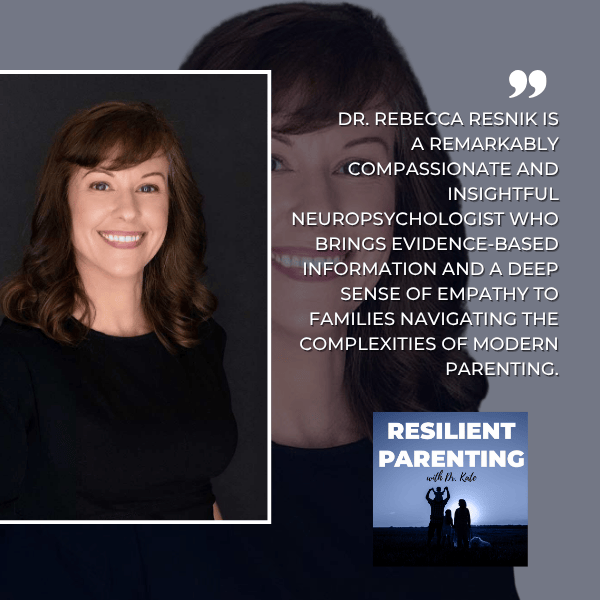
What resonates with me in the work that you do is your level of compassion for people who are raising kids in this difficult era. I love the fact that you’re trying to provide some evidence-based information, but with a huge dose of real compassion and empathy, because this is a very difficult time to be raising kids.
Parents feel that if it’s hard, there must be something wrong. Everything in the media tells the parents, “You’re terrible. Your kids are horrible. You’re not resilient. You don’t have the skills that previous generations had. Your kids are weak.” It’s full of negativity. These poor people are working so hard to put one foot in front of the other most days.
Much of the media tells parents they’re failing — that their kids aren’t resilient — and it’s overwhelmingly negative.
I hear you. It is so hard. That barrage of so much information, the comparison trap on social media, and all the things can come together in a way that they can make us as parents feel less than. It makes us look through the lens of everything is bad, negative, or a challenge. To help folks shift that lens and see the good things within the context of challenge, and see the possibilities on the other side of the challenge. You’re right. Within the context of an authentic human relationship is so incredibly powerful.
I love being a mom. It’s such a great experience in my life. I had that total fascination with my kids. I didn’t love every moment like having liquid poop on my hands. I’ll pass. A lot of people talk about, “I feel awe when I look at the stars or the Grand Canyon.” For me, it was always my kids and watching them develop. I see that there’s so much pressure on parents of this perfection trap or this social media funhouse that we’re all in.
I was listening to a comedian, Nathan Macintosh. He was talking about why all the moms are hot now. I’m thinking, “You’re right.” Why do we feel pressure to be hot, have a perfect house, have everything all decorated, be the room parent, organize the bake sale, and stay happily married? Why do we feel pressured to somehow do all of this and exercise, meditate, and do self-care? Nobody can possibly accomplish all of that.
It is too much. That comparison trap and all of that info that we’re barraged with from social media fosters that kind of lens and outlook. It is important to help folks to appreciate their own context and understand how to flourish within that context without looking to the outside. It is easier said than done. It’s a huge process. Normalizing the reality that a lot of what we’re seeing on social media is highlight Reels. It’s the best moments amidst a million other moments that aren’t the best. We’ve got the advent of AI. How do we know a lot of what we’re seeing out there on social media is even real?
It’s like, “Welcome to the funhouse.” My husband is a technologist, so I’ve gotten to attend events with him. I always tell people the best and brightest minds in this world are out there being paid millions of dollars to keep us clicking. You don’t keep us clicking if you say, “Good job, Mom. Well done making the birthday cake, getting so-and-so to bar mitzvah prep, and getting to the soccer team.” That doesn’t get us clicking. What gets us clicking is feeling bad and feeling anxious.
Some of the brightest minds are paid to keep us clicking — and what drives clicks is anxiety and feeling bad.
That’s what gets us clicking and buying things. You have to step back. The way you talk about your step-away skill, I always referred to it as a stop, step-back. It’s so easy to get sucked in and absorb all those negative messages about how you’re not good enough as a parent. D.W. Winnicott talked about good enough parenting. If your kids are alive, thriving, healthy, growing, and maybe eating one vegetable every now and then. That’s most of what it’s all about a lot of days.
Labels Vs. Diagnosis: Shifting The Lens For Neurodiverse Kids
That’s huge. That is such an important point and important foundation to help folks to see in terms of appreciating their own context.Also, appreciating the fact that they’re showing up and doing the best they can. That’s an important message to help folks integrate. Instead of beating themselves up at every turn, look at what they are doing, how they are showing up, and the impact of that. That can sometimes be flipping the script or helping someone flip their own sense of what’s happening. That’s a big piece of the process in terms of my work. I’m curious what your thoughts are on that.
For me, I work with mostly kids who have some kind of disability, learning difference, or neurodiversity. The message those parents get is always, "You're not good enough. Your child isn’t good enough. Why aren’t you going to Harvard and being captain of the varsity wrestling team with your hair perfectly highlighted?” It’s not realistic.
They keep us clicking and buying. It robs us of that time when we’re fully present with our kids, and enjoying who they are no matter who they are. You get the child you get. Every child has things about them that are a real pain in the neck. That’s the way of it. There are also so many good things. A lot of it is choosing that lens that you’re going to look through. We can choose that lens.
We’re taught that we don’t see the world as it is. We see it as we are. That’s some very ancient wisdom. Stepping back and taking back control of the narrative of who you are, what your family is all about, and who your kid is. That’s an important message for us as clinicians to send people because we see people at their very worst.We know what’s going on behind closed doors in ways that most people don’t.
We don’t see the world as it is. We see it as we are.
I love the point that you make about kids who maybe struggle with a learning difference or a learning challenge. It’s so important in those cases to help the kids to see their strengths and see what they do have that’s going to help them circumvent the challenges. Oftentimes, that piece or that message gets missed for both the child who’s struggling as well as for the parent. It’s important for the parent to see their kids as capable. It might not be in the way that their sibling is capable.
It might not show up the same way on paper. Despite those test scores, and the numbers, where are the strengths? I know that you’ve got lots of numbers with the Neuropsych assessments and such. What are the ways in which this particular child can flourish within their own context? That was an important piece here.
We have twin boys and they have very different learning styles. One of them is extremely academic. He hit the ground running in that way and put all the pieces together. He still is. That’s great stuff, but he has had other challenges. His brother had some learning challenges early on, but we didn’t want him to define himself based on those challenges. We wanted him to see what his strengths were and what he was capable of beyond the challenges. That has made all the difference for him.
He’s flourishing in school. He’s a junior. His brother is a senior. He took an extra year along the way. It made all the difference to not only focus on the challenges. We address them. We got him the support that he needed and did all of that, but what else did he have? What other angles could he take? That piece is huge.
I agree. What I always tell parents is, “You can get test scores anywhere. Go get them for free. Do it.” What psych testing is at its best is you’re contributing meaning and a deeper level of understanding. Parents are so worried about getting a pejorative label and having their beautiful child defined by that label or limited by that label. I always tell them there’s a difference between a label and a diagnosis. As a psychologist, a label is something that, generally, a layperson puts on you because they’re done thinking about you.
A diagnosis should come from someone who understands you in context — your strengths, your challenges, and your needs.
You get put in this little box, and that’s who you are. A diagnosis should be something that somebody thinks deeply about you in your context, who you are, your strengths, and your support needs. It comes up with a sense of, “Who’s this person now? How do we help them thrive? What does this person need in order to make their gifts grow, flourish, and blossom?” It’s fun when I get to test a child. Something that nobody knew a gift pops out. That’s one of the best days for me.
Vulnerability And Connection: The Clinical And Personal Realities Of Parenting
That’s huge. The folks weren’t coming in to discover that gift, but they did discover it. Who knows how powerful that will be in helping this child to move forward into their potential? I love that. I’m curious. How do you frame it for parents when the parents are stuck on the challenges that the child has? You see so much more beyond that, but learning the challenge needs to be managed, or whatever it might be. How do you help reframe that for parents so they’re able to create space and see those possibilities for their kids?
The families come at me with a lot of different levels of understanding. A lot of times, if it’s their very first child, they don’t know how development is supposed to unfold. You and I spent years learning about child development, what’s supposed to happen when, and how it’s supposed to happen. In this age of managed care, people tend to get maybe ten minutes with a physician. I love pediatricians so much. I don’t know how they’re not all burned-out alcoholics because they have so much to do in that ten-minute appointment. They have to do the whole exam, chart, and ask all the right questions.
For a lot of parents, they’re not aware of what development looks like when it unfolds in the typical way that we expect it to. Sometimes, parents will not know that there’s anything unexpected until the child goes to school. That can be wounding when you’re there, and you’re that young parent. You’re so vulnerable at that time. It’s the first-time professionals are looking at your child and saying, “Your kid isn’t doing this. Your kid isn’t doing that.”
I know that from experience. One of my sons is very hyperactive. He is Hyperactive. I knew that. I knew when he was in the womb because he kicked the heck out of me. To hear the teacher reflecting that back as a criticism was hurtful. Even though I’m a professional and I tell people about hyperactivity all the time, it wounds you as a parent.
That constant negativity can wound parents and make it feel like everything is falling apart.
Sometimes, we have the folks who come in who are hearing so much negativity about their child that it seems like everything is in freefall, and their whole life is about managing what’s happening for their child. A lot of times, I’m having a conversation with them about labels versus diagnosis because they come in with a lot of fear and a lot of wounds already.
When we’re seen by a professional, the thing that we most want to hear is, “You’re doing a good job.” If you, as a professional, don’t tell a parent, “I like how affectionate you are with them. I like how you were so attuned. You could tell that the toilet flush was going to be too loud for him, and you proactively went in there to make sure he was okay,” and are noticing those little things. I will also ask them, “What are you worried about in this process? What are you concerned that I’m going to get wrong?” You have to own that.
As clinicians, we get a lot of stuff wrong. I find if I open the box of asking, “What are you afraid of here? What are you worried might happen? What are your concerns that I’m going to either see or not see, or that the teachers will see?” Give them space to articulate all of that. I feel like it makes me much better at my job. I’ve been there as a parent. I know what it feels like. Taking the time to do that makes the connection evolve much more naturally.
Cultivating Well-Being: Social Lifelines And The "Good Enough" Parent
I love that. It makes the connection much more authentic. I like that. Shifting gears a teeny bit. I’m curious. How do you optimize your own sense of well-being within the context of your parenting and your work? That’s a big deal, particularly in the work that we do. The focus of my new book, Step Away, is how we, as parents, are optimizing our own sense of well-being such that we’re able to show up fully across the domains of our lives and model those things for our kids.
I’m not going to pretend that I was a perfect parent. I won’t pretend that there weren’t a lot of times when I locked myself in the bathroom for a big ugly cry because of work. I put on a movie so that I could stare at the wall for a while when my kids were little. Modern parenting in this time when we are barraged with so much is more stressful in a way that it has ever been.
I do want people to understand the generations who came up before, which oftentimes is the mother-in-law who has that helpful critique for you. The previous generations don’t understand what this is, particularly when we’re pulled in so many directions. It used to be that one member of the family was a full-time parent, and that was their full-time job. Now, we’re supposed to be somehow doing the full-time parent work in the hours that were off work.
For me, that was challenging because I was trying to raise my kids and manage my professional life. My husband is a serious workaholic. I was doing all of this a lot of times when he was off at work or out at a conference. It’s a very lonely feeling. You do feel like, “Everyone else seems to be doing it better,” but I know as a psychologist that they’re not. That’s my work. I get to hear about how it’s not going well.
For me, leaning on my friends was important. There are times in your life when you can make friends. Making friends with the people who are going through the same type of thing with you is a big help. When there were days off, my friends and I would trade the kids back and forth. I wish that I had more family around because none of my family is around. It’s like the Carol King song. Does anybody stay around anymore? They don’t.
We’re in this strange point in history where work is 24/7, including holidays. Every hour of the day, we’re getting emails. Instead of having all of our aunts, sisters, brothers, and grandparents around, we’re on our own with worse social pressure than we’ve ever had. For me, it is exercising, hanging out with my friends, and leaning on my dogs. There were days when hanging on to a tiny little scrap of being able to look forward to something was all that was getting me through.
Overriding The "More Is Better" Narrative
That is so powerful and so much of it resonates with my own experience.
I didn’t even have twins. I don’t know how you did that.
As a new mom and also all the way through when our boys were infants, my husband was traveling six days a week. That was accentuating that workaholic thing. He had to. It was for his company, but still. It was a lot. We moved around a lot as well because of Ted’s job, but it’s a whole other story. It’s true. It’s connecting with people in the new towns. I always tried to do that as best I could. That was an important lifeline.
I didn’t have a lot of family around either, so connecting with those new moms and making those play dates at the little gym or whatever was powerful. I hear you. It’s been a cool evolution with those early relationships because we’re not living in the same place anymore ever since we moved across the country. I am still in touch with those ladies or those mom friends. It’s cool. Our boys are teens, and it’s like, “That has evolved.”
I hear you. There's so much power in social connection and support, and I write about that in Step Away as well. I also think it’s doing the best you can and reinforcing that message for yourself. I tried to do that, but I didn’t always feel like I was succeeding. In reality, it is trying to hone in and recognize what you are doing as opposed to what you’re not doing, and the good enough piece.The other thing that popped out was the exercise. Movement, for me, was everything, and it still is, to be honest.
It was my lifeline back then. I would take the boys in the morning. I put my work on hold for a little bit because it was too much chaos with the balance and Ted being away and stuff. I would put them in the double BOB stroller. We’d go and walk through town all day sometimes. It was awesome. We met all the people in the children’s bookstore, Starbucks, and all the other places. The only tiny problem with Starbucks was that I was drinking maybe three mochas a day. That was not compensated by the movement at that point. Don’t panic. I don’t drink mochas anymore, but it’s fine.
They’re so good.
They’re very tasty. That was the unfortunate part of the lifeline, but it was everything. It was that movement, that connection. Also trying to reinforce the idea of, “It might not be perfect, but you’re doing the best you can.” That’s a message for parents. There is no perfect in parenting.
The researcher, Dr. Thomas Curran, at the London School of Economics, wrote this wonderful book called The Perfection Trap that resonated with me. He’s talking about, ever since about 2007 with the advent of social media and such. The rise in perfectionism, stress over having to achieve more, measuring our self-worth by everybody else, and falling into these thinking traps that advertisers and companies lay for us. He’s writing about what a pernicious impact that has on us.
We hear people brag about how much they work, but rarely about taking time to be present with their kids.
You hear people brag about how much they work. You don’t hear people talk about, “I had a lot of work, but I decided I was going to take half an hour, take my kids to the park, put off my phone, and be with them.” When we’re trying to do that, we feel bad at the same time because we know our inbox is filling. Sometimes with people writing three different times, “I want to make sure you saw my email.” It erodes your ability even to enjoy the times that you have set aside to spend with your kids.
Sacred Time: The 15-Minute Rule For Connection
That is such a great point. It’s so important to override that message so that you are spending the time. I know it’s easier said than done. I get that. I had that experience early on when the boys were infants, and we were moving a lot. I did put my work aside for a minute, and I didn’t love that at the time. There have been moments when I have been questioning that, but then I think, “Focus on what that time was.”
I know that’s not possible for everybody. I was very fortunate that I was able to have that opportunity. I understand that, too. It’s that push-pull in that professional identity, particularly for moms, and that time with our kids. It’s a delicate balance. I know it looks different for everybody. It’s a hard decision to make what works best for you within your context when we’re constantly being barraged by the messages of, “The more you work, the better and the more successful you’re going to be.” Nobody’s ever talking about working 24/7 and the impact on their overall sense of well-being, which is very real.
The part that wasn’t mentioned in Sheryl Sandberg’s Lean In is who’s making the lunches? Who’s getting the soccer uniform ready? Who’s picking up the prescriptions? Lean In works amazingly if you have a huge staff full of people. For most of us, that’s not the case. The days of living like Homer and Marge Simpson with one income are gone for most families. In a lot of families, the women are the breadwinners. Here we are. Somehow, we have a full-time job of parenting and running a household, and everybody is trying to squeeze it in. We have to be easy on ourselves.
If your house is messy, who cares? Is Town and Country coming to do a photography shoot? Probably not. That’s okay. I don’t care if there are socks on the floor. If I can carve out even a few minutes a day for connection with the child, where you put away the phone and turn off the tablet. The insidious effect of having all of these screens around is a whole other topic.
It’s putting away all of the electronics and doing something simple together, whether it be eating breakfast together, drawing a picture together, doing a puzzle, or reading a book. Those quiet and intentional times. The research shows it doesn’t have to be hours and hours. You can get a lot of bang for your buck at fifteen minutes of real connected time with a child. That will make you feel so much better, too. When you carve that out and say to yourself, “I am going to ignore the 50 texts that I am getting because this moment in the day is sacred.”
There’s always something to be ashamed of. You’re going to be ashamed that you didn’t work out, you didn’t walk the dog, or whatever it is. You might as well carve something out for yourself that you feel good about. The rest of the world is going to say something bad about whatever you do as a mother like, “Did you work too much? Did you not work enough? Did you not sign your kid up for bilingual education, violin, or whatever it is?” That’s never going to stop. It’s always going to be there in the background. Pulling away from that and asking yourself, “How do I want to move through my day?” Is the message I try to impart to younger parents who are feeling like they’re drowning.
The College Admissions Tidal Wave: Fit Over Prestige
I love that. That is amazing. It's giving them the idea that it doesn’t have to be perfect, or it doesn’t have to be everything. How does it work best for you? That’s the most important question. I know we talked a little bit offline about the fact that we are both in this college process mode. I’m curious from your psychologist lens, as well as from your mom lens. What advice do you have for those of us in that space, navigating the chaos of it? That process has become incrementally more challenging, don’t you agree?
It’s like a tidal wave. For me, my first experience with the college go-around was with my stepson. My stepson is in his 30s, so he’s a Millennial. It was very different. If you go back and look at the selectivity and rejectivity rating of a lot of colleges back then. You had a 30% chance of getting into a lot of top schools. Back in our day, if you took Algebra 2, great. You were going to a good college if you managed to crack 1,200 on the SATs. You were going to go pretty much anywhere you wanted to go. I refer to it as a late-stage capitalism funhouse that we’re in.
It’s awful for kids. The reason it’s awful has a lot to do with economic constraints. Colleges want to work the numbers to get the maximum number of students applying so that they can reject most of them and up their selectivity rating. They are encouraging kids to have what they call a hook. Which means instead of being a young person working at summer camp or as a lifeguard, or doing theater. Now it’s, “You should be spending your entire summer doing a research project alone in your room, sitting in front of a computer.”
I’ve heard a show where the person was talking about how ridiculous it is that kids are thinking about a college fit instead of going for the very most selective colleges. In my work, I see plenty of kids, especially boys or kids who identify as male, who make it through about the first semester of college and come home devastated because it didn’t work out. Maybe even don’t survive their first year. We are in this distorted world where the way we’re thinking about this is so unhealthy.
Books like Jeff Selingo’s Who Gets In and Why and Dream School bring some sanity back to us so that we can think much more about how there are a bazillion colleges out there. It’s never been easier to get into college, but if we’re all focused on the same twenty schools. It’s like, “They must be the best because they reject so many students.”
Particularly, what if 1 of those top 20 schools isn’t the right fit for a particular kid. Yet they’re still thinking that’s where they have to end up to be successful? It's a horrible message.
I was even reading a biography of Mr. Rogers. Mr. Rogers started out going to Dartmouth, and he hated Dartmouth. He was miserable there. He changed to Rollins College and was so happy. That’s what set him on the path to do amazing things. There are so many great schools that have great professors and great programs.
If we push our kids to chase only prestige, we may be setting them up for unhappiness.
Putting that artificial lens on where we are only looking through this lens of, “It has to be the most selective school ever.” We’re setting our kids up to be miserable. I can tell you this as a psychologist because I have seen so many of them where they’re miserable at school. It wasn’t the right fit, but they went for the prestige. That was all that mattered.
Guarding The Heartstrings: Framing The Process For Teens
It’s a rough time out there. Sitting down and helping your child to understand the possibilities and understand what they need to allow them to flourish is a big piece of the process. Sometimes, the kids aren’t ready for that conversation quite yet because they’re amidst the fact that it has to be a certain thing, and if it’s not, it won’t be enough. Still having that conversation with our kids of, “What does it look like to flourish? What’s needed for you?” Helping them to articulate and understand that is an important piece. It’s easier said than done.
With my own kids, I try to emphasize to them the economic forces behind all of this and that this is a business. When you get those flyers in the mail that are like, “You would be amazing at this school. We love you.” That’s not about you. They paid for your contact information. They want you to apply. This has nothing to do with you.
There are so many wonderful schools out there. The idea that the kids are getting seduced to fall in love with a school is cruel. Especially if it’s a highly rejective college. The odds that they’re getting in aren’t good. Yet you’re pulling on their heartstrings because you know that’s what works. That’s what it is to be young. Your heart pulls you in all sorts of wonderful directions. It is up to us as the parents to frame it for them so that they don’t fall prey to all the advertising and corporate forces that are playing on their fears and their heartstrings.
That is such an important insight and advice. This whole conversation has been wonderful. I so appreciate you being here and joining us. As we’re thinking about wrapping it up, any last-minute pieces of advice or thoughts that you have for my audience out there in terms of optimizing their own sense of well-being as parents or as people across domains?
What I often tell parents and what I say almost every time I give a talk is parenting is exquisitely difficult. It’s not you. It’s not your fault. It’s not your kids. Ever since the days of Aristotle, the older generation has been criticizing the younger generation, saying they’re lazy, they only love luxury, or they’re not good enough.
Parenting is incredibly difficult — it’s not you, and it’s not your kids.
That is part of it, but think about yourself in context. Think about all the things that you’re trying to manage as a parent in the mid-2020s. It is so complicated. Nothing you saw in how your parents, aunts, uncles, and grandparents modeled parenting for you has adequately prepared you to cope with the level of complexity that we’re dealing with.
I love your message about having some self-compassion, but making deliberate, intentional choices that you’re not going to let other people put a lens over your eye where you’re constantly seeing everything as not good enough. You’re taking back your own power to see things in the way that makes sense to you and makes sense for your children. If we can do anything in this world for young parents, those of us who have been through it, I feel like that’s the gift we can give, not criticizing and shaming.
I love that. That is very powerful advice. Thank you so much for being here with us. This has been a wonderful conversation.
My pleasure.
Important Links
About Dr. Rebecca Resnik

For over 15 years, Rebecca Resnik and Associates, LLC, has been trusted in the Bethesda area for providing excellent psychological care. Our highly-trained clinicians are dedicated to providing evidence-based care in a comfortable, supportive environment. We understand that our clients want to work with clinicians who have strong credentials.
We know our clients have high expectations. We also believe that choosing a highly qualified clinician does not mean having to sacrifice the quality of the experience.
Here at Resnik and Associates, we believe that your experience, and your relationship with your clinician, is the foundation for finding the right solutions.