Parenting Smarter With Fatima Bey, The MindShifter

Are you struggling to connect with your teenager in a world that feels increasingly digital and disconnected? You're not alone. Parenting is one of the most challenging roles we take on, and the pressure to be "perfect" often does more harm than good. In this insightful conversation, we sit down with Fatima Bey—the "MindShifter"—to break down why the secret to resilient parenting isn't about having all the answers, but about listening first.
Discover how to navigate the modern "comparison trap," why sharing your own struggles can actually strengthen your child's self-esteem, and how to trade lectures for the authentic, human-to-human connections that truly matter. Whether your teen is shutting you out or just navigating the complexities of growing up today, this post offers the honest, actionable perspective you need to parent smarter, not harder. Dive into a new way to bridge the gap and build a relationship that lasts.
---
Listen to the podcast here
Parenting Smarter With Fatima Bey, The MindShifter
Welcome back to another episode of the show. I'm so glad you're here. We're super fortunate to have Fatima Bey the MindShifter with us. I want to welcome you to the show, Fatima. I want to ask you to give a bit of an overview of who you are and the work that you do then we'll jump into it.
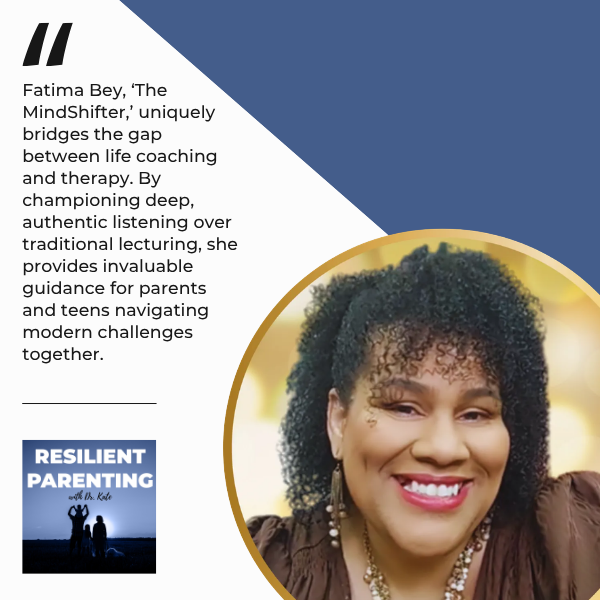
As you said, I am Fatima Bey the MindShifter and I'm a MindShift coach. What that means is I am not a life coach. I am not a therapist. I'm right in between. There's a big gap between those two things that needs to be filled and I'm here to fill it. One of the things that I focus on in all of the mind shifting that I do is teenagers. Bridging the gaps between teens and the adults who work with them. It's something that I'm very passionate about and understand a lot of.
I have a lot of experience working with teens and children, in general. I work with schools doing workshops, case management of teens and career development. Anything having to do with youth, I've mostly done. Not everything I do is focus on teens. They have my heart. A lot of what I do tends to gravitate towards them.
It’s such important work. The domain working with teens in this space is so vital. We have to help teenagers out there to see the possibilities on the other side of the challenges they are inevitably going to face. I have twin boys myself. Challenges come up here.
That’s a nice way to say it.
We do spend time trying to navigate those challenges or help them to navigate those challenges. Let's face it, they need to navigate on their own at this point. They’re moving into college and all of it, but things come up. Talk a little bit about that mind shift with teens who are facing challenges.
The Critical Need To Stop Talking And Start Listening
Let me start off with one of the things that I do as a mind shifter with any age. I do individual coaching as well. I didn't mention my entire resume because you'd still be reading. When it comes to humans, regardless of any age. One of the first things we have to do is unlearn. This generation are teenagers now and young adults. I won’t even say middle school. They are facing challenges that those of us over 40 never had to face in ways we never had to deal with.
They deal with peer pressure. All humans have dealt with peer pressure. They deal with bullying. Most humans have dealt with bullying. They deal with adults trying to tell them what to do. We've all dealt with that, but not on the level that they are. We grow up on earth with humans. They're growing up on another planet with robots. They're not the same. That affects how you develop your thinking and your mind. I'm going to say this before you even ask because it's vital and I want to put it out there. One of the number one things that we need to do as adults when working with teens is to stop talking to them and start listening. Shut your trap and listen.
We need to listen more. It doesn't mean that we need to let them be disrespectful. I'm saying all of that because some people will take it to the extreme when I say that. I like to say it out loud. It doesn't mean that we need to let them be disrespectful. It doesn't mean that we need to let them go on and on for 25 years. We do need to take the time and listen to what we don't understand. If you're over 40 and you think you understand the teenagers. Unless you work directly with them like me. You're wrong. You don't.
Take the time to listen to what you don't understand because you can't help them. You can't be there for them and they're not going to listen to you until you listen first. As they're navigating all these challenges. As you said, they're going to college or trade school or gap year or going into entrepreneurship. Whatever they are doing. They're doing it differently than we did for the most part. It's not just that they're doing it differently as far as programs but they're doing it differently culturally. They are more confused than we ever were on about 50 different levels.
They have more information shoved down their throat and in their face than we did. We already had a lot. No generations are perfect. Our teams now are not navigating the world the same way we did. We need to listen to them to understand what they're going through. I'm going to use this as an example because I know that most parents can relate to this. When it comes to teens who shut down, we don't always see it as shutting down.
They get quiet. They stop responding. They don't say the word or whatever because they want to be respectful, but they act like whatever. That's usually bad. It's not always because they're accepting what you're saying. It's because they're shutting you down and shutting you out. That's the worst place for any of us to be as parents.
It’s engaging with them in that authentic human way by listening first, which then creates that authentic connection.
Listening first doesn't mean that you're not going to end up telling them off. Listening first doesn't mean that you're not going to be like, “Look, little girl.” It doesn't mean any of that. Listening first means just what I said, listening first. It doesn't mean that a speech doesn't come second because sometimes it’s necessary. Most of the time, they're not. It doesn't mean that other things aren't going to be said because, a lot of times, what parents are saying they're often right. They often write about what the kids should or shouldn't be doing.
However, what you say to them does not matter. I'll put it this way. If I shut the door and I can't hear. It doesn't matter what you're saying outside of, does it? This is what happens when we talk. our kids. We talk to our young adults or teenagers or adolescents. When we're talking to them, we have to listen to them and have a conversation. Only because what they're thinking is mad, crazy and stupid. Maybe it is. Maybe you're just out of their mind and what they're thinking is totally wrong.
It doesn't matter if it is. You're not going to get them to see your side of things. Unless you have a conversation first. Having a conversation first doesn't mean that they're going to change overnight because you do. Most people don't. I know I didn't. Most of us don't. I do want to understand this difficulty as a parent because some parents do realize that they don't understand the use of now. That's a good thing. If you realize you don't understand it, then you have the opportunity to try to understand. You don't need to be perfect to do it. You just need to try. Some kids will meet you if you do that.
That is such a good point. This idea of slowing down and not trying to be perfect. Only trying to understand. That's important. It's all very much complicated. You mentioned robots and AI, but this social media situation is intensifying so much. The comparison trap for teenagers and how they view themselves in relation to others. What's your thought on that?
The Reality Of Growing Up In A Digital Age
This is something I've talked about on MindShift Power Podcast on many episodes. When we use the term social media, we give out our age right then and there. You'll never hear a teenager say social media. To them, it's not social media. It's like the blood running through their veins. It's the air they're breathing. It's part of their existence. They've grown up in an era where that's all they know is digital connection. We grew up with human connection first. We learned digital later. Although, I try to tell people I’m 25. I'm Gen X.
For us, we were the last generation of human contact before digital contact. We learned social media later. I'm very well-tuned to social media now. Honestly, the only reason I'm on social media now is because of my business. If it wasn't for that, the rest of you all can just do it. I don't care. I'm there because it's the best way to get your information out and connect with people. It is now. When I was younger, it was the mall.
When it comes to social media, as adults now, we have to stop thinking of it as a separate thing. They don't think of it as a separate thing. We do. That's adults talking. That's not the people who grew up with all that. That's all they know. You’re like, “What's wrong with these kids? They're so connected.” You have grown up. Who taught them to be that way? For real. We want to blame the younger people for being the way they are but they were born into what we created. They didn't create this world. They're only reacting to it.
That's a very good point. The reaction to it but still, that modulation has to come into place somewhere.
I agree. Here's the thing. That's where us adults can help to take a turn. I'll be honest with you. There are even some teenagers and young adults who agree with us that these two are digitally connected. Some of them literally don't know how to undo that. That's where we have to come in and help them with that. Not tell them what to do. That doesn't do anything. Partner with them.
I love that because that's the thing, we lecture. That's rarely if ever effective. Partner with them and think about other angles or directions to still have social media be a piece of. The digital connection is a part of life. That's my thought on the whole thing. From an early age, helping kids to modulate their use because it's going to be a piece of their life and experience. It's a piece of our life and experience but we all know we have to modulate such that it doesn't overtake our life and experience.
Avoiding The Trap Of Over-Sheltering
I want to add something to that because it’s just as important to say. We do need to modulate. We do need to help them to have some balance. However, that does not mean we need to go to the extreme of saying, “You can't ever be on Instagram. You can never do this.” When you take things to the extreme, you now have an imbalance and everything's going to tip over. Think about a teeter-totter. A teeter-totter has a balance. The reason why it can go on the side a little bit. It's still balanced and still good. Once you put too much weight on the side, the other side goes flying off.
Sometimes, our kids go flying off because we go to the extreme. For example, this is a big one. I want to protect my kids from everything. Loving good parents will say that and they’ll mean it. The problem is, I want to over shelter them. What happens when you over shelter your kid? The second they get out of the house, they become the biggest hoe, bully or jerk. They don't know how to handle money. They don't have to do anything because you've made them and sheltered them too much.
Sometimes our kids spiral because we push things to the extreme.
That is an extremely good point. We can't do that. We have to let our kids, from an early age, learn to problem solve. Grapple in a developmentally appropriate way with things that come up so that what you just said doesn't happen.
I want to add to that because this is an important next piece to this part of the conversation. I should mention I also do an audio blog. It's called the MindShifter Audio Blog. I have like 60 of them so far, but I'll have 100 soon. I'm not exaggerating. They are all for me. Except for the two guest contributors that I had. I have one of them. I write them all myself and then I narrate them with music. It's a whole audio experience.
One of them I have is something about there's no such thing as a perfect parent. Parenting is something that is hard. What a lot of parents don't realize is that when we're parents, we're not just there to develop our child. They're also there to develop us. If we see things that way, it's a lot easier to not beat yourself up. I say that because I know there's so many parents who are reading now that beat themselves up when they shouldn't. They beat themselves up because they weren't perfect. They beat themselves up because they messed up with the first one. They're doing better with the second. Welcome to being human. That is normal.
Welcome to being human because there is no perfection in parenting and in life. That's an excellent point. Very important.
The Power Of Transparency About Parental Struggles
Also, that was leading into this key point. One of the best ways to teach our children is to be honest about our own thoughts. The child that respects their parents the most isn't the one who got everything that they wanted and were spoiled. Those kids end up disrespecting their parents 9 times out of 10. The parent who gets the most respect when the child hits maturity and recognizes what they're seeing. Is the mother who would not quit, regardless of what hit her in life. She was honest and the kids watched her suffer. The kids watched her challenges but they also watched her overcome it.
The father who was beat down every day, still kept working hard, still kept teaching his kids, still kept providing and still kept whatever. The challenges work because we all have a few challenges. When we do that as parents, it builds respect from our kids. We may not see it until later. That matters because once maturity hits, they're thinking changes. That's true with all of us because we're human. Once maturity hits, our thinking changes.
Some of the parents who try to hide like, “I don't want the kids to see me suffer. I want them to see me strong. I don't want them to worry.” Ninety-nine percent of the parents who say that are well intended and wholeheartedly mean it. However, it's one of the worst things you can do. When they don't see your struggles, then they don't know how to handle their struggles. No matter how much you try to shield and protect them, they're going to have some.
Did you read my book Step Away: The Keys to Resilient Parenting?
I heard some of your talking but I didn't.
I have to tell you that's spot on. It’s exactly what I believe and what I write about. It’s this idea of not being afraid as parents to share the places that we've struggled with our kids in a developmentally and appropriate way. Also, our challenge. All of it. If our kids see us as some perfect being who's never had a challenge, who's never fallen down, they're not going to be well equipped to handle their own challenges. They're not going to understand that challenge is inevitable and we need to be able to navigate it. Get back up when we're knocked down and move forward. I love that point.
I want to go a little deeper on what you said. Part of being ready because you said being ready to handle challenges. The other side of the coin to that is when we don't let our kids see our weaknesses, how we overcame, how we overcome, and how we're able to meet the challenges. What it also teaches our kids unintentionally is that they're not good enough. It’s like, “Mom didn't have this problem so it must be me.” Mom had that problem. She just hid it from you. She had those conversations while you were at school.
She yelled around the house screaming like a maniac where nobody was there. Those are the things that they didn't see and didn't know about those challenges. They didn't know that she just merely escaped her life from a date that she was on but she's not going to tell you about it. She doesn't want you to be scared of going on dates. At the same time, if you tell your child about it, they might be more cautious going on dates. Which is not a bad thing, but they'll also see, “My mom is strong.” This is how you overcome when this happens.
I don't care who you are and what you do, they will hit you as long as they're living on earth. When those challenges hit, they won't be prepared to handle them. They will know how to handle it because they watch you handle it. That is such a big deal. Again, going back to the self-esteem piece. A lot of parents unintentionally produce low self-esteem for the children because they’re trying to protect their child. That's the old-fashioned word. We say so forth now, but I still say low self-esteem because I'm from the ‘80s.
We accidentally produced that by not showing our weaknesses. Therefore, unintentionally telling them that their weaknesses are bad, they're wrong and there's something wrong with them. If they go through a struggle and they know that auntie went through this or brother went through this or grandfather went to this, then they know that they're not alone in their struggle. All of these perfect images that we try to present, they're doing more damage than we realize.
We're going back to social media, the highlight Reels, so to speak. It’s like, “We went to Disney World and everything was so great. I got the love of my life and he buys me flowers.” They don't tell them about all the crap they went through before those pictures and all the crap they went to after the picture. They don’t tell you all that. Who’s going to tell you that? That doesn’t look good.
A hugely important point. In social media, it’s a lot of the highlight reels that we're seeing. We’re not seeing all the chaos and all of what's going on beneath the surface. For all of us, I can promise you. There's plenty beneath the surface. It's not appearing in those highlight reels. Helping our kids, helping our teens to understand that reality is very important.
The Hidden Dangers Of Secrets And Closed Communication
Helping them to understand that and how you understand that isn't lectures. It's conversations. Don’t tell them, “Don't smoke weed. I was a perfect little child. I didn't screw anybody.” Don’t lie. Tell the truth. That truth will help develop them and help to mature them. Not to go out and do the same thing that you did, if it was bad or wrong because we've all done that. That honesty allows for dialogue. Here's the other key reason why honesty is so important.
When we're not honest with their kids, they know you’re lying. You could try to pretend all day. They’re not stupid. Unless you know they're stupid, but most of them are not stupid. They know you're lying. They know you're avoiding something. They also know your personality. They know when you're avoiding something. You're also teaching them to not come to you when there's a problem. Number one reason why molestation and incest goes on is that reason right there, secrets and the feeling like they can't come to you because you're going to dismiss it. You're not going to believe them or most importantly, they can't talk to you.
When we're not honest with our kids, they know it. Children can spot a lie long before adults think they can.
When they can't talk to you, as a parent, there are a plethora of problems you will never know about. The problem with that, if they're not talking to you, who are they talking to? If they're not talking to anybody, they're cutting themselves or having suicidal ideation or sleeping around with many women or many men to damage themselves or doing other things that are self-damaging. Also, if they're not talking to you, who are they talking to? The pimps and hoes down the street. That's who they're talking to. They’re not talking to you. They’re talking to Uncle Bobo down the street who molest every child that comes near him. That's who they're talking to. Is that what you want? I know that's so hard.
Starting early with that authentic human connection, building the dialogue, building the openness and sharing your own challenges so that your child will come to you. That builds over time because, as you say, it's vital that we have that open line of communication without lecturing and the prescription of how things should happen, how we want to understand their experience such that they can build from there. I’m curious what your advice or your thought is on how we can help our teens to optimize their own sense of well-being within their own unique contacts from the inside out.
First of all, the real responses are an entire book but I’ll just focus on two main things. The one thing I already said, the number one thing, first listen. You could be talking to them over when in fact, mentally, they're somewhere else. Don't assume where they are. Talk, listen first and then meet them where they are. Don't meet them in a concept or an idea you read in a book. If that's not where they are, it doesn't matter. I can get a map from here to California, but if you are in Florida, that map is not very useful.
Stop reading all the books and listen to all the lectures and experts without the context of where your child is. Listen first. Get them to a point where they're willing to be open with you. That's the hardest challenge. You have to honestly start when they're young. Maybe they're older now and it's too late. You can't go back to when they're four. They've already developed this relationship where they can't talk to you. I will tell you that it's not too late to start that.
I experienced it myself. I understand it. It's not too late to start it. It is harder the older they get, but you have to be as persistent to get there as you were to lecture them. It starts with a conversation. It starts with being able to have real conversations but the number one piece of that is listening first. Number two is get them to the point where they're willing to be open to you because you're not going to immediately react. One of the worst things you could do. and this is what a lot of parents do and it's understandable. Especially when you care about your child, which every good parent does. “I did X, Y, and Z.” “What?” When do we react that way? Why would anybody come back and tell you anything?
You want to work to respond, take a step back, gain a little bit of space and perspective such that you can respond as oppose to react. Perhaps they present something that might not have been the best choice, but we're all going to make choices, which aren't perhaps the best at some point.
That's the thing. We all are. The hardest part is, sometimes you want to be like, “Little girl, I told you.” You want to smack some sense into them. It’s like, “If I hit you hard enough, will the brain start working?” I'm not saying that you should do that, but I'm saying it's how people feel sometimes as parents. It's totally understandable and reasonable to feel that way. At the end of the day, what's more important is your emotions in the moment and expressing those emotions? Was it more important to reach your child?
The question you have to ask yourself when you're in that moment and you want to give the lectures is, “How many times have I told you?” If you find yourself saying that, that means that listening wasn't happening. Sometimes, listening wasn't happening because you're looking too much. You're not doing anything wrong. Listening wasn't happening because they are not ready to listen yet. This is not something people want to hear. Unfortunately, the stronger the child, the stronger willed you have to be to get them in the right direction.
They're not going to just listen. Some of us need to have experiences before we believe. We want perfect kids that listen to what we say and follow. That's not what most humans do. There are people that are like that and those are the easy kids. They do exist but the stronger the will of the child, the stronger the will of the parent has to be to override that to get them to learn the right lesson. Let me say this. Listening first is a key element that most people just glaze over.
Do your kids respect you? Here's the thing. If they respect you, I don't mean they’re not perfect or never get an attitude. Even if you respect your parents, you’re getting an attitude. I don't mean that. Do they actually respect you? If they respect you, that has more power than any of your words alone. This is not just true with parenting. It’s true with humans. Respect is one of the most powerful tools that you can use to affect people.
When your children respect you, your example speaks louder than your words ever could.
This is why listening to them is important because it shows that you respect your opinions. When you act like their thoughts are stupid. Now you're stupid and I'm not listening to you. That's the attitude that you're going to get. They may not say those words out their mouth because they want to be respectful but that's what they're thinking. The thing is, do they respect you? If the answer is no, let's work on that. It's not impossible to reverse that. It isn't.
Do they not respect you because they watch your mom and they watch every man you're with disrespect to you? Do they not respect you because you say you're going to do things you don't do? Do they not respect you because you're constantly lying to people on the phone and gossiping? Do they not respect you before because of X, Y, and Z? I can go on and on. Do they respect you? If you work on that, everything else is less hard. I didn't say it's easy.
That is an excellent point. Less hard because it's never going to be easy. It's never going to be easy in life, but we want to give our teenagers, give us his parents, the best possible chance to maximize our potential within our own unique context. See the possibilities on the other side of challenges and move forward to the best of our ability. That's what I'm hearing here. Your insight into all of this is gold and it can help a lot of my readers to frame what's happening out there with themselves as well as their kids. Particularly within the context of that relationship because that's where the power is. Our relationship that we're having with our kids and how we're building that over time.
Building Respect Over Trying To Be Perfect
One of the reasons why I know some of the stuff is because I directly work with teens and I actually listen. I hear some of the frustrations. I just hear a lot, but I also understand when you're a parent and you love your kid more than life itself and you want the best for them. Maybe you didn't have the right upbringing and that's something that's hard to admit sometimes. Maybe you aren't taught some of the right things.
I have also learned that even if you aren't taught everything, there's no such thing as a perfect parent. Maybe you had great parents but they aren't perfect. They didn't teach you how to say I love you or how to communicate better or whatever the issues are. It doesn't mean that you can't learn. It doesn't mean that you can't start to implement them now. I want to emphasize this again. Do not expect perfection from yourself. Do not be too hard on yourself because you try to do things right and you still mess up. That makes you a normal human being.
The ones we have to worry about are the ones who don't care, whether they mess up their children. Those are the ones that we need to be smacking in their head. No violence. I'm just kidding, but the ones that we want to do that to. I also want to emphasize reading to parents. For those of you who are probably reading this because you are a caring parent, you wouldn't be reading a parent show if you didn't care. You're reading this now because you care.
Do not beat yourself up because you're not perfect. Learn from the things that work, the things that don't work and move on and do better next season, next incident or next whatever. The last thing I want any of you to do is beat yourself up for not being a perfect parent because you're grasping at air. You're never going to be perfect. What you can be is strong, good and your kids can still learn from you. When you go to church and you look at let's say a speech at the White House or a college, the ones who are like, “I remember my mom taught me this or my uncle taught me that.”
It's always something that they did wrong and there was a shift in that moment. Whatever the incident was, they learned. It's never because the parent was perfect. I never heard a story of a parent that was perfect. It might be that it was just so perfect and they learned some words of wisdom from their mother or father or grandma or whoever. It's usually because they went through something to learn that lesson. That's the imperfect part.
Precisely, because imperfection, that's what it is. There's no such thing as perfect. We need to be focused on doing the best we can and helping our kids to do the same and seeing that as normal. Normalizing the fact that there is no perfection is important.
Normalizing it, but giving it some balance. I have to say this because of how imbalanced people are. Normalizing it does not mean that I try for 30 seconds, so now I'm done. I'm going to eat some pizza now. That's not normalizing it and that's not what Kate means. Normalizing means it's okay that you're not perfect. It also doesn't mean that you don't keep trying.
Exactly. You got to keep trying.
The effort has to continue.
Fatima, this is amazing stuff. Unfortunately, we need to think about wrapping it up here. How can my readers get in touch with you, learn more, and all that good stuff?
It's just simply my name FatimaBey.com. I have MindShift Power Podcast, which you'll find on there. It’s an international show for teens. It’s the only one like it in the world, literally. The MindShift audio blog is on there as well. They're all between 2 minutes and 11 minutes or 13 minutes. They're mostly between 5 and 7 minutes. They're just quick things that you can listen to. give you a mind shift. That is not focused on teens. Although, there's some teens stuff in there.
It's focused on mostly adults. I have a couple there for parents and I'm going to have some more going up for parents as well because parents need that refreshing, too. I have Fatima Bey The MindShifter - Guesting. Every time I’m a guest on someone else's show or television or speech or whatever, it gets put into one show. You can hear me speak all in one place because this content is different from my own content. I find myself saying things here that I don't say in my own content. There's that. You can follow me on social media and all the other stuff that I do. I also speak at high schools and do workshops. I'll be getting into college as soon as well.
Thank you so much again for joining us. This has been great.
Thank you for having me.
Important Links
About Fatima Bey

Fatima Bey The MindShifter is a speaker, coach, and host of the internationally streamed MindShift Power Podcast and The MindShifter Audio Blog. Her work focuses on helping people challenge limiting beliefs and step into who they were created to be.
Through hundreds of conversations with young people from around the world, Fatima has developed a unique perspective on the growing disconnect between teens and the adults who guide them. Her mission is to bridge that gap by helping adults better understand how teens think, process pressure, and develop identity in today’s world.
Her message is simple: when we shift how we think, we change what becomes possible.