Helping Neurodiverse Kids Thrive With Aeris Wren
In this episode of Resilient Parenting, Dr. Kate Lund speaks with Aeris Wren, host of TELOS: A Neurodiversity Conversation, about raising and supporting neurodiverse kids with understanding and intention. Aeris shares her personal journey growing up neurodivergent in an immigrant household, and together they explore masking, generational pressure, and the importance of creating safe spaces where children can thrive without hiding who they are. This is a thoughtful conversation on redefining resilience through compassion and awareness.
---
Listen to the podcast here
Helping Neurodiverse Kids Thrive With Aeris Wren
We are so fortunate guys to have Aeris Wren with us. I’m very excited about our conversation that’s coming up. Thank you, Aeris, for joining us.
Thank you so much, Dr. Kate, for having me.
Looking Back To Aeris’ Childhood And Career Journey
I’m super excited to have you here. I would love it if you could give us a little bit of an overview of your story. How you got to where you are and then we'll jump into our conversation.
My name is Aeris. I am the host of TELOS: A Neurodiversity Conversation. Which is also a show where I talk a lot about neurodivergence, systems of support, and how our identity can shape the way we move through the world and find purpose. Long before I had language for any of that, I was a neurodivergent child in a loving but culturally complex household.
To start off with that, for most of my early life, I didn't know why certain things felt harder for me than they seemed to be for other kids. I masked quite heavily. I learned to observe others, copy behaviors, and perform in order to survive socially and academically. From the outside, I was seen as a very capable student, even gifted in some areas. On the inside, I was more confused and quite exhausted internally.
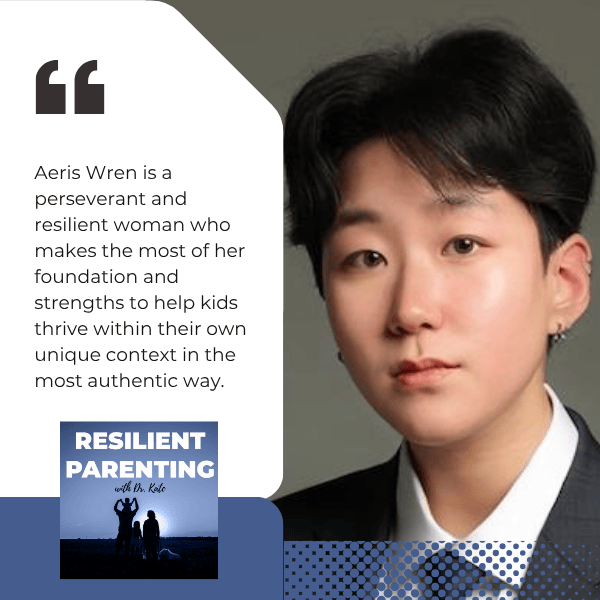
I would say that this experience shapes how I think about going about my life and also resilience. Resilience isn't just toughening kids up at this point. I see it as helping children understand who they are, giving them language for their needs, and creating this safety so they don't have to hide in order to belong.
That is so powerful. What powerful words you just spoke. You hit on such an important point about this idea of helping kids to thrive within their own unique context whatever that looks like for them and doing that in an authentic way that feels natural as opposed to exhausting as you mentioned. At some point, it's hard. You didn't understand why things might've been a little bit harder early on. I'm sure your parents didn't either. It was a process that had to evolve for you all to understand. What was going to help you thrive within your own context? What did that look like? How was that that shifted over time for your parents early on?
I would say that my parents cared for me deeply. I want to be very clear about that but they did not have the framework to understand neurodivergence in the contexts that they were raised in and lived in. That's common for so many other families, especially immigrant families or families connected to China. There's something I would describe as a rather generational scarcity trauma coming from living through or being directly shaped by such a prolonged period of instability.
We're looking at China in the mid-20th century experiencing widespread famine and systemic disruption. When a generation grows up with that kind of food insecurity or educational competition and social instability, getting the advantage over those criteria becomes the primary value. A lot of that pressure is put onto children.
For instance, stability becomes sacred to the family. Academic performance is just another form of protection there. I would say that parents push hard not because they lack empathy. It’s because they believe excellence is the only shield against the instability that they might have suffered or heard about. They don't want that to happen for their kids.
For my parents, my strengths developmentally were celebrated because they aligned with these sorts of survival values. I was a quick reader and hyperlexic as a kid. My academic performance was fine. I was rather disciplined. My struggles were confusing. For instance, let's say I had a lot of difficulty focusing on non-preferred subjects.
There is no single blueprint in parenthood. Two children in one household often require completely different approaches.
If it wasn't an interest of mine, I tuned out. That took a lot of effort. Social misunderstandings looked a lot like you were raising an immature child who didn't know how to talk to other people or behave in an “acceptable manner.” They were parenting through a lens of protection. I would say the step beyond protection is understanding.
I love the historical context and the perspective that you give. I hear you. I'm 100% confident that your parents cared for you 100%. They’re trying behind the scenes to understand what was happening for you and why some of the things were challenging as they were. As you mentioned, you were excelling in so many different ways. That makes finding that balance difficult.
As parents, we're focusing on the things that are going well and things that are helping our kids to move forward and thrive in a sense. Focusing on those challenges is important as well. Sometimes, they can get a little lost if you're excelling so heartily in certain areas. Tell me a little bit, what is hyperlexic? Does that mean that you were a very fast reader who could just ingest a lot of material and synthesize it well? Tell me a little bit more about that.
I was a voracious reader. I also talked constantly. My parents talk about how, developmentally, they never expected me to hit that talking milestone so much earlier than my other ones. For a while, I was just sitting there like a little rock that talks. That's a side note. I enjoyed reading just because it felt like a whole different world that I could immerse myself in. I was constantly holding a book and muttering to myself about it. I like to joke about it now, that reading above my age level in grade three has not done that much for me. I thought it might make things easier as life went on.
We're forgetting there are so many social aspects that come with society and learning to live in the workforce. I also have a younger brother. This is important to note because his strengths and challenges look different from mine. We're both neurodivergent. Where I was hyperverbal and deeply immersed in language and words, he has different processing patterns as well as social responses.
He's a lot more tactile and physical. Words wouldn't get to him if he's trying to explain something to you. Watching my parents navigate both of us showed us how complex parenting neurodivergent children can be. There is no single blueprint. Two children in one household often require completely different approaches.
How To Parent A Neurodivergent Child
That is such a great point. That's exactly it. I have twin boys and they are completely different. My husband and I had to figure out early on how to help each one of them to thrive within their own unique context and what that was going to look like. It’s very different. It's okay because we had to figure out say for example one’s very academically focused. He needed very different things than his brother who had some learning challenges, but maybe was a bit more socially focused early on.
Striking that balance was delicate at times. It was something that became a natural piece of our fabric, our framework within the house. As they've gotten older, each of the boys appreciates their differences and can see them for what they are. It's made them much closer in a way, if that makes sense. How did that piece play out for you and your brother?
I would say that my parents helped in ways that were not always obvious at the time. I recognize very clearly as my brother grows older. We have a nine-year age gap. He's quite a bit younger than me. I would say as I grew older, they began to adapt a lot more. It was not immediate and it was not perfect. With the second child, you have to adjust.
For instance, his strengths and struggles look different from mine. They cannot apply the same strategy to both of us. That force a growth in the family. It shows that parenting is iterative, I would say. You adjust, reassess, and you try again. For instance, with me. They tried to protect my strengths, even if they did not fully understand my challenges.
If teachers noticed that, “Aeris is in the corner reading all the time and not socializing.” My parents didn't try to dismiss that as useless or force me to stop. They bought me books when they could. They allowed me to spend long stretches of time immersed in learning. That's what I was interested in at the time. That protected space became a refuge for me. They had to learn how to adapt creating a refuge for your child for my brother. That was interesting to watch.
You make a great point there about this fact. As parents, adaptation, flexibility, shifting with where the needs are, where the challenges are. Finding ways to adapt to move through and beyond those is so vital and not always easy, but very important. As we as parents do that, in a sense, we're modeling for our kids. Do you remember any moments where there were some adaptations, some shifting gears as a way of navigating through a challenge that maybe stuck with you that you can think about all these years later?
I would say I was always observing my parents model perseverance and resilience. Even if it didn't look perfect all the time and even if it wasn't very smooth. I watched them growing up navigate language barriers and cultural differences, and all of these social uncertainties without giving up. As a child, it's a little awkward to see your father trying to have a conversation at the bank in English. You have to step in to help him out because he doesn't know the word for a mortgage.
Being able to see them show up constantly is the most powerful part. They stayed engaged. They showed up to school meetings. They monitored my progress. They were invested. Even when these sorts of misunderstandings happened, I never doubted that they were on my side. That was the biggest piece of observing that perseverance.
Making The Most Of Your Foundation And Strengths
I love that. That's something that will stick with you always. You seem to be a very perseverant and resilient person who is making the most of your foundation and your strengths. How are you using those strengths beyond this amazing show you have in the here and now in your life because there are many, clearly?
Thank you. I want to say that when school felt socially confusing or academically overwhelming. Quitting was not an option in my head. I had seen what endurance looked like. I knew that I had to be on my side too if everyone was wanting to support me. I would say I'm using the same strengths that once made me feel different as tools for connection and impact.
I love people. The intensity that led me to, let's say, read for hours as a kid is what allows me to research deeply and synthesize complex ideas without giving up and communicating them to people. I love psychology and cognitive science. It's always been through a framework of understanding behavior but this time not to copy people or to mask for social validation. This time, it’s only to analyze patterns in family systems or classrooms and cultural dynamics to further that research and make sure that other families can also be supported.
It's amazing. I think that by fostering your strengths early on in terms of loving to read and giving you that space to read for as long as you want. Your parents gave you a great gift. Our strengths serve, oftentimes, as the foundation for what helps us to navigate through and beyond our challenges. That's what I'm seeing very clearly here. Do you think that a career in psychology is in your future?
That is the long-term goal. I care about the topics. I would say that academia or clinical psychology allows me to expand on that breadth, go deep and speak to people about the things that I care about.
How Parents With Neurodivergent Children Optimize Their Wellbeing
I love that. Shifting gears a little bit back to your own parents. I'm curious because I wrote this book. It was released in the fall, Step Away: The Keys to Resilient Parenting. At the foundation of that book is this idea of how, we as, parents can optimize our own sense of wellbeing and in doing that model for our kids. We've talked a little bit about the modeling piece. At the core, how do you believe your parents worked to optimize their own sense of wellbeing within the context that you're describing? There's some challenges or some things that aren't that easy. How do they do that, would you say?
When I look back, honestly, I can see that my parents were not just surviving for us. They were actively trying to stabilize themselves, optimize their sense of wellbeing. It didn't look like what we might call self-care now or what we might generally think self-care looks like. A lot of busy parents might relate to that where wellbeing is tied to stability or forward movement.
Parents are not just surviving for their children. They are also actively trying to stabilize themselves and optimize their sense of wellbeing.
That planning was regulation for them. It reduced a lot of anxiety. I remember how structured my parents have always been. There was always a routine around getting things done. It wasn't that they were perfectionists or they needed a rigid schedule. It was about creating some predictability in family where they knew outside the world could shift quickly.
I also remember that they were invested in community, even if it was small. Other immigrant families, let's say, or cultural gatherings. These spaces that only belonged to us or them. Having that just for them was precious. Time away from us as well. Having that time where it's just for you and you don't have to be worrying about your child or what your child is thinking at this moment.
I love what you say about community. I'm sure that there was a degree or a lot, of social support within the communities that your parents were engaging in. That's one thing I talk a lot about in my book. The power of connecting with some sort of a support or community network such that you're not in it alone as a parent. There's so many different ways that we can garner that type of support. I love what you're describing with your parents.
All About TELOS: A Neurodiversity Conversation
Also, the stepping away piece. The not feeling like you always have to be pushing forward. Sometimes, taking a step back, creating space, and gaining perspective is helpful in terms of the big picture. I love what you say about structure. For some people, structure is paramount. It works so well. It sounds like that was the case in your family, which is amazing. Tell me a little bit more about your show. That sounds an amazing project. How long has it been going on? Tell us a little bit more about it.
TELOS is my show that I started in October 2024. The word represents an ultimate purpose or end goal in Ancient Greek. That's exactly why it resonates so deeply with the work that I try to do. When we talk about neurodivergence or vulnerable populations, and caring for them, the conversation can easily get stuck in deficits or misunderstandings.
Being resilient in your parenting is not about lowering standards. It is making sure your child knows who they are and you know who they are as well.
My parents often would be scared when we only see headlines about bad things that are happening to vulnerable populations, or people who we consider different. For me, TELOS is meant to shift that forward towards finding purpose. It asks, “What are we building towards?” I like having people with lived experience on the show as well as experts to talk about mental health and neurodiversity. I want to help people understand their traits, even the ones that might feel weird or isolating. They're not random flaws. They can be aligned towards finding purpose.
I love that. That is so powerful and so spot on in terms of the lens that I look through. Sometimes, our challenges, the things that make us stand out as different or unique, our strengths that we can use as catalysts to move us forward to that place of purpose and meaning. That's such a powerful, very spot on and relevant idea particularly in today's world. I love the premise of your show. It's out there. You're helping so many people with it. It's very clear.
Thank you. I hope so.
Taking A Breath And Slowing Down
Aeris, as we're thinking about needing to wrap it up here. What would be a piece of advice that you would give to parents of perhaps a child with neurodivergence to help them thrive, to help them flourish within their own unique context?
If I had to give one core piece of advice to these parents, it would probably be to take a breath and slow down your interpretations before you move with corrections. For instance, so often, especially in families shaped by high expectations or a lot of stress because you have a lot of kids. Behavior is immediately evaluated. Is my child being respectful? Is my child productive? Many neurodivergent behaviors are signals. Not inherent traits or flaws.
Let's say your child avoids eye contact or struggles to start homework. I would advise pausing before assigning meaning. That can save both you as well as your child a lot of the burden of misunderstanding. It’s asking yourself, “What might the child be experiencing now? How are they trying to tell that to me?” I would also encourage parents to examine whether fear is driving their reactions.
Sometimes parents are scared and that's valid. When we don't take enough time to care for ourselves, that fear is unintentionally communicated that love is conditional. I would say being resilient in your parenting isn't about lowering standards by any means. It’s making sure that your child knows who they are and you know who they are as well.
That is so powerful. I love the piece about awareness. It’s so important. Taking that step back, pausing, gaining perspective, and being discerning in a sense about what things mean. That's powerful stuff. Aeris, I appreciate you being here. Thank you for joining us. I hope we can have you back at some point soon.
Thank you so much, Dr. Kate. I appreciated this conversation.
Important Links
About Aeris Wren

Aeris Wren is a young adult with ADHD and autism who is passionate about psychology and mental health equity. This show dives deep into topics like executive functioning, masking, DBT skills, self-advocacy, and identity.