Helping Anxious Athletes Thrive with Cali Werner

In this conversation of Resilient Parenting, Dr. Kate Lund is joined by Cali Werner, an expert in helping kids and families manage anxiety and OCD, to explore how to help anxious athletes thrive. Cali shares her personal journey of navigating severe OCD while competing at an elite level, and together they explore the dangers of "survival mode," the importance of emotional regulation after a loss, and how parents can move from accommodating anxiety to fostering true independence for anxious athletes. This is an empowering conversation on moving beyond mere functioning to find genuine freedom and resilience in both sports and life.
---
Listen to the podcast here
Helping Anxious Athletes Thrive with Cali Werner
In this episode, we’re lucky enough to be joined by Cali Werner, who comes to us as an expert in helping kids and families manage anxiety, OCD, and many other things. Welcome, Cali. Thank you so much for joining us.
It’s a delight. I’m so excited to be here. I’m ready to dive into a topic that I’m so passionate about.
If you could just give us a quick snippet of who you are and where you’re coming from, then we’ll dive in.
Researching the Performance Mindset
I work full-time at the OCD Institute of Texas. I’m here in a leadership role, and I’m also a clinician on our team, where we treat individuals with severe OCD at the residential and PHP level. I also work with outpatients. My passion is working with anxious athletes. My PhD was researching. I did a study on twenty Olympians. I got to see their background and what made Olympians ready for a performance mindset, and what negatively impacted them.
My outpatient consists of lots of young athletes and also parents, because when you’re working with the kid, you are looping the parents into that as well. I have lots of different passions. I’m a distance runner myself. I got into this work because there was a point in my life where I was completely debilitated by OCD, and my parents didn’t know what it was. There was a lot of accommodating going on. I wanted to help others get the treatment a little quicker than I did.
That is such powerful stuff, and I am intrigued by the sports piece. I have twin boys, and they’re both rowers. Particularly for one of them, he’s held back a little bit with things like dessert time and other things. I am convinced it’s some anxiety stuff or some overthinking that gets his way. That’s a fascinating area. Maybe we can jump into that as well.The whole idea of sports parents is so important. I work with a lot of sports parents myself in helping them to modulate their emotional state on the sidelines and beyond. It’s so important.
Adapting to the Individual Athlete
We always talk about how coaches have to learn to adapt to the athlete. If it’s a type A athlete, they don’t need the coach screaming at them on the sideline, versus the type B athlete. They might thrive with some of that. We forget that so much of that also needs to take place in the household. If an athlete is more Type-A, hard on themselves, and maybe has some perfectionistic tendencies when they don’t score a goal. They’ve probably already thought about that mistake ten times. They don’t need their parent overviewing that with them off of the field. It’s such an individualized approach to each athlete. It’s hard for us to know when they’re the ones that are in it, the best ways to respond.
That comes down to this idea of awareness and knowing yourself as a parent, how you might respond. More importantly than that, knowing your child, their disposition, and how they’re going to best respond and what they need in these situations. What I always feel is the most important thing for our kids when they’re coming off the field or have had a hard event or whatever, is to be there and create that space. Allow them to come forth with how they’re feeling about things as opposed to jumping in and saying, “It could have been better. Maybe you should have done this. Maybe you should have done that.” It’s not so helpful.
The Importance of the "Bounce Back"
You think about it, too. One of the most common things I see with some of the young athletes that I work with now is that the second they make that mistake on the field or court or track, you can see their emotions thinking. It’s hard for them to bounce back into the game if they have to go back and keep performing. One of the things I like to tell them is you think about a football player. A football player makes a mistake and in the middle of the game, they don’t immediately run to the locker room to start watching film to see, “How did that mistake go? What should I do differently?”
They reset, have a bounce back and get back into the game. They watched the film the next day once they’re more emotionally regulated and able to handle that. As adults, kids, whatever age we are, that emotional regulation is so important. Once a kid steps off of the court and they did make some mistakes, they’re probably not even going to hear what their parent is telling them. If their parent is already going into correction mode, they need to be able to process it and regulate then maybe there’s a time to talk about it on the road.
As adults, kids, whatever age we are, emotional regulation is so important.
It’s creating that space and that time to allow everybody to gain some perspective on what happened. When there is perhaps a clinical anxiety or OCD or something along those lines, which can interfere at a higher level, talk a little bit about that. What’s the most helpful path there?
Oftentimes, parents will tell or ask me, “how long do you think my kid will work with you?” I usually tell them, “I have to see them in an intake to give you a better idea because so much of my work is very structured.” We’re giving them the tools. Once they have those tools, we’re going to by weekly and then to as needed. My goal is for them to thrive and utilize those skills independently. If the child or the teen is truly coming to me with the need for sports psychology tools, I’m looking at 6 to 8 sessions. If they are struggling with a mental illness, it’s a bit more obvious.
Building Rapport and Buy-In
It’s not usually just impacting their sport, but also impacting their social life or their home life or their grades or other things going on. I always say, “We’re looking closer to 12 to 18 sessions because so much more of it is tied into the mental health aspect.” What I like, especially for kids who maybe don’t quite think therapy is cool yet. I get to share with them, “The added bonus is this can enhance your sport performance as well.” We’re actually working on the mental health side of things. That’s just how I get them to have some buy-in.
The buy-in is so important. Also, I imagine that you’re forming a strong authentic human connection. It’s this idea of understanding the kid beyond what their struggles are.
You have to build rapport first and know that you’re on their team. The parents will share all these things. I usually like to meet with the parent and the kid together or the team together for the intake. For the follow-ups, it’s myself and the team putting our heads together and putting together a treatment plan.
We might tell the parents some of the things that they’re working on down the road, but I always keep in mind that the patient is my client. I’m sure you’re very familiar with, Dr. Kate, the parents have some of their own anxieties. They might need some support with that, too. There can be some psycho educational along the way, or I might have them work with a provider while I’m working with the kid if there’s a lot more of that hands-on approach needed.
That’s my approach as well. Oftentimes, the parents do need some support. Whether that’s in the form of coaching or perhaps therapy, but always cycle education around the impact of erupting on the sidelines in a way that perhaps isn’t helpful, and the impact it can have even when it’s so well-meaning.
What I see probably most commonly, there could be some anxiety but a lot of the parents are seeing me for some sports. I can see the ability to process loss and maybe not doing as expected in a game is that co-regulation. A kid or a teen doesn’t get the outcome that they wanted. They start to abrupt after the game or feel like they can’t handle some of those emotions. They’re unloading it on parents, and parents taking that on and trying to help them regulate. That can work temporarily, but it’s not a long-term fix.
We want the kid or the team to have some of these emotional regulation skills so that they can work on these things independently and become the best individual athlete that they can be. I would say most commonly, one of the things I’m working on is helping that parent see that it’s okay for their team to be uncomfortable after a loss. We’re working with that team to build the appropriate skills to regulate, but they have to do that independently.
Developing Skills from the Inside Out
That is the goal that you mentioned earlier as well, to integrate these tools and strategies such that they’re coming from the inside out. Inevitably, whenever there’s a disappointment whenever there’s a performance that doesn’t go as planned or is hoped, we all have to sit in that space and process it. It takes a bit of time.
One of the things that’s helped, one of our boys, a lot in this, started journaling whenever he didn’t hit his org time or the mark that he was hoping to have achieved. That has been helpful. It’s been in an evolving process. That’s been extremely powerful for him over time. I’m so glad he found it. He found it on his own and good stuff. I encourage some of my own clients for whom this could be a good fit. Let’s be honest, not all things, not all strategies work for all kids.
Journaling is basic. Everybody can grab a pen and paper. We know that it’s helping them process some of the things that maybe they just can’t process until they have a quiet space to do that.
I’m curious about how your own experiences early on in sports and perhaps with OCD and such play into all of this.
It ignites my passion for this work, but a little bit about my personal background. I struggled with OCD as early as three years old. I was going around the house, tapping my nose saying, “Sorry, God,” because I thought my nose would grow like Pinocchio’s if I told a lie and didn’t seek forgiveness, which is a form of OCD known as group elasticity. My parents didn’t know what it was at that time. Most people don’t and we just rolled it out as quirky, like I was just a quirky kid, and I had some of these repetitive behaviors that I would sometimes do.
It wasn’t until college that I was running competitively. I was able to get a full ride and I just felt like the pressure was so much more intense. I was trying to make it to nationals. I got to this place where I couldn’t even tie my shoes at the starting line because I was looking for this just right feeling. I would do it over and over again. In high school, too. My coach had a tie my shoes for me so that I could get to the starting line on time.
Moving from Survival Mode to Freedom
The problem with OCD is we tend to be in survival mode and I was. High school is when my running started to take off. I got to this place where I was like, “I have to get to the starting line.” I had this core belief that the OCD is what made me a good runner, so I didn’t want to fix it until it got to a place where in college, I was so debilitated. I couldn’t use a public restroom. I couldn’t get to a race without having probably ten panic attacks. The evidence-based treatment change my life. For the first time, I felt something wasn’t wrong with me. I had wished but also was able to see the resilience that built that I had gotten treatment so much earlier. I got burned out for my sport.
That’s the message I would want people reading to take away. If an athlete is struggling or a student is struggling, it doesn’t have to be an athlete with their school work or performance and there is some perfectionism. Be preventative. Perfectionism or OCD are different diagnoses but over time, it can lead to burnout. You don’t want to get to a place where you resent something that you used to love. It’s much harder to do the treatment later than it would be if you could be preventative with it. That’s why I do what I do.
You don’t want to get to a place where you resent something that you used to love.
That is powerful stuff. I know that your own story, your own background, is probably something that you keep in the back of your mind. You’re probably not sharing it with all your patients, but how powerful in how it must enhance your ability to connect with those that you’re working with.
I always say as long as someone’s trained in ERP they can be a great provider. I do think that it does give me this ability to connect with patients and empathize a little bit more. I know there is a lot of pain behind what’s caused. I do think it helps my patience and patients. For the most part, I’m eager to help them get their lives back.
Choosing Freedom Over Functioning
Where it becomes a challenge is because I know what true freedom from OCD looks like. I rarely have at this day, an OCD thought. It isn’t a daily thing. Maybe once a month, I see some OCD flare up if life gets stressful. I know what it means to truly have freedom and some people aren’t ready for that. They want to settle for functioning and that is a hard pill for me to swallow still because I know what it feels like to have freedom. That would be the only thing that I think is a little bit more challenging with my circumstances.
I can understand that for sure because you’re like, “It could be so much more.”
Sometimes you have to meet the patient where they’re at and where they’re ready.
Meet them where they’re at and meet them where they’re ready, then let it evolve in a time and space that works for them, but I hear you. That’s challenging for sure. What about your parents? How do you think they were able to care for themselves through the situations that you were experiencing? How did that piece evolve?
I feel for my parents. When I was struggling, as I said, I didn’t have a diagnosis. They were probably just as scared as I was. If you don’t know what OCD is, most people think, “It’s keeping me in tidy or it’s washing her hands a lot.” There are eight subtypes of OCD and I didn’t have any of the typical subtypes. Mine looked more like the taboo subtypes that people don’t know as much about. I would just say they were so scared and didn’t know how to respond.
In those times where I was in heightened distress, they got into survival mode and sometimes said things that weren’t helpful, which is what most parents would do. If they would have known that there were resources that they could use to not answer my reassurance questions or to not help me regulate my emotions. They want 1,000% would have because they would have done anything to help me get better and did.
We all suffered for a while, and that’s so not needed because there are resources available. My clinic director, she’ll say that you don’t have to suffer. She always says, “Get freedom over functioning.” Why would you ever regret not getting the treatment earlier? You wouldn’t. If someone’s on the fence and be like, “Should I do this? Should I not?” Either way, you’re going to learn the skills and be ahead of the game down the road. That would be a message I’d want everyone to hear.
That makes so much sense. I get it because, as parents, we want to help. We want to allow or enable our kids to feel better. We think we’re offering what’s needed, but in the case of OCD, not so clear. It’s powerful stuff. Imagine psycho-education for those you work with is a big piece to try to help them understand what’s possible and what the process might look like.
The other piece is having parents see that sometimes they’re not doing it wrong. They might be saying some of the right things. I can’t tell you the amount of times I’ve had a parent say, “What in the world? You shared the sentence with them?” It was like a light bulb went off, and I have been telling them that for a few years, and nothing has changed. Sometimes you need someone from outside of your inner circle to put the pieces together.
The Necessity of an Objective Perspective
The other piece is when you’re the parent that’s in it, I don’t care if you are an anxiety specialist. You can’t see anxiety the same way in your own kid when you’re under the same roof. That is why having that third party educate on what they’re seeing more clearly from the outside of your inner circle is so valuable.
It’s clear we’re not able to see within our inner circle what’s happening, oftentimes, if there’s a challenge or a struggle. That objective third party is so vital. What about your running at this point? What does that look like? How has that evolved since college?
I finished college running, and I was determined at that point. I thought I wanted to be a news reporter. When I got the diagnosis and appropriate treatment, I was in my final year of college. I was like, “I’m going to be a Mental Health Clinician.” I switched to that trajectory and still competed post-collegiately for a while. I trained for a marathon, and I went to the Olympic trials in 2020 and ran the marathon, which was such a cool and unique experience. I trained more after that for a while, then with my husband, we started family planning. It was hard to keep up that mileage. We are pregnant now.
There are all new journeys coming along with that, and a lot of sickness. The running is probably at its slowest point that it’s been in the last fifteen years of my life, which comes with its own challenges because it was such a big part of my identity for so long, if I can practice what I preach with sports. I’ve worked hard not to make it the only part of my identity, and because of that, it’s much easier than it could be if I hadn’t done that. If I hadn’t started working on that years ago, it would be a big stressor and shock to go to the point where I’m barely running three times a week at the moment.
You can’t see anxiety the same way in your own kid when you’re under the same roof.
There’s so much in what you said. The first thing that popped out at me was the fact that you wanted to be a news reporter, because I did as well. I was doing an internship back in college. I had taken a semester at American University. I was working at the White House, and I was on the lawn. I was with the communications folks and I saw the news reporters. I was like, “This is not for me.” All the hair and intensity of it. I did a few other things in PR and marketing, then ended up in psychology school, and knew that I wanted to become a psychologist. I was so fascinated.
That piece resonated with me. I love it. How awesome is the Olympic trials and just running at that level? I hear you, the pivot, because the baby’s coming. It’s just a phase or a season of your life that you’re in now. You’ll get back to the high level. What I’m picturing now is the baby’s going to come, and then you’re going to get a BOB stroller. You’re going to be out there running with the BOB.
That was the first thing on my mind, the cool running stroller. That is what I want more than anything.
We had the double BOB. I wasn’t a major runner back in the day, but we were out there every single day. That was what we did. My husband was traveling a tremendous amount, and we were in this new town. We had to check it out. We took the dog and the double BOB, and we went all day long. I’m picturing this for you. It’s going to be awesome and exciting.
I’m embarrassed to share this because I haven’t shared this on a show or anything before. When I would get stressed out, this was after college. I had a lot of coping skills for my OCD, but I would say I didn’t have a lot of good coping strategies yet for general life stressors. I was in grad school, and when stress would get heightened, I would drop everything and go run a mile very fast. People will say, “Cali, exercise is good for your mental health.”
My response to that, now being on the other side and seeing how unhealthy that was, is, “It can’t be your only skill. It can’t be the only thing that you rely on.” It felt like my only option now because I feel all this hidden stress is to just go run as hard as I can for a mile. It’s so cool to see that I’m waking up every morning now, and I’m not running. I’m still doing my job, and I’m still accomplishing what I need to. I would say this time of my life is a reflective time because I have extra time to reflect. It’s been cool.
That’s exactly what was popping out at me as you were talking. It’s this idea of reflection and perspective in space. That’s so important and hard for all of us to recognize the power in those things. I love that. This is amazing and powerful stuff. One question that I want to leave our readers with or ask you such that we can leave our readers with this, What advice would you give to parents out there who have a child struggling with severe anxiety or maybe OCD? What’s the core fundamental advice that you would give them?
I would tell them if they know that this is a problem, like if they know that it is negatively impacting their child’s ability to do the things that they should be doing, that their classmates can do without any disruption. Go ahead and get the preventive work in. Reach out to a provider that specializes. If there’s true anxiety, my recommendation would be cognitive behavioral therapy, if there’s OCD exposure with response prevention, specifically a form of Cognitive Behavioral Therapy for treating OCD. Don't settle for anything less than that evidence-based treatment because it’s an investment in your kid's future.
Prioritizing Preventive Care
Parents sometimes are on the fence of, “I don’t know if they need it.” My response is if they are 10 or 11 or 12 or 13 and they’re experiencing the stress, life is only going to get more stressful. It’s so much easier for them to have those skills now so they can start working on them than it would be for when they have ten homework assignments at night or when they have to figure out how to do their homework and play in their sport and do these extracurriculars.
It’s a lot harder to learn when the stress is more heightened. You would never regret getting started early and seeking that outside support. Not doing it on your own or trying to implement the skills on your own because, as I said, when it’s you in the inner circle, even if you’re listening and you’re like, “I’m an anxiety clinician, I know these tools.” It’s not the same as having someone from the outside looking in.
Finally, a follow-up question to that. How can parents focus on their own self-care, such as optimizing their own well-being amidst this struggle?
The Foundation of Resilient Parenting
Resilient parenting means that you are taking care of yourself because your kids, your teens, mirror what you do. It’s very close to home. If we’re expecting them to be able to regulate during difficult times, we also need to do that. Parents are more prone to say, “I’ve been through more. I’ve struggled with these things. I’ve gotten tough at it. I can knuckle it through.” You would never expect your kid to do that, so you shouldn’t expect that of yourself either.
The most beautiful thing is that therapy is for the whole family. Even if your kid doesn’t need therapy now, but you’re working on some of those skills. You are innately going to teach them some of what you’re learning, which is such a beautiful thing to watch. If anything, you’re investing not only in your future, but your child, your teen, and your young adults' future as well if you’re all getting those tools.
That is awesome advice and I so appreciate it, Cali. Thank you for coming and joining us here. This has been great.
It was an honor. Thanks for having me.
Important Links
About Cali Werner
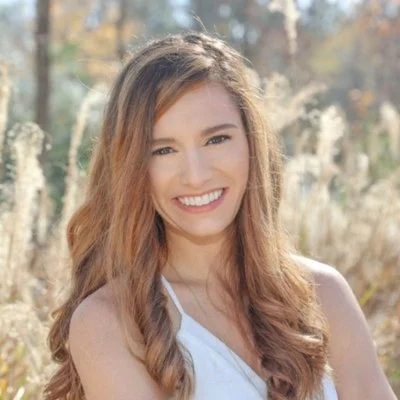
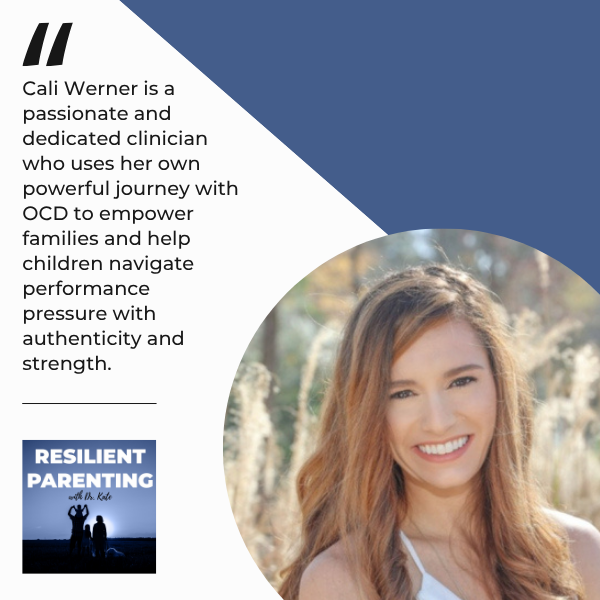
Cali Werner, Ph.D., LCSW, CMPC is the Director of Business Development and a behavior therapist at the OCD Institute of Texas. As an undergraduate from Rice University, Cali competed as a Division I collegiate distance runner winning nine conference titles, and an Honorable Mention All-American in the 10k while battling OCD.
Her most recent athletic success was competing in the 2020 U.S. Olympic Trials in the marathon and placing as first female Houstonian in the 2023 Houston Marathon. Cali’s personal experience with OCD led her to specializing her career to help others obtain evidence-based care.
Cali is passionate about anxiety, OCD, and mental health in athletes, which led her to starting Athlete Rising, LLC, where she sees athletes with OCD and related anxiety disorders, in addition to working to help improve performance mindsets.
Cali has written a Children’s book titled Anxious Annie, for the purpose of helping children learn to vocalize anxious feelings. She is dedicated to informing the public through advocacy and education on mental illness and evidence-based treatment.