Grit, Goals And Motherhood With Cherilyn Suiter
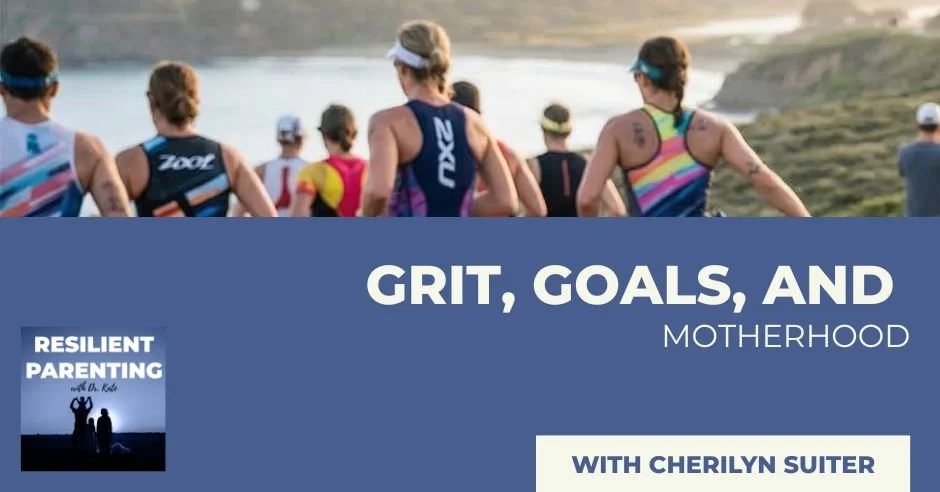
In this inspiring episode of Resilient Parenting, Dr. Kate Lund sits down with mom and triathlete Cherilyn Suiter to talk about reclaiming passion, prioritizing self-care, and building resilience as a lifestyle. After nearly 20 years away from the sport, Cherilyn returned to triathlon at 52 to improve her health and model strength for her family. Together, they discuss the balance between motherhood and personal goals, the battle between discipline and motivation, and why “put your mask on first” is a powerful advice for every parent. If you’ve been holding back from pursuing something for yourself, this conversation is your reminder: taking care of you helps everyone.
---
Listen to the podcast here
Grit, Goals And Motherhood With Cherilyn Suiter
I am so excited because we have Cherilyn Suiter here with us. She is a mom. She is a triathlete, and she has a lot to say about this idea of resilient parenting and how we, as parents, can really optimize our own sense of well-being, such that it can help us move forward with our passions and impact our family in positive ways as well. Welcome, Cherilyn. Thanks so much for joining us.
Thank you. I really appreciate you having me on your show. This is great.
How Cherilyn Got Into Triathlons
I am so excited. I have followed you on Instagram and watched your triathlon journey back into triathlon really evolve. I have been impressed with the fact that you have been a mom for 24 years and really have worked triathlon back into your life within the context of your parenting and the other aspects of your life. It is such a powerful and impactful way. I am just wondering if you could talk a little bit about that process.
I took the better part of twenty years off from triathlon. I used to compete. I used to be fairly fast. Along came the family and the kids, and you say that nothing is going to change, but it does. I spent twenty-something years just not doing a whole lot of exercise and gained a bunch of weight. Four years ago, I decided that I wanted to be healthy, mostly for my kids. I started doing triathlon a little bit at a time, working out again.
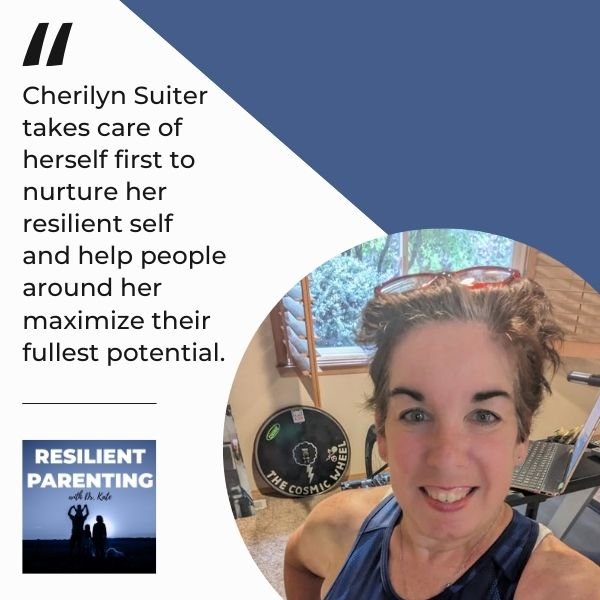
I realized this is really important, and it is really about self-care. If I want to show up for my kids, I have to show up for myself first. That is how it started. I actually started just wanting to get healthy. Triathlon was not even part of the plan. That came second. It was not too long before it came second, but it came second. I just wanted to be healthy and present, and I did not want to die. I was not doing very well. I was really sick. 52 was too young to start having health issues, so I decided I did not want that in my life. I want to be a good example for my kids.
Got it. Demonstrating the power of exercise and the power of movement in terms of boosting our health. It sounds like the foundation in triathlon was there. It was a natural progression over time to get back into the sport. Is that how it went?
Your body and your muscles do not have memory after that long, like everybody says, “Muscle memory.” Not so much. I am five years in now, and I am still learning how to run. Last year was the first year that I actually started back with triathlon. Before that, I was doing Aquabike, which is a swim and bike without the run. It has taken me a few years to get the run back. When your body is sedentary like that, and it is overweight, it takes a lot to get it moving off the couch. It was not the easiest process, but we got our movement, and now five years later, we are consistent. That is good.
That is such an important and powerful point. Oftentimes, in even my own life, I want to start something new, and I want to try something new. I want to go from point A to point Z all at once. That is not really possible. You are demonstrating here how it is step by step. I imagine appreciating the small wins and small successes along the way.
In the beginning, everything was a success. Everything was like sunshine and rainbows and unicorns. In the beginning, it was like, “Another PR and this and that.” That was good. You get to a point, at least I got to the point maybe two years in, that it started to not be the way it was in the beginning. It was a little weird. It was all exciting and new. Now it is harder. Now I have to really do some work to get better.
It is cool. It makes sense. That is an evolving process that needs to really come into focus. Sometimes it is not clear how that is going to happen. You just have to keep going. It is just a very inspiring story. I am curious. How do your kids look at this? How does your family view this? This must be inspiring to them as well. Although your focus on the triathlon might take a little bit of focus away from them at times. How has that piece worked for you guys?
Now that I have been doing it for five years, it has definitely evolved into different things. At first, it was very exciting. They were very inspired and excited to see me, and they have stayed that way. They are very happy for me. They are very proud of me, and they tell me all the time. It is really cool. It also gets to the point where I hear comments like, "You're biking all the time. You're running all the time," which really is not true.
I hear that, and I have to think about what I can do differently. I can still get my workouts done and still be with the family. There have been things that we have done, like a family night. No working out on family night. I will get my workouts done when they're asleep or when everybody is out of the house. It does not appear that I am working out every day.
Even though they are so proud of me and they want me to work out, at the same time, it definitely sometimes takes away. Sometimes, for me, it is really hard because the family will be up here, and my workout room is downstairs. You can hear them laughing and having fun, and I am sitting there on the bike, going, "This sucks, I cannot be up there with the family." Sometimes that gets a little bit hard when they're having fun without me.
Building Resilience Despite The Many Challenges
There is a sacrifice in it all. It is striking the balance there. Things like this are always an evolving process. What do you feel like for yourself has been the most important mindset piece allowing you to get here? I imagine that it is taking time to build the resilience to keep moving forward because challenges will come up. How have you navigated those?
In the beginning, it was harder. It was harder to get up off the couch. It was harder to do things. My kids were encouraging me. "Come on, Mom. You said you were going to work out. Go down and work out." It just evolved into more of a lifestyle instead of a chore. I had that for quite a while. Now it is more of a lifestyle. I still sit on the couch, and I still to this day have trouble sometimes getting off of it. It is hard to get up off the couch, but when you make it a lifestyle, then it feels weird not do it.
It is hard to get off the couch and work out. But when you make it a lifestyle, it feels weird not to do it.
Building up all that stuff with my kids and having them be okay with everything definitely was a process. It is a checks and balances thing. Even today, you have to decide, “Is the family getting mad about this? I have got this three-hour ride, how can I do that so that it fits into everything?” It just becomes a lifestyle.
The household does not revolve around my training, but everybody has taken their place with it. My husband will come out with me on the trail on his bike. If I am running, Jenny sometimes comes down to the pool with me. They know which nights I have what because it is a pattern. I am at the pool a couple of times a week. It is not your pool night, and they're okay with that.
When it is not pool night, I need to be up with the family hanging out. It is something that we have all learned to adapt to over the last five years to get into that groove of what we are doing. I threw this on my family. I was with them all the time, and then I wasn't. That is an adjustment. It was probably harder for them than I gave them credit for.
It’s very powerful stuff. I love what you said about the lifestyle piece because that is really how I define resilience. Oftentimes, it is looked at as a challenge will pop up, we have to be resilient and move through it, then we put resilience to the side. That is not it at all. To be resilient is to develop a lifestyle with strategies and techniques built into your life that make you stronger and more able to navigate the challenges as they come up.
I love that this has become a lifestyle for you. I imagine in so many ways it has made you stronger in handling other things that come up in your life in other areas. I also love the piece about adaptation and flexibility. You make a very real point about the delicate balance between what you're doing to foster your dreams and the needs of your family.
That is oftentimes a delicate balance, particularly for us as moms. Particularly if there has been a time when we've been there for everything all the time. You're still totally in it, but you've also carved out this other piece to foster and fuel your own passion. That is such an important point that you make.
I do feel like that, too. My daughter has some mobility issues, where we are at least twice a week heading to some doctor's office somewhere, and she cannot drive longer distances. I am driving her around. Trying to fit in working out with driving her to the doctor, "I got a half hour. I think I'll go for a quick one." You fit it in where you can. It does get really busy and really crazy. I do still find myself wanting to be there for everything like I was when they were smaller. It is definitely a balancing act.
Definitely a delicate balance. What I am hearing there is that you really have a lens also on helping your daughter and your kids to flourish within their own context. Your one daughter has some mobility challenges. It sounds like you're really working hard to help her maximize her own potential within the context of the challenges that she has.
Self-Care Practices Outside Triathlon Prep
That is such an important and powerful role. As part of that delicate balance. I am really curious how you're caring for yourself. What are your self-care pieces, and how do those look or fit in? I imagine the triathlon piece is a piece of it, but what else is there? Managing your stress response and all of these things is also important in this whole mix.
What do I do outside of triathlon self-care?
Yes.
I mostly swim, bike, run, lift, and stretch, but I do have some self-care pieces that I think are really important. The first one is therapy. It is really important. I also have a dietitian, who, fortunately for me, is 100% covered by my employer. I have been seeing the same dietitian for five years since I started.
That is a big part of self-care is eating the right foods and making sure I am fueled up for what I do. Outside of that, self-care looks like hanging out with the family and spending time just taking time for myself. I consider triathlon self-care because when I started it, the idea was that I was trying to get healthy and take care of myself. I did not even know what self-care was before. At least I did not think I knew very well what it was.
Self-care to me is when it is in question whether I should do a workout or not, that word self-care comes up a lot for me. That is something that I try to remember. That is one of my strong whys, is self care. I need to go out for that run because it will make me feel better and it will do all the things. Self-care is definitely important in all areas aside from triathlon. Of course, triathlon trumps most things.
The Consequences Of Skipping A Workout
I love that. I was thinking as you were talking, what about those moments when maybe you're tired or overwhelmed to the point where maybe you need to skip a workout? Does that happen? How do you make that call? When you are involved in competitive sport, it is very hard to make, but sometimes it is important. I was just wondering what that balance looks like for you.
That looks like a battle between literally the workout and the couch. The couch is probably my second favorite thing to do. The family loves to watch TV. We all sit around and watch different things on YouTube. It will start out like, "I don't really feel like doing this today, but I kind of have to." Most of the time, the workout wins out. I get off the couch, and I do it. It is not because I want to do it or because of motivation, but it is because of discipline.
Get up and work out, not because of motivation but discipline.
You just have to get this done because if you do not, you either have to make it up or you're going to skip it, which is not good. If I am only swimming twice a week and I skip one swim workout, that is 50% of my week for swimming. I have to think of it that way. There are other nights where it does not win out, and I am bravely okay with it.
"Yes, I am going to take this night off, this is a family night." I am declaring this is important, and I am perfectly fine with it. There are other nights when I skip it, and I am just battling in my head for hours. "I should have done that. I cannot believe I did not do that. I could still do it. I have time." You do not want to do it. You want to sit here. The back and forth is just hilarious. It is nice when everything works out, and I do not have to battle with myself.
Basically, it definitely happens. If you skip it, you skip it; then you cannot go back. I do sometimes have to make up some crazy stuff, like getting up at 4:00 in the morning and getting it in before I start work at 6:00 because I did not do it the day before. There are consequences to my skipping. You sort of weigh all of that, and sometimes you're just too tired to do it. It is okay. I do a lot of battling in my head.
The importance is that I get the power of the internal dialogue. I love that. You have your coach to be accountable to as well. Tell me about that because it’s got to be a piece of the dialogue, perhaps.
That is definitely a piece. I struggle with like, "Maybe I just should not tell her I didn't do it." No, if I do that, that will be bad. She is so cool. She gets the whole family thing. She is amazing. If I have to skip, I have had to skip quite a few. I have never heard her say anything like, "You should not have done that," or "Why did you do that?" Nothing negative.
It is all, "You must have needed that sleep," or "You must have needed to spend time with the family." We reframe the week and go from there. She is pretty good about it. Almost to the point where I make it okay to skip because she is not going to make a big deal out of it. I rely heavily on her opinions. If she is not bothered by it, why am I bothered by it? I struggle with those things too.
I love what you are saying there because it is the flexibility piece. If there is a moment where it just is not going to happen or cannot happen for whatever reason, we will shift gears. We will fit it in somewhere. That is a really important point for all of us in terms of whatever we're doing. If we become too rigid, we can hold ourselves back.
Eating Healthy With Your Family
That flexibility piece is super important. I want to jump back to the nutrition piece for a second. I am really intrigued by it because I know you have to fuel in a certain way to make all this happen. Where does the family fit in there? Have they adapted their eating habits a little bit as you've been making things to fuel your training? What does that piece look like?
My daughter was actually the first person to get a dietitian, and it was right around the time that I wanted to start doing what I was doing. Literally in the same week, she reached out to this dietitian, and I thought, "I am going to reach out to them too." We started at the same time in the same company team with different dietitians. They were telling us similar things. Jenny and I started eating the same way at first.
There are just the three of us. My son is not living at home, but my husband puts up with it. He does not eat everything that we eat, and sometimes we have different things. I think the diet in general has worked really well for my daughter and me because she was getting help with the dietitian at the same time I was. They're pretty good about it.
Now Jenny will ask, "Are we going to have a vegetable with that?" Before this all happened, we did not even know what vegetables were. We just did not eat the right way. Now everything is balanced. Everything has this and that. We call each other out on things sometimes. My husband is evolving, too. He has actually lost a bunch of weight in the last year, and he has been inspired. He has been getting out there and doing a lot of walking.
When I do serve meals that are balanced and healthy, he is actually eating them, whereas he was not eating any of that stuff before. We are all sort of on the same page now. Not every night, but mostly. It is nice to be able to cook something and have everybody eat it. Instead of "I don't want that," there are three of us. If one wants this and one wants that, I have to cook three different things. I do not have time for that. I am tired. My daughter is old enough to do her own stuff now, but she can jump in there.
Upcoming Races For Cherilyn
It is entirely too complex for you to cook three things. I love that evolution. Historically, if I have tried to tell my husband, "You should do this to feel better," it is never going to happen. It is that example, making the food and putting it on the table. It sounds like your husband has evolved in that kind of way as well. He is becoming better naturally as a result. That is an awesome byproduct of this whole experience. I love that. As we are thinking about needing to wrap it up here in a minute, what is next in terms of races? Do you have anything coming up that you're training for at the moment?
I am always training. My big thing is another half Ironman in June. What is trumping that a little bit is I want to qualify, hopefully for the second time, for Worlds Aquabike Championships. The qualification race that I am going to do is in Penn Yan, New York, and that is in August. We're working on that. It is a long one. It is a 2.4-mile swim and 112 mile bike. I am hoping to qualify for Worlds.
It is a lot easier to take care of your children if you are taking care of yourself first.
That is awesome. That is so amazing and inspiring. A 2.4 mile Open Water Swim?
Yeah. It is going to be in a lake. Open water, but not in the ocean.
Why You Should Take Care Of Yourself First
A lake is intense, too. That is amazing. I have every thought that you're going to make it and qualify. It is going to be awesome. As we're wrapping it up here, what is your advice to the parents out there who are listening? Those who have a pull to rekindle some sort of a passion from the past and are holding back because they feel like they need to be doing other things, or it is not the right time, or all of those things that can hold us back, what would your advice be for those people in terms of moving forward?
It is the analogy of putting on your mask first before helping your kid with theirs. Take care of yourself first so you can be present for your kids, and you can be a good example for your kids. That is the lesson that I learned is it is a lot easier to take care of the kids and what they need if you're taking care of yourself first.
100%. That is such important and powerful advice. Cherilyn Suiter, seriously, thank you for coming on here and joining me on the show. Thank you for sharing all of this really powerful and important insight and information. Your story, we truly appreciate it. I know this is going to really reach a lot of my listeners. Thank you.
Thank you so much. I appreciate you having me on.
Important Links
About Cherilyn Suiter
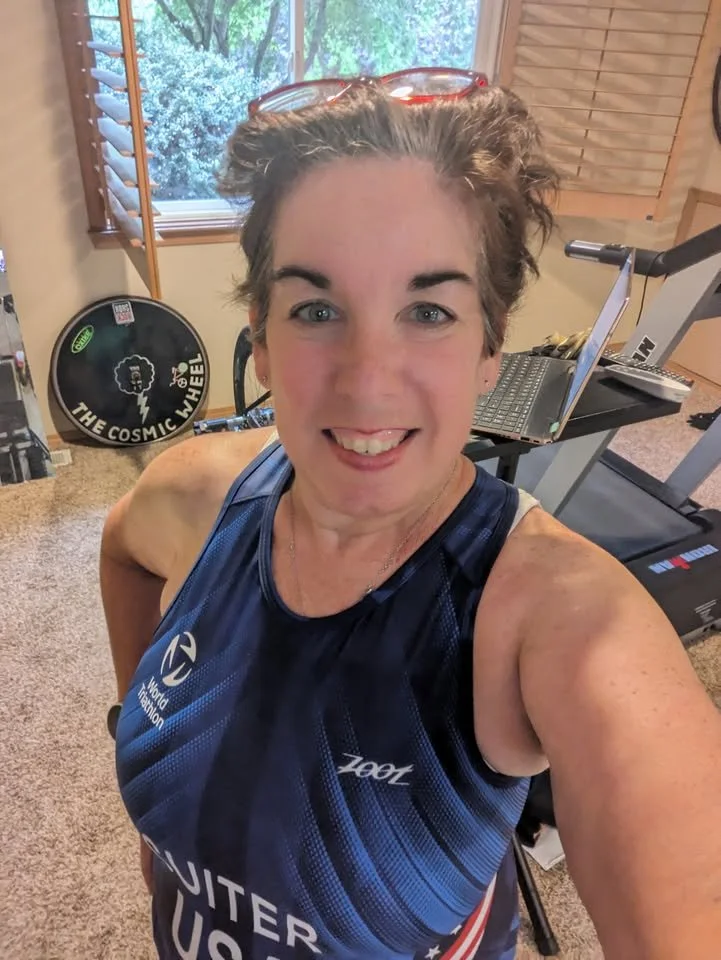
Cherilyn Suiter is a triathlete, coach, and mother of two who rediscovered her love for endurance sport after years away from racing. Her journey back to triathlon is rooted in resilience, patience, and rediscovering identity through sport.
Now a USA Triathlon Level 1 Certified Coach, Cherilyn helps athletes – especially beginners – build confidence, consistency, and strength at every stage of life. She documents her journey back to sport and shares encouragement with other athletes on Instagram @dcsuiter and on her Facebook blog, My Triathlon Journey 2.0.