Unlocking Resilience With Andy Vasily

True adaptability begins when we shift away from sterile parenting standards and focus on conscious emotional regulation. Dr. Kate Lund welcomes international educational consultant and performance coach Andy Vasily to share powerful frameworks for Building Family Resilience during times of transition. They analyze how our internal narrative dictates our coping mechanisms and why cultivating a practice of micro-gratitude stabilizes the home environment. Through deeply personal reflections on childhood medical struggles and life-altering accidents, they demonstrate how to model perseverance for our children. You'll walk away with concrete ways to foster agency, helping your kids discover their intrinsic strengths rather than focusing on deficits.
---
Listen to the podcast here
Unlocking Resilience With Andy Vasily
The Journey Of An International Educator
We're very fortunate to have Andy Vasily with us, and I'm going to welcome you to the show, Andy, and then ask you to introduce yourself a bit to our readers.
First of all, we had a great conversation before you hit record, and I always call that the conversation before the conversation, where we get to know one another and we share stories and our work. I really appreciate being on the show and the invitation. I'm from Canada, Windsor, Ontario, border city with Detroit, Michigan, but currently living in Antwerp, Belgium, which I think is 5 hours, 6 hours ahead of you, Kate. I’ve been in international education since the late '90s. I met my wife in university in Windsor, she was studying nursing, and I knew I was a Windsor boy through and through.
I never wanted to leave Windsor. I had played football for years through university and wanted to become a police officer or a teacher in my home city in Canada. My girlfriend at the time, who I fell in love with and married, was a nurse, and then she said, "I'm going to go to Texas because they need nurses.” I was like, "Well, I guess that's the end of this relationship.” Ultimately, she had an opportunity to go to Hiroshima, Japan with her sister and said, "I'm going for six months.” I said, "Okay, well, then I will take a leave of absence from my job as a child youth worker at a young offenders facility, and I will follow you."
We never went back to Canada. That was 1997. Since that time, we've lived in six different countries, so Japan, Azerbaijan, Cambodia, China, Saudi Arabia. Our boys were born in Hiroshima, Japan. We've been blessed with these amazing opportunities to travel the world and work and raise our boys in an international education. Your show really comes alive for me because regardless of context or country or culture, we love our kids.
We talked about your twin boys going to college. My boys are through high school and now finding their path through college and a career. We always want to do what's best, and I'm just so grateful that our boys have grown up considered to be third-culture kids. They have never lived in Canada. Our one boy is there now in college. It's that idea of Canada is our home, but they grew up internationally experiencing the world, and they have friends from all over the world. Parenting is parenting wherever you go in the world. You want to do your best.
Shifting Focus From Deficits To Strengths
To circle back to your question, a little bit about myself. International educator turned instructional coach, so I was coaching teachers around the world in different schools, and that turned into my fascination with performance psychology and then trying to understand the conditions upon which people thrive.
That led to me getting coaching certifications and then coaching leaders and coaching phd students, helping them navigate that difficult space of uncertainty and trying to optimize their performance. Your old podcast, The Optimized Mind, trying to create those conditions for them to find the best within themselves. In a nutshell, that's my journey. My wife is a trauma-informed counselor, suicide attention counselor, and she works under Dr. Gabor Maté. Do you know Dr. Gabor Maté?
I don't, actually. No.
He's a Canadian physician turned trauma expert, and he does a lot of work around trauma-informed counseling. It's called compassionate inquiry. That's her passion, and then our passions merged together. We work with schools. She works with schools developing well-being, and then I work with schools developing every student's capacity to find the best in themselves, which requires teachers approaching curriculum and the delivery of curriculum in very specific ways. That's a nutshell glimpse into who I am.
I have my own podcast like you, I’ve had it for many years. I interview a lot of amazing people around this idea of how do you excel? What are your guiding principles? What has allowed you to achieve the success you have, but also to make the impact you're making and really pull that apart and pull on the threads and really unpack that? That's, in a nutshell, the work that I do.
So much there and so much incredible perspective and experience and, as you say, opportunity in it all that you've lived for all these years along with your family. I imagine that raising your children across so many different cultures and internationally definitely took a specific angle on this idea of resilience and how to maximize within different contexts.As you also said, we love our kids, and the bottom line is regardless of where we are, there's really no one-size-fits-all in parenting, in resilient parenting. It really comes down to understanding ourselves, understanding our kids, and what we all need to be at our best within our own unique context.
Connecting Through Shared Childhood Challenges
Absolutely, as a parent, for sure, but in the work we do, and that's the same, and I think as it always comes back to doing our own work and understanding ourselves. I know you have based a lot of your work around your early childhood and some of the struggles you went through with health. When I knew I was coming on the show and I started to look more deeply into your work, suddenly something was triggered within me.
I grew up asthmatic. I spent so many weeks in oxygen tents, so this would have been the '70s, which for your readers, maybe some can connect with, some have no sense of reality with what living in the '70s was like. I remember being asthmatic and being woken up in the middle of the night and then my dad carrying me out to the car because I was having an asthma attack and rushing me, I lived in rural Canada, to the hospital and then ending up in an oxygen tent for seven days and having my homework brought to me, the Phonics books, and doing all the homework in an oxygen bed.
That's what I was triggered, not triggered in a bad way, it just triggered memories that haven't been present for a long time. What that was like, and what that means to me now is like so many kids struggle, and I believe my job, my calling, my service now is to empower educators to understand that every child is unique in their own way. We have to meet them at their entry points, and we have to create psychological safety to allow them to thrive.
Whether they're artists or they're scientists or mathematicians or musicians, really honor that and bring that out through the delivery of the curriculum. I'm just tagging back to your comment, but also recognizing your own past and what you went through that drove you to do the work that you do. That's to this day what drives me every single day to do the work that I do.
That is so powerful. Absolutely. Yes, and the whole idea of they're going to be challenges, they're going to be struggles. Certainly, there were for me early on with the hydrocephalus and the hospitalizations, the surgery, all of that. Sounds like for you with the asthma and the oxygen tents and rushing to the hospital in the middle of the night.
It's a fact of getting through those challenges as best we can and then focusing on the possibilities on the other side of them. For me, definitely focusing on what I could do as opposed to what I couldn't do, which really did help me hone in on my strengths and using those to navigate through and beyond the challenges, which of course there were many.
Parenting is parenting wherever you go in the world. We all want to do what's best for our kids.
I think that's a really important piece for all of our kids, particularly out there in the schools, because in my work, I find that we can often get mired in the struggles, the challenges, what kids aren't able to do, the learning challenges that they have and all that, and not get past there's the challenge, and of course we have to deal with it, but where are the strengths? What is this child capable of? What are the possibilities out there for them? Making sure that parents don't lose sight of those, and teachers don't lose sight of those and don't put the child in the box as a result.
The Role Of The Private Voice In Shaping Reality
We talked about Dr. Martin Seligman, and I'm holding up his book right now, Flourish, because I know you have really embodied his work. His work really profoundly shaped me because he, as a clinical psychologist, was so used, for the first part of his career, decades looking at what was wrong with people. He got so fed up with it and decided to look at what's right with people and introduced the concept of strengths and gratitude.
Also, the power of recognizing our strengths. Not looking at our deficits, but looking at our strengths. Our job as parents is to really recognize that and go through this journey of trying to truly understand and dissect what our young people's strengths are, but also teach them the power of gratitude. Martin talks about this idea of journaling gratitude. When he worked with clinically depressed patients, teaching them the skill of gratitude.
Gratitude is fluffy. Gratitude doesn't mean you have $1 million in the bank. Gratitude doesn't mean you're going on vacation. Gratitude is the nitty-gritty work every day at recognizing what's working. What comes up for me is one of my mentors I call him a mentor because I’ve been mentored by his work for so many years he's come on the podcast, Dr. Jim Loehr. He's written many bestsellers. Do you know Jim?
I love him. I have this really quick I don't mean to interrupt you but a really quick story about Jim. Growing up, a lot of challenges, whatever, but I figured out pretty early, and this was fostered by my parents and some parents of friends, that I was a tennis player. I loved tennis. That became the core of my identity. We had this one mom of one of my teammates, my playing partners growing up, who gave us his very first book, Jim's very first book as young tennis players.
The power broker in your life is the voice no one hears. The stories we tell ourselves create our reality.
That was the cornerstone. When Jim wrote his book and I don't think it was his latest book anymore, it was a couple years ago on choices and decisions, Wise Decisions was what it was I got in touch with him and invited him on The Optimized Mind, I was so excited that he accepted. We had a lovely conversation, and I was able to tell him about the tennis situation back in the day. Sorry to interrupt.
No, I love how you tagged that on, and that's amazing that we have that connection because Jim came on my podcast and I have his book, Leading with Character, right behind me, and I went through his journal. I went through his journal three times, and I gifted that book to people I coach and people I care about. I would go on Amazon, I would send them copies of it or I would order copies and then hand-scribe why this book means so much to me. "Please read it, it's going to make a difference in your life."
Now, I have a good friend that I worked with many years ago, his name's Donovan Hall. We would go for runs when we lived in Saudi Arabia. He's from New Zealand, he played rugby, pretty hardcore rugby player growing up in a hardcore athletic culture, man up kind of culture. Donovan has this very reflective side to him, and we'd go on these runs, and we would start talking about deep stuff, and we'd go on 15-kilometer runs or 10-kilometer runs, whatever it was, and we would talk the whole time.
Our gauge was we need to continue being able to talk, so that's how we could gauge our pace. I was like, "You have to read his work. I'm going to give this to you for your birthday.” He was interviewed, he's now in Korea and he's an IT expert and leading a school, the IT school in Korea, an international school. He was featured in an article, and he just put on LinkedIn, "One of my most profound influences has been Dr. Jim Loehr."
He thanked me on LinkedIn for giving him the book, and I want to share a quote because in Saudi Arabia, we had a big home and we had a chalkboard wall and I would put up quotes weekly or bi-monthly, quotes that mattered. It was big, like I love the art of putting these quotes on the chalkboard wall so when my kids and wife would walk down the stairs, the chalkboard wall was right there. The quote that I kept up for a long time is from Jim, and what he says is, "The power broker in your life is the voice no one hears. How well you revisit the tone and content of your private voice is what determines the quality of your life."
"It's the master storyteller, and the stories we tell ourselves create our reality.” That circles back to the work you've devoted yourself to with resilience, and we need to continue to tell ourselves different stories and recalibrate and then tap into our God-given talents. Oprah talks about this all the time. We've been tapped on the shoulder by a greater force to recognize the talent within, the talent that we're meant to serve the world with, the talent we've been blessed with, the talent that God gave us. I'm not religious, but I'm very spiritual and I believe every single human is tapped with this talent. It's recognizing that as a parent, and that's the biggest job as a teacher, as a coach, that you have a tremendous responsibility to bring out that talent.
I get emotional talking about it because it matters so much. When you think of the way you grew up and I grew up, I lost a brother to suicide, I lost a brother to drug addiction, and then I found sport, and sport allowed me to thrive. Sport was my escape from the house. In my TED Talk, I know you gave a brilliant TED Talk and you know what that's like to stand on the red circle and you have eighteen minutes and it's such a gift and the greatest challenge to stand on that little circle and to share your heart and to share your soul and to share what matters to you.
In my TED Talk, I almost backed out of it a week before because I was so scared to be vulnerable and share my real story. I thought, "No, I'm not going to do that," because I had to go you know what it's like, you got to go through the stages and get feedback. I was like, "F that, I'm not doing that, I can't go there, it's going to be too hard, I'm exposing, I'm breaking my heart open and I'm exposing myself."
We must meet kids at their unique entry points and build psychological safety to help them thrive.
I just decided to go with it and I shared my story and I shared my brother's story and I shared the impact physical activity and sport has made in my life and the mentoring that I received. It goes back to the stories we tell ourselves. Finding the strengths within and our own responsibility to create that ripple effect onward.
As you were speaking and as you were talking, so much of what you just said resonates. Standing on the red circle, absolutely. I was probably more vulnerable on that red circle than I had been prior to that point, and that probably enabled me to start talking more openly about those earlier experiences.
There was certainly a time early on when I was a kid, all I wanted to be was the typical kid in the classroom. I didn't want to be going off to surgery all the time, coming back with half a head of hair and these giant glasses. That wasn't my first choice, but that was my reality, and so moving through that was something that had to happen. Something else that you mentioned was the fact that sport and exercise, movement, really defined a large part of your life.
Sports And Movement As Catalysts For Healing
Me too, for sure, with tennis. That was a big deal, and that really helped me to focus on what I could do. It helped me focus on this idea of what it means to be out there playing because you love to play. I rarely won the tournaments. I was a runner-up a lot, but rarely won the tournaments. I had a playing partner, one of my best friends growing up, and she was really good and often won.
And it was okay, though. I was thrilled to be out there. I didn't really focus in on the second-place trophy or no trophy. I was out there because I truly loved it. I think that filtered into the rest of my sports endeavors. I might not be that gifted naturally as an athlete, but I work at it. One of my examples that I give also is the summer after I graduated from college, I rode my bike from Seattle to Denver with a group called Cyclists Ending Hunger.
That was a trip that meant a lot to me because five years before that, I had a major medical incident and it wasn't clear that I was going to come through that. I went off to college a year later and I rode my bike constantly while I was in college, I was in Ohio, and I just got really into cycling and had this opportunity the summer after I graduated.
It was awesome. I’ll tell you, it was hard. It was really hard, and there were moments when I easily could have gotten into the sag wagon, the bus, and called it a day. I was stubborn, I wanted to ride every single mile. I finished last every single day. I thought I was a really strong rider, but found out otherwise when I got there.
It was just a really good reminder for me, as long as we're doing our best within our own unique context, all is good. Helping kids to internalize that idea isn't always easy. I see that a lot in my work and really try to help kids and families and parents to hone their inner messages just like Jim is talking about. I talked for a long time there. I usually don't do that but I love the synergy.
I think that's really important because you're providing context to what resilience means, like your bike journey from where to Denver?
Seattle to Denver. Yeah, so it was through the Rocky Mountains, it was crazy.
Finding Light In The Darkest Moments
Exactly. When I finished university and I was a child youth worker, our house that we were working in, we literally got kids from abused families to live in the house then we provided schooling for them, counseling, all of that. The government cut the funding and shut the place down, and they had no place to go. There was a window of six months. I'm done playing football now, I had a pretty good career playing football as a quarterback and a punter.
I finished and I felt this sense like, "What can I do?” I remember one day it just came to me, "I'm going to get some of my teammates together, and we're going to walk from my hometown to Toronto passing and punting a football.” It was called the Pass Punt Marathon Windsor to skydome in Toronto. It took fourteen days and we had police escorts and we were throwing the football and punting it and we were raising money for kids.
In that first year, we raised $67,000 and we kept the home going for a few more months and then it shut down, but that's not the point. The point is that I felt even back then a calling to do something. You pick that apart a little bit, as a 58-year-old, I'm picking that apart like, "Where did that drive come from? Why did that matter?" it mattered because I knew what it was like to grow up disadvantaged and then wanting to make that difference.
That led to me doing what I feel is good work, but in 2011, I was almost killed in an accident in Cambodia and I had my ulnar artery severed and I almost bled out. My life was saved by a retired Scottish doctor that moved to Cambodia that opened up a charity to do volunteer surgeries on landmine victims and kids born with birth defects.
I was in really dire straits. My wife, who had the nursing background, was trying to figure out what the next moves were for me to have surgery and we needed an orthopedic surgeon because the ulnar artery had been severed and there were no orthopedic surgeons in the city that could be found. To this day, I look at that moment as a pivotal moment because as I was laying there not knowing what was going to happen, almost unconscious, suddenly this doctor was found 5 hours, 4 hours after my accident. I was rushed to him and then that led to me being medevacked to Singapore to have total reconstruction of my hand.
Reflecting on my life and we go back to Martin's work at that time I looked at my life as being telling myself unhelpful stories. "Of course this is happening to me," in the family I grew up and all the bad stuff that had happened in my life, losing my brother, losing my other brother, and, "Of course this is happening.”
Those are unhelpful stories. Going back to Jim Loehr's quote, "What gifts are we given?" I was given the gift of that doctor. I prayed. I'm not religious but I prayed my ass off when I was laying there, and I was praying for somebody to help me. This doctor was found. It goes back to looking at the blessings in our life, and after that happened, that reshaped my narrative and forced me to not look at and dwell on the darkness.
People thrive when they have agency. Our job is to create conditions that let them tap into their own essence.
Marianne Williamson, I think her name is, she's an author, I don't know if I have her name correctly but she always talks about this idea of, "Through the darkness, the light shines." that idea of really looking at in our darkest moments, the light is there, and the light is human connection and the nature of humanity is to do good.
We look at the Middle East and everything that's happening right now, I have so many friends in the Middle East, both Muslims and Christians. Instead of looking at the darkness, look at the light and what we're blessed with and then what is our responsibility to carry that forward? You can dwell on all of that, but that is our responsibility with young people, especially in such a chaotic world is to help them recognize their strengths. Resilience is a tool resilience is built on many tools that we can deliberately practice, as you know, and put into play to help us build a resilient spirit and mindset.
Cultivating Agency And Micro-Actions Of Kindness
I could not agree more. There's so much synergy also in what you were just talking about, and one of the things that pops into my mind as primary is this idea of the calling to give back, to do good. One of the things I think that I'm called to do right now, largely as a result of my early experiences as a kid in the hospital and trying to bounce back from looking different and feeling different and some hard stuff, is going out to the Children's Hospital here in Seattle with my dog Wally.
It's such a simple thing, really, because dogs are present, they're in the moment. They're happy by nature. Wally is a goofy big boy who is a typical dog here at home, will not hesitate to steal a steak off the counter, although I have him conditioned not to do that at the moment. Anyway, when he walks into the hospital, something clicks in his mind and he knows why he's there.
It just gives me such joy to see him bring smiles to the faces of the kids that we visit and to give those kids a sense of what could be possible for them, in the moment, really. Oftentimes, we're part of physical therapy sessions and we'll stand at the end of a hallway when a child is really struggling to walk or engage in the PT session and they'll see Wally.
The therapist will ask us to sit down and wait, and that then becomes the goal for the child, to make it down the hall so that they can pet Wally. The power in that is it just makes me smile every time I think about it because the key here is helping kids to see the possibility on the other side of the challenge and rewrite the script, the longer-term script of what's possible.So much synergy, I think, in what you were just talking about and just really keeping our mind focused on those stories that we're telling ourselves and try to shift those when they become something that could hold us back or hold the kids we're working with back, and fostering that is so key.
Yeah, and that's through the lens of curiosity, so keeping the lenses of curiosity open. "What might be another way to look at this?” I think the really important thing is to create those lenses of curiosity in all the work that we do to try to instill that upon young people, but ourselves as well when we're going through a hard time. What might be another way of looking at this?
We can catastrophize our situation, we can look at it as though okay, we're going through something difficult and then, as Martin Seligman says, "Scan for evidence of good. Scan for evidence that we've gotten through hard stuff. What has allowed us to get through it?" Now pull the threads of that out and apply it to what we're going through now. It's not easy because each context is different, but we know the resilient nature of the human spirit, we're built to move forward, we're built to thrive. It doesn't seem possible at times when we're going through difficult things, and those are the lessons that we absolutely have to pass down.
It's so important but not always easy, particularly when human nature often leads us to all of the would-have-could-have-should-haves, the things that didn't go well on a given day, all the things that are bringing us down. I always recommend to folks and to do this with their kids, to at the end of each day jot down three to five things that perhaps went well during the day.
That really will help to neutralize that lens and maybe even bump it to a little bit more of the positive, open us up at least to see the things that are going well a little bit more readily, a little bit more naturally. I think that's a really important piece because otherwise, it's too easy to get bogged down, particularly also with all of the inputs that we're getting externally from everything that's going on in the world and everything that just is happening. Social media is another driver of that, I believe, that could be mitigated in many ways, which I think is important too.
One last thing I would just want to reference is that idea of the micro-gratitude. You're talking about what went well, those are the three W's from Martin. We often overlook the micro-actions of people around us, they gift us with these micro-actions. Martin talks about this, and it might be holding the door open for us.
In parentheses, when you're journaling at the end of the day and everything's going to crap and you're trying to find good things to be grateful for, and then you go to the mall and then you're walking out and somebody deliberately they could have walked out and closed the door, but they wait three seconds for you to hold the door open. That's an act on their part of kindness.
So to recognize that and write down, "If my only thing to be grateful for is that somebody held the door open for me at the mall,” in parentheses write what that action represents. Kindness. If somebody is very struggling, let's just say maybe they're semi-depressed or mildly depressed or whatever it is, and they take action to get out of bed and go for a walk, then write that down and in parentheses put self-initiative to recognize the micro-moments in our life to be grateful for.
People think gratitude is about these big moments and we have to pull it down to the micro-moments in our lives that appear every single day. Anybody reading this can walk out their door or has walked out their door already and experienced one act of kindness from another human. Maybe it's a nod, "I see you, I recognize you. I see you, hello," whatever it is. Maybe it's a store clerk being extra kind. Recognize that, that's humanity extending kindness back to us, and we forget the importance of that. That's Martin Seligman's practice, is to recognize all of those moments that we're blessed with every single day.
That is such a good point. It really speaks to the idea of recognizing in all ways the small steps, the small actions towards our goals or, as you say, the micro-actions of kindness and of how those are benefiting us because oftentimes, we want to see things from A to Z, and then that's not realistic, doesn't happen, we stop moving forward.To recognize those small wins across domains is so vital and helping our kids to do the same. I think that's a really important piece.
Absolutely. That's what I'm working on every day. That's what I return back to and I'm grateful to be on this show and to have this connection with you, and I hope that we stay connected after this. I’ll return the favor and have you on my podcast and we can dive deeper into your story. That's the one thing that I really want to leave readers with, is resilience is built on these tools that we develop within ourselves.
We all have this ability to make choices and to deliberately be intentional about the choices we make about building the tools necessary to navigate a very complex world as a parent, worrying about our kids, as a teacher trying to do the best for your students, as a clinical psychologist or a coach trying to do well for your clients. We have these responsibilities and we have to keep looking within because the answers are within.
We have to understand that we also have to do the internal work to recognize our own triggers and our own habitual ways of showing up and trying to fix problems and trying to give people solutions. People thrive when they have the agency, as Dr. Albert Bandura and Carl Rogers often said in their work, is this idea of agency. Create those conditions for agency to come alive where we present options to people.
We allow them to tap into their own essence and maybe they're going to fail a number of times, but when we continue to create those conditions of agency and allowing people to make choices and to see what's possible, that eventually, hopefully, they will make the choices that empower their lives and change their own narrative.
Andy, this is amazing. I so appreciate you joining me and coming on the show. I think your wisdom and your insights are going to benefit my readers in so many ways and I truly appreciate it. Thank you. Where can folks get in touch with you, learn more?
Thank you for that. I’ve had my podcast, as we talked about, for many years, I'm approaching my 300th episode. It's the Run Your Life Podcast with Andy Vasily, so they can just find me on Google there. They can find me on Facebook and LinkedIn at Andy Vasily. I love hearing from people. I also have my first book coming out, which I told you about, in May called The Wisdom of Alignment. Connecting Our Heads, Hearts, and Hands to a Greater Purpose. I would love for them to read that book because it really is my life's work and everything we talked about is shared in that book. They can search for the book and they can definitely find me by searching Run Your Life Podcast.
Wonderful. Thank you so much, and I cannot wait for your book to come out either. I'm excited, that's going to be amazing.
Yeah, thank you so much, Kate, I appreciate it.
Yeah, thank you.
Important Links
About Andy Vasily
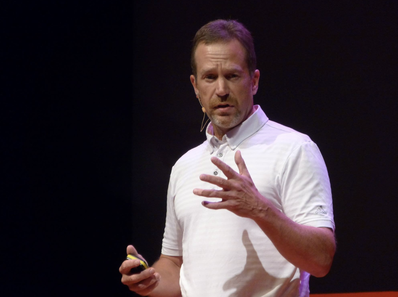
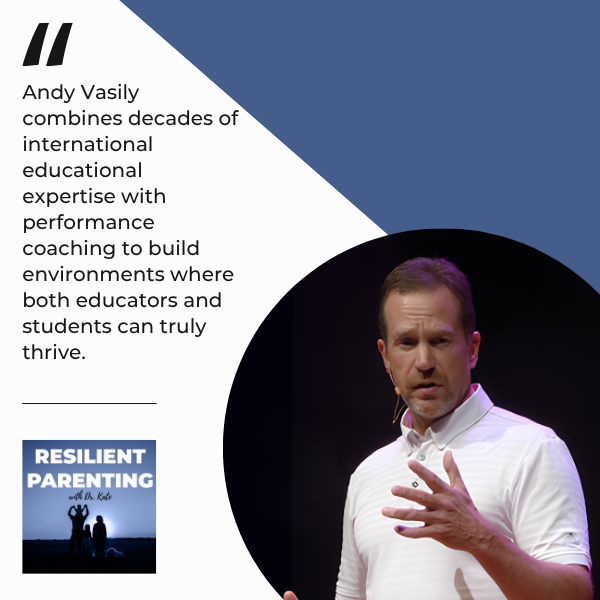
Andy Vasily is a Trust at Work performance and leadership coach, international educational consultant, and speaker with over two decades fostering excellence worldwide. Currently based in Belgium, he combines education expertise with leadership development to create meaningful change in organizations around the world.
Host of the "Run Your Life Show" podcast for 10+ years, Andy has interviewed extraordinary leaders including sports psychologist George Mumford (who worked with Michael Jordan and Kobe Bryant), bestselling author Daniel Pink, Olympic gold medalists, elite combat pilots/Green Berets, Fortune 500 CEOs and many others over the years. His podcast receives consistent praise as very relevant and essential for personal and professional growth and has received nearly one million downloads in over 90 countries since its origin.
A sought-after international speaker, Andy has presented in over 40 countries and delivered a TEDx talk, sharing insights from his transformative near-death experience in Cambodia.
Andy's consulting focuses on leadership development, trust-building, and organizational excellence, helping leaders worldwide pursue meaningful impact. He is married to Neila Steele and has two sons, Eli and Tai, who are 22 and 20.