
Optimizing nutrition serves as a foundational pillar for busy parents looking to navigate the daily demands of life with more resilience and less burnout. Registered Dietitian Cassie Groeschl joins the conversation to share how shifting away from restrictive mindsets can lead to a more sustainable, science-based approach to feeding our bodies and our brains. We dive into the "bidirectional highway" between the gut and the brain, exploring how small, four-minute habits like prepping chia seed pudding can stabilize blood sugar and cortisol levels. It is a powerful reminder that when we prioritize our own well-being through thoughtful food choices, we are not just fueling ourselves; we are modeling a vibrant and healthy legacy for our children to follow.
---
Listen to the podcast here
Optimizing Nutrition For Busy Moms With Cassie Groeschl
Nutritional Strategies For The Burned-Out Parent
We are so lucky to have Cassie Groeschl with us, who is going to dive into the conversation on resilient parenting from the angle of nutrition and how we can optimize our own sense of well-being by feeding ourselves in a way that is perfect for us. Anyway, without further ado, welcome, Cassie. Thank you so much for joining us.
Thank you so much for having me, Dr. Kate.
Yeah, this is really exciting. Talk to us a little bit about what you do, the lens that you're looking through, all that good stuff?
Absolutely. I am a Registered Dietitian and busy mom of three. In my business, Wellness That Fits, I help high-achieving moms and women mostly with burnout and brain fog, stress, inflammation, all of those things to help optimize their energy, their focus, and their overall brain health so that they can show up confident every day, build their legacy, whatever that might mean, whether it's building a legacy within their family, their business, their company, their community. I am science evidence-based practice, so no quick fixes or fads here. Really looking at science-based nutrition that fits a mom's real life.
How vital because what we're putting in our bodies impacts us across domains. Sometimes I think, particularly as busy moms, we overlook what really needs to be happening nutritionally, and then we might get caught up in those shiny objects or that thing that's going to help us do this, that, or the other. How do you approach work with a new client, a mom who comes in, maybe burned out, stressed out, just not at their best, but wanting to be? How do you approach that client?
Managing Stress Through Nervous System Regulation
We absolutely take a look at managing stress and their nervous system regulation. I think a lot of people are surprised that food can actually help with that. It's more than breathing exercises and positive thinking and more along the lines of reframing a mindset and that nutrition actually plays a critical role. The things that we are putting into our bodies and what we are feeding our good gut bacteria versus bad gut bacteria and how that's impacting our brain.
When I talk about that regulating the nervous system, we're really going to focus on what does stress look like? What are the key targets that are causing a lot of stress in your life, and how can we help you be more resilient to that? My main area of focus is how can we nourish our brains so that we can create those conditions for calm in our lives?
Nutrition psychology is more of an up-and-coming word where you're using nutrition to help manage symptoms of depression and anxiety and other mental health disorders, and not just disorders, but also overstimulation and all of those things, just burnout. Things that a lot of moms experience and parents experience, taking on the role as parents and work-life and all these other hats that they're juggling.
Nutrition psychology uses food to help manage symptoms of depression and anxiety, especially while balancing parenting, work, and everything else.
Nervous system regulation, and a lot of that managing stress has to do with balancing our blood sugars. I have a lot of people come to me and maybe they're skipping breakfast and they're maybe eating really late at night or they're thinking, “I want to restrict so that I don't eat as much,” but then we see it coming up later in the day.
Cortisol usually spikes highest during the morning. Along with that, your body's also releasing sugar in your blood. We want to actually eat to help manage those blood sugars. I think it's a lot of work on specific foods that are good for the brain and also just timing of when we're eating and then quality of food as well when we're talking nervous system regulation and also that gut-brain interaction.
If I should just mention too, if people aren't familiar with that, because I think a lot of people are just familiar with how important the microbiome is, but that gut-brain interaction really is as like your gut and your brain interacting with one another. There's a bidirectional highway, and so when you eat something, it sends signals to your brain and your brain also vice versa sends signals to your stomach and your gut and areas in it. Crazy, food can help regulate that whole interaction for the better or for the worse. I help clients realize the benefits of the food that they're putting into their bodies and how much of an impact it can have on mental health.
The gut-brain connection is a two-way highway — what you eat sends signals to your brain, and your brain sends signals back to your gut.
That is huge. Yeah, absolutely, so powerful. It's what we know in the research about exercise and managing certain mental health issues and conditions, anxiety, depression and the like. Absolutely, nutrition fits in in the same way. I imagine there's often at the outset some psychoeducation around that, because it's not necessarily our first go-to thinking about it in that way, unless we know that that's the thing.
How do you help clients, moms in particular, make these changes in a way that they're sustainable? It's so easy to be caught in that rut of our habits, intermittent fasting or not eating breakfast or all of these things when really that first meal of the day is quite important in that nervous system regulation, wouldn't you say?
Sustainable Habit Building And Sunday Meal Prep
Absolutely. You mention we're in the rut of our habits. I think it's like taking a look first of all at what are the conditions that we're living in? Where can we begin to remove some of the distractors or things that are causing us to have bad habits? I'm a big fan of James ClearAtomic Habits, and it's really about if there's something in the house that we're eating that we know is not good for us, and we know that we do just fine without it, that would be one example of just creating the condition by removing the stimulus, if you will.
I think so many women come to me with this mindset of restriction. A lot of women, they go to see functional medicine doctor and they say, “Restrict. You can't have any of this, you're sensitive to this.” All of a sudden, their diet comes down to like fourteen safe foods that they can eat. You're decreasing so much of the goodness that food can bring. This is this mentality of restrict and restrict that people are coming with.
Many women approach food with a restrictive mindset, cutting out much of the goodness it can provide.
I think when we are working these real strategies and how to eat into our true lives, which are complete chaos at times, totally get it as a parent, you're just barely surviving at times. I think it's creating boundaries around some of those things that are causing a lot of the stress and causing you to get into habits that aren't really the best habits that we could be in. I think a lot of it comes down to taking a look at your calendar and making time for the things that you know are important to you and the things that you value.
Something like this in terms of nutrition might look like the person or client, they know that they want to feel better, have more energy for their kids. They want to be around for a long time, fully energized and keep up with them. It's important to them, it's a value, but how do they actually do this. When they get done with work, they can't think straight, they just order takeout again just because they've had such a long day. How do we make this fit?
I think the first step there is really being aware of what your values are and scheduling them into your calendar. What that might look like is maybe we set aside one hour on a Sunday for meal prep. That way, you at least prep, let's say, five things, easy things, even if it's washing fruits and vegetables and making them more accessible, you're setting aside time to do that so that you are preparing yourself and your family for the week ahead.
That's one example there of meal prep. Something else might be, like you said, people often, or parents are very busy and they might not eat breakfast. If we can meal prep, just to get us through the week, 5 chia puddings that take literally 4 minutes to put together, and just grab-and-go breakfast. Now, I'm all about breakfast on the go, I know it's not the very best thing for my nervous system regulation when you're on the go and you're eating, but tiny little four-minute strategies like that that can fit into a parent's busy schedule is where we want to go.
I know everybody is very different, and so one client we might start with the breakfast, another one we might start with a dinner because dinner's just the absolute crazy time for them. I think it really depends, but I think knowing ahead of time what your values are and creating time in your calendar, scheduling those priorities is really important.
I love that. Individualizing the plan for what works, what fits in into one's context. All of our contexts are different. That makes all the sense in the world. I imagine it gets easier when folks start to recognize, start to feel the positive effects of the changes that they made so that they're gaining momentum and they're maybe able to add in more things nutritionally that are going to bolster the plan and the way that they feel even more.
Absolutely, and I love that you said that because it is such a downstream effect, whether we use the example you mentioned before with movement, because we know that when we engage in exercise, we have a higher level of dopamine and that further motivates us to do more. Same thing with any habit you build.
What I love about food is that the more good foods that you put into your body, let's use fiber as an example. If we're eating a little bit more fiber, we're feeding the good bacteria. The good bacteria in our gut, they ferment that fiber and they produce these things called short-chain fatty acids. I’ll give you an example, like butyrate. Butyrate then travels to the brain and it activates these things that that impact your mood, that decrease anxiety, that create calm.
The more good foods you eat — like fiber — the more you create the biological conditions for things like dopamine.
When you are in that state of mind and not overstimulated and you're nourishing your brain, I bet you would continue the good habits. The more good foods that we're eating, you're actually, it's not just, “I feel good about myself, I'm eating good and I'm eating well.” That certainly is a thing, that's mindset, but biologically we are creating the conditions for dopamine and for some of those other neurotransmitters that are going to help us make better decisions later.
I love that. In making these changes, building our nutritional foundation, we're also modeling for our kids.
The Long-Term Impact Of Modeling Healthy Eating
It absolutely is and I am a huge proponent. Now, I have kids. I know they're really little yet. We do some events, but we're not into the sports events every single night. I'm speaking from a point of a parent with young kids, still busy. I am such a proponent of having some sit-down family time meals. Whether you do once a week is great, but if you can get 3 or 4 meals where you're sitting down together, it doesn't need to be dinner.
I know that's hard. It can be breakfast, it can be, again, the weekends. If you can sit down together with your family, there is so much research, thousands and thousands of kids were looked at, and they looked at the kids who sat down for family meals together had usually healthier foods that they were eating, less risky behavior like suicides and disordered eating and things like that, and overall just better health.
Family meals are linked to better health and less risky behaviors, including lower rates of suicide and disordered eating.
To me, when I read that research, our grandparents and those who came before us had it so right in that they took the time to spend time with their kids and to have that sit-down meal. To your point of being a good role model, I think it's just an excellent way to show our kids that we can increase variety and eat different foods. Will they always eat them? No, absolutely not. The more they're exposed to those food, whether it's looking at it, smelling it, maybe touching it, maybe putting it on their face even, doing something with it, the more exposures they have to it, the more they're able to eat probably those things down the road.
I can't tell you how many times I’ve made a salad for myself and my daughter, she loves salads, but I’ll make a salad for myself and if I don't make her one, she's asking me for bites. Sometimes they don't eat the salad that's on their plate, but they'll eat yours because they think it's so cool, like whatever you're eating, they want to eat.
Be the role model you want your kids to follow — in movement, eating, and how you treat others.
Obviously, that's for little kids, but I think just modeling that good eating behavior is one of the best things that we can do. It's not just food. It is modeling good marriages, modeling good relationships with our spouses. The number one predictor of how your kids turn out is really just that relationship that you have with your spouse, I know. It's along those same lines, like be the role model that you want your kids to be.
That filters into movement and the way we're treating other people and all of these things. Yes, I could not agree more. I have twin boys and I wish one of them would enjoy snacking on the broccoli on my dinner plate, but that's not something that happens. In fact, he's pushing himself to eat more things that are green now because he knows. It's knowing, it's theory, and then it's doing.
I'm happy about that because I think as kids get older, so we're modeling, we're exposing, we're doing all these things, and I also agree that family dinner nights are very important and we make that a priority here for sure. I think that part of it is noticing what we're eating and knowing what's important in terms of fueling the body. I feel like once kids hit late teens, they need to integrate from the inside out how they're going to carry forth into the rest of their life college and beyond, because they've got to nourish themselves when we're not there. These foundations that we're setting early are so important.
I just thought of an example with somebody I was working with. Her kids don't eat a lot of veggies, not very different from a lot of the US. What we did is I started talking to them about the things that were really important in their lives and it was sports and baseball. We started talking about, “What do you think is going to help you run a lot faster and hit the ball harder and things like that?” If you can try to relate the outcome of eating well with something that they're trying to achieve as well, that helps. Not saying it's the end-all be-all.
When you start talking about, “The muscle that you gain is actually from eating some more protein and the antioxidants. The greens that are on your plate are going to help your brain make quicker decisions and you start thinking about these things.” Pretty soon, they're starting to try a couple more things. I'm a huge believer in always linking it to a purpose. Even in high school, they start doing things on their own. Again, my kids are not that old, but just talking to neighbors and stuff and they start taking maybe like classes, like health classes and they start realizing it on their “own.”
Always connect healthy eating to a purpose — for kids, things like running faster or hitting harder make it tangible.
Even though Mom and Dad have been telling them this the whole time, I think maybe getting an outside perspective on people that they look up to and other people who are doing amazing things and they're supporting the idea that taking care of your body, whether it's through nutrition or working out and things like that, are really good for you, I think they're more apt to listen to those people too.
An example of that is actually with both my boys, they're rowers. Starting around sophomor-ish year, one of them in particular decided he was going to bulk so that he could go faster on the erg, that's the rowing machine. Their speed on that dictates a lot in terms of their placement on the team and that thing.
He was very intentional about it, did it alongside a trainer at school, his coach, and was quite intentional about it and coupled that with his workouts in the gym as well as on the rowing machine and was actually quite successful. He got faster and was very proud of himself and the outcome. Very conscious of what he was putting in his body, just didn't add more greens, he felt those weren't necessary, but I don't agree with that, but hopefully that will evolve over time.
They'll get there.
Question, protein. What's your thought or your advice or your angle on protein, particularly for busy moms? I know that's a huge topic out there, lots of different points of view and advice. I'm just curious how you counsel busy moms in relation to protein.
Balancing Protein And Fiber For Blood Sugar Control
I know the new dietary guidelines came out, the new food pyramid, if you will, and it's recommending a little bit more than the previous one. What I tend to calculate for clients is about 1 to 1.2 grams per kilogram. For like 180-pound woman, 80 to 100 grams about of protein would be enough. Now, how do we get that throughout our day?
A lot of moms, busy moms are skipping breakfast and we're trying to pile all of this into lunch and supper and before bed maybe. I think again that's why it's so important to eat at regular times and consistently throughout the day. If you think about that, that might look like 25 grams for breakfast, 25 for lunch, maybe 25 for supper and then you have a 5-gram snack here or there. I think that's the way that women can get it in.
Now, protein is such a buzzword and of course protein is so important for our bodies. It absolutely is. It helps with muscle synthesis and hormone regulation and all of these other great things, blood sugar control. I think sometimes, when we put such a huge focus on one macro or nutrient, if you will, there are some things that might fall to the wayside.
For example, if you are a woman who is eating a lot of protein, doing everything you can and you're still constipated or you're getting some other symptoms that you don't really love, the missing piece may be fiber because when we are only looking at our target protein goals, everything else falls to the wayside. Fiber is important. It's actually not a nutrient, I feel like it should be, but it's a very important food product that we should be getting to ensure again that gut-brain connection where we are feeding our gut bacteria the good things so that it can not only regulate blood sugar but those gut bacteria can help send signals to the brain and help produce those neurotransmitters to help us feel better and and all of that, that whole system and process.
Water's important. Of course there's so many things that are important. I just wanted to mention that if protein is important and it's a really good market for people to sell products on too. I think fiber is only going to get there as well because we're starting to see more and more fiber products and more so than just the Metamucil that your grandma was taking. I think fiber is probably more of the missing piece that 90% of Americans are not getting enough of.
Fiber is probably more of the missing piece that 90% of Americans are not getting enough of.
I would love for readers to take a second and maybe think about the amount of fiber they're getting in their diet too and not to add more overwhelm, not that, but just if you do have your protein down and you know the goals that you should be hitting, maybe take a look at adding some additional fruits and veggies and complex carbohydrates too.
Optimizing Brain Health With Bio-Individual Nutrition
Yeah, I got you. It doesn't all have to happen at once. It's like one small change here, one small change there, integrating over time as you're starting to realize the benefits. I'm curious, another thing that I see a lot out there and I’ve done some reading on it myself and some reading in relation to intermittent fasting and how that can optimize brain health and clarity. What's your thought on that?
Yes, that one is a little nuanced because I feel like most people understand intermittent fasting in the context of weight loss. There is a lot of research that does show that people can lose weight by eating the same amount of calories but in a more constricted time period, which is what intermittent fasting is. Now, I would say something to this is really individualized because it depends on what you're eating in that time. I think diet quality is really important because you might be losing weight but are you getting the right nutrients and protein and carbs and healthy fats? The scale's not going to tell you that. I would take that on a more personalized, individualized basis.
My general answer to that would be women tend to be a little bit more sensitive to the morning cortisol rise. When your cortisol rises in the morning that's like the stress hormone, but we do need it right at certain times. When that cortisol rises in the morning, it also triggers your body to do a couple other things like releasing glucose and some other things.
When cortisol rises in the morning, it increases blood sugar — and many women do better when they eat something in the morning.
I actually think for women, it's important. It depends on the situation. Are you working how early are you working out? What type of workouts are you doing? Like all of these things come into play. If I'm speaking generally, I would say women would do a little better with eating something in the morning. It doesn't need to be at 6:00 AM maybe 8:00 or 9:00 AM. That way they can hit their fiber protein all these other goals that they're supposed to be hitting a little bit better with that extended time period that they can be eating. It can help manage blood sugars as well.
Now, I know there is also research on the intermittent fasting in a way where people do skip breakfast. We have a lot of research on just decreasing caloric intake can extend your life so there's that longevity piece. That's why I want to say because it's nuanced. I think it really depends on the person and in the circumstance. Maybe a mom who is having tons of cravings at night, we'd actually probably take a look at eating earlier in the day and filling her a day with more protein and fiber so that we have a lot of time for that satiety to happen in the body so that they're not having those cravings later at night.
Now, if it's somebody who does a really good job, they're not having cravings maybe they're working out at noon, I would say maybe that would be an okay thing for them in terms so doing like intermittent fasting from like noon to six or something like that. That might be a doable strategy for them. It's really individualized and based on what the person's goals are with their nutrition. I think it's so individualized.
I think that's a huge point because all of this stuff is nuanced and individualized and that really speaks to this idea of optimizing within one's own unique context. All of us have a different context, different needs nutritionally, different needs from a stress management perspective, all of that. I see the point about maybe putting something in with a little bit of extra fiber early on. It doesn't have to be big or complex. You mentioned chia seed pudding. I mean, that's one of my favorites, I love it and it is. You can put it together in like four minutes. There's so many different ways to do it. Just curious, any tips for our readers on an optimal chia seed pudding?
The one I just did this literally an hour before we got on. I use kefir, and plain kefir with a little bit of like strawberry kefir just because I like the flavoring. I do like half and half and then 2 tablespoons of chia, which by the way, 1 tablespoon of chia is five grams of fiber, so it's amazing. If you can do 2 tablespoons of chia seeds, you are increasing your fiber 10 grams.
I like doing kefir. Kefir, if you don't know what it is, it is a fermented milk product. It is a probiotic food, and probiotics are really great for our gut. We're helping the diversity of our gut bacteria and it's easily digestible too. The kefir, the chia, and then I do a good heap of blueberries because blueberries and the polyphenols and the antioxidants that you can get from blueberries are amazing for your brain. I think a lot of people know that blueberries are good for your brain.
I just want to share this research study actually because I don't think people realize how amazing they can be. There was this research done on people who had a blueberry drink smoothie versus a placebo so nothing. They looked at the executive functioning and working memory so like how much they were able to focus through a bunch of tasks. They found that the people who just had it was like a cup and a half of blueberries in this smoothie, they were able to maintain focus two hours afterward, which is like my whole morning. That's like being able to focus that much longer versus the people who lost focus over time who had the placebo.
Not to say that blueberries is the one and only answer, but some of these foods can be just a huge help for our brain. It's the kefir, it's the two tablespoons of chia, and then like half a cup or even a cup of blueberries. I do a little bit of maybe like coconut sugar, sweetener or cinnamon, and it's really amazing. Such a good, easy thing. You throw them in a mason jar. You put the top on, stick them in your fridge, they're good for a few days for your busy week ahead. That's what I do. What do you do?
Simple Nervous System Hacks And Quick Brain Foods
I love that, and that actually simplifies this whole idea. So to be honest, my chia seed puddings don't always turn out perfectly because I feel like I might be putting in too much liquid. Maybe a little bit of yogurt and then maybe an almond milk or a coconut milk. Sounds like the kefir is enough on its own and the pudding will turn out a lot better. I'm going to try your recipe.
I do some Greek yogurt. I’ve only been doing one tablespoon of chia seeds, so I'm going to add another one. Some fruit, but then like a coconut milk or an almond milk or what have you. I think that might be where things go off track because they don't always solidify like I'd like them to. I love the strategy that you've that you've offered. Can the blueberries be frozen or do they have to be fresh?
I use frozen. I use Wymans. I am not affiliated with them, I just love them. Wymans wild blueberries. You can get like the three-pound frozen bag. They're wild, and so they have two times the amount of antioxidants. Love the flavor, they blend well. Of course, you could use fresh blueberries too, whatever you have access to. For me, busy mom so things aren't rotten in your fridge the frozen is a nice, nice thing to have.
I was hoping that that's what you were going to say. That's perfect. Cassie, that is an amazing tip, but what you're sharing here is so helpful and really I think going to benefit so many of our readers in terms of optimizing their own sense of well-being within their own unique context. In terms of that optimization, as we have just talked about and talked through, nutrition is really everything. It's so much of the of the puzzle. Thank you so much for joining us here. Before we wrap it up, any last tips or strategies, something you'd like to leave our readers with in terms of getting started on this road?
Yes. One strategy I think that is probably the very easiest thing that you could do is to increase your wellness journey in a number of ways. I think the easiest thing to do is there was research done on just simply breathing before eating, taking 3 to 4 deep breaths. Think maybe 3 to 4 box breathing exercise. Breathing before a meal can automatically decrease your blood sugar. You're literally doing nothing but breathing.
Taking a moment to breathe before a meal can help lower blood sugar — it’s simple, but powerful.
If you just take that moment to slow down, whether it's before a family meal or you're standing at the microwave or at the stove and you're just waiting, having those three to four deep breaths can really bring your sympathetic nervous system, which is that fight-or-flight into a parasympathetic state, which is rest and digest. Not only is it decreasing blood sugars, but it's preparing your body to digest and it does a number of other things as well.
That's one of my favorite tips that's like you don't even need to eat anything or do anything but simply breathe. Start there, start thinking about some of those easy nervous system regulation strategies and certainly I'm here if you want any more tips and tricks and brain foods that can really help turn the needle and put the needle forward in your health.
Where can folks reach out? Where can they find you?
I'm at Wellness That Fits. On Instagram, @WellnessThatFits. You can email me, Cassie@WellnessThatFits.com , and my website is WellnessThatFits.com. It's all the same name. Keep it easy.
Thank you so much for joining us here. This has been amazing.
Thank you so much for having me.
Important Links
About Cassie Groeschl
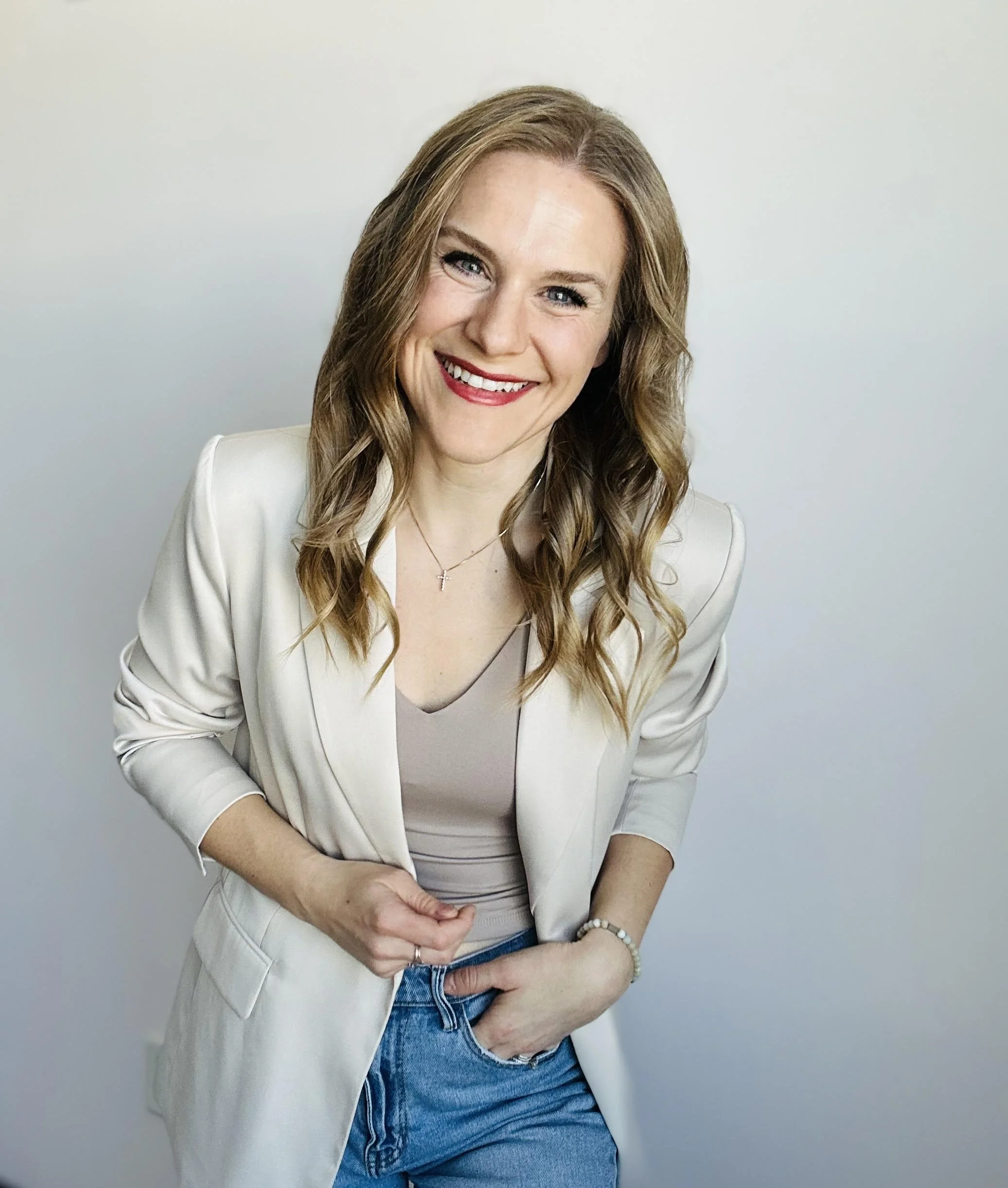
Cassie Groeschl, registered dietitian and mom of three, is the founder of Wellness That Fits where she helps high-achieving moms with burnout, brain fog, stress, and inflammation optimize their energy, focus, and brain health so they can show up confidently every day and build their legacy. No quick fixes or fads–just science-backed nutrition that fits real life.
As a lifelong high achiever, she has balanced multiple roles--corporate dietitian, healthcare sales consultant, university teaching professor, nursing home consultant, entrepreneur, and host of the Wellness That Fits Podcast. It is her mission to inspire and lead women toward better health and wellness so that they have the energy to serve others and make a lasting impact on their families, communities, and within their careers. They can thrive as the person they were put on this earth to be.