How To Raise Accountable Kids With Sue Donnellan

Are you tired of feeling overwhelmed, stressed, and constantly yelling at your kids? You're not alone. The journey to raising accountable kids and fostering independence often feels like a constant battle, leaving parents drained and searching for a simpler way. In this powerful interview, we sit down with parenting expert and author Sue Donnellan (Ask Mom Parenting) to uncover her non-conformist, business-minded approach that has been proven over 25+ years. Her repeatable system, rooted in behavioral psychology, isn't about changing your child—it's about transforming your approach. Discover the foundational shift from "react mode" to "prepared mode," learn how to bake responsibility and buy-in into every phase of your child's life, and finally make parenting easier. Read on to unlock the secrets to building self-assured, confident adults.
LEARN MORE:
Book a FREE Discovery Call
FREE Parenting Resources
Join the Yell-Free Parenting For Exhausted Moms Facebook Group
Get the Book
---
Listen to the podcast here
How To Raise Accountable Kids With Sue Donnellan
Welcome back, everyone, to another episode of the show. I’m so glad you're here. We are super lucky to have Sue Donnellan with us.
Sue Donnellan's Foundation: Behavior Psychology And Repeatable System
Thank you so much for having me. I am really happy to be here and looking forward to our conversation. I created Ask Mom Parenting. I am an author of a parenting book, Secrets to Parenting Without Giving a F^ck. I also do coaching, and I have workshops, and my background is 25-plus years in behavior psychology rooted in Montessori practice.
It is about what you talk about. Resilience, independence, and creating accountability. My system is that I make parenting easier. What I have done is I studied all of this, and I have raised kids through every phase. They are now in their twenties. It is like I have created a simple, predictable method so that you can repeat it. What I have sort of done is zoomed out and looked at some of the processes.
How do I make this easier for parents with a system that is repeatable and transferable for every phase? In other words, we talk about parenting in advance and how to predict and interrupt patterns. Once you get this way of thinking, it applies to every age and phase. We bake in accountability and responsibility, and we have different ways of doing that. My overall goal is to make parenting easier.
As you are doing that, you are helping parents probably build their own foundation of resilience because they are not strung out with all of the chaos that is going on, because you have actually helped them make parenting easier through your system, which I would love to hear more about in a second. First, I wanted to just say that you have triplets. We have got twins, and I think that is really cool. At some point in the conversation, touch on the fact that parenting triplets, parenting twins, we are still parenting in most cases, very different kids. That takes a bit of a different angle. Is that what you experienced with your triplets?
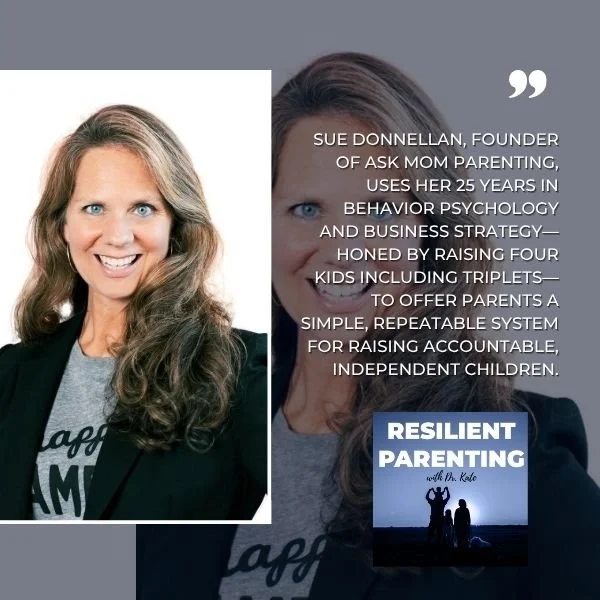
Absolutely. Even though we have an older son, we decided to have our second baby, and two eggs dropped and one split. I have the identical twin dynamic inside the triplet. We have got two boys and a girl, and then an older son. That was an ecosystem all of itself, and they, even though they are identical twins, could not be more different. Of course, the two boys and a girl of different sexes.
Just everybody's personalities and the DNA that they pulled from my husband and me, just as with every child, with every family. It is funny to see how it all comes together in the child as you are raising them. Yes, it was definitely an intentional effort to view each child as the independent person that they are.
We experience that same thing across developmental phases with our twins. Very different boys, very different learning styles, very different aptitudes, all of it. Really, an intentional effort my husband and I made to help each one thrive within their own unique context, even though that looked very different for each of them. The cool thing is, now that they are eighteen, they are very close. They have both become very involved in rowing as their main sport.
It has been really cool to see how that has really brought them together, even though within each of their contexts, they are different rowers. Different strengths, different aptitudes in the boat, and different attitudes around it. It’s really cool how that happened here. I just wanted to touch on that because it is so true. Oftentimes, we think that our parenting approach will be the same for both of our kids or all three of our kids or all four of our kids, but really, it never is. I am just really curious, did this system develop as you were raising the kids when they were very young? How did all that come about?
It came about because I am an entrepreneur. For 30 years, I have run my own business from home, before that was even popular. I am a business-minded person. Business-minded means I am looking for patterns, I am looking for ways to simplify, ways to be strategic. When I am not even a kid person. I just had a couple of kids for my husband and ended up with triplets, and I was thrown into the deep end. I went from one to four kids overnight. My husband is in the military. He was gone.
I am running a business. I was yelling all the time. I had to find a better way, and our kids happened to be enrolled in Montessori preschool at the time. They offered a class, and I was hooked because my business brain, my leadership brain resonated with the accountability and the responsibilities and the way that we were involving our kids in the process. They were packing their own lunches at five, they were doing their own laundry at five and six with training. That was where my head was.
My processes came through trial and error, learning the techniques that came from Dr. Rudolf Dreikurs and the psychology fathers who created the foundation of Montessori. As I read it, it took me a little while to understand it and apply it. It was like learning a foreign language because none of us parents knew this way. After doing it, I had a couple of pivotal moments when all of a sudden, my new techniques really worked and came together.
From that point again, my business brain zooms out and goes, “I could be doing this with this one and with that one, and no matter what the kids were doing.” There are repeatable, transferable ways to apply this method throughout every age and phase. That is why I love getting parents who have kids at 4, 5, 6, 7. We start baking with these methods earlier. By the time we get to the teenage years, a lot of our foundational parenting has been set.
First, before I ask you this question, I love the thing about the laundry. I thought we were good here. I have had the boys doing their own laundry since they were ten. Certainly not five or six. Maybe I should have tried that too.
Four kids. “Whose shirt is this?” I was doing everyone's laundry. What are we doing? If I had the two, I would have been more apt to do everything myself. The four just became an outlandish number to me. It was just mayhem. You guys just have to figure this out. That is why we pushed it a little earlier. My business brain is like I need you to be adding value in my home and getting stuff done for yourself because I am busy.
I love that. That also creates agency in our kids. It gives them a sense of responsibility, a sense of belief in self, “I can do this. Doing laundry will generalize across different domains, which is what it feels like to me. It happened in this house.” I love that. That is amazing. What are some of the other aspects of the system, foundational aspects of the system that have generalized? You mentioned that you were yelling a lot. You perhaps were stressed out a lot. That is probably baked in somewhere. Talk a bit about that.
Recognizing The Problem: Yelling And Being Out Of Ideas
Every parent relates to yelling. I was out of ideas. I did not know what to do. I did not have a lot of experience with kids. I did not have younger siblings or babysit a lot. I did not know that they do not just do what you tell them. I did not realize that there was this whole level of psychology and approach that needed to be nuanced and tweaked to motivate a child. I am a quick study.
There's a deeper level of psychology and approach that needs to be nuanced and adjusted to effectively motivate a child.
My oldest really is the guy that just sort of looked at me with the deer in the headlights, like I do not even hear you, and I am screaming, my throat's hurting. I am seeing that nothing's resonating. Learning that there are techniques. It was the yelling that pulled me out of going, “I do not know what else to do. I got to that point of just despair where I do not know how else to get these kids to do what I am asking.”
I was out of ideas. It was at that point of readiness that I was able to go in and start learning these new things. Most parents can relate to that. When I do my workshops, I do get every parent reluctantly admitting yes, I am yelling, and I feel guilty, and I feel bad. I always repeat the same question that was asked of me because when I went into my first class, she made us go around and say why are we here.
I was full of myself. I have got triplets, I have got four kids under five, and my husband's deployed to war. She is going to feel sorry for me. She just looked at me at all these things that I thought were justifications and just said, "Is it working?" I had to take that splash of cold water on my face. I am ready to learn.
I actually know it is not working.
I thought I was justified in the yelling, even though I knew it was not working. I just needed that little bit of crystallization, that little moment of like, “I am pivoting. Ready to learn.” We can all relate to that, and we all relate to being overwhelmed and doing things, saying things to our kids that we regret. Getting to that level of like, “I do not know what to do after this.” We can read the books, but one of the reasons why I offer my workshops, and I like the coaching, is that you can read the books, and it makes intellectual sense, but the application is where we fall down.
Knowing and doing are two totally different things.
You need the material to come to life. That is why I wrote the book and all of that. I do the podcast, and I do coaching, and I do workshops because even though I say I am making parenting easier and I do, the first couple of times you understand and hear some of these techniques, you hear it and you go, "That makes sense." When you are in the moment again, you are back into that pattern.
“What was I supposed to say again? What am I supposed to do?” It is relearning patterning. There is a reason why all of us were yelled at, grounded, and punished, and we then resort to that because it is the familiar feeling, and we know it is not working, and we know we did not like it on us, but we just do not know what else to do.
It sounds like there is something at the core of your system, and I would love you to talk a bit more about this. Is that piece about instilling responsibility, a sense of agency, a sense of belief in self from the inside out for your kids, which is really going to help them over the long term? It is something that I have definitely and my husband has definitely focused on that very thing a lot here also. Different ways to do it, I am sure. There is no one-size-fits-all in parenting. Talk a bit about that because it sounds like that is at the core of what we are talking about here.
Parenting Is Not About Changing The Child, But Showing Up Differently Yourself
Again, immersed in the psychology of it all, immersed in all of the terms and the ideas and all of that, learning. I took multiple classes a year of studying, and I am a zoom-out person. That is my business brain. I immersed myself in it, and then I went home to my petri dish of children. Experimented child. All of a sudden, something clicked, and I can give you an example that ties everything together. First, I was able to say, you know that saying, the tail is wagging the dog.
We are all so overwhelmed, we are all living, and we are in react mode. I am thinking, “How can I teach parents to be in prepared mode?” How can I take all that I have learned, distill it, and package it in a way that makes parenting easier, that again is repeatable?” It is a framework. My business brain works that way because I needed it that way.
In essence, what we are doing is I have got my system, which is preparing parents in advance, and we have a way of doing this through patterning and looking at patterns, interrupting the pattern, and figuring out what makes you yell, or whatever it is you are trying to change. Big picture, we start with goals. What are your goals? Every time a parent learns something new, and it is hard, people think it is hard, but it is just new. It will not be new in two weeks. Let us learn this new way.
Every time they start to do it, it starts to get a little difficult, or their kids test them, they start to lose the boundary. We learn how to look at the patterns, interrupt the patterns, and we have to always go back to about two weeks in, or we go back to the goal. What are we trying to achieve? What are we trying to change? Where are we at here? I teach a method of looking at the patterns, interrupting, and understanding what you are bringing to the table as a parent.
The overarching idea is that we are not what we have been taught, that we have to change the child. Parenting is not about changing the child. It is about showing up differently yourself because guess what, your child is reacting to you. We think we are yelling, and we are reacting to the child, but no. It is a counterintuitive way of thinking, and it is how we get the dog to wag its tail. When we are in react mode, all of us are in react mode. How do we back it up and parent from back here?
That is what my system really teaches is to identify those patterns, understand how to interrupt them, and how to structure conversations with kids so that they get buy-in upfront. I have a chapter in my book called Partnership Parenting. We are not friends at that age. These are adults in training, so I know they will be my best friends, but today I am the parent. They need my leadership. How do we build accountability and bake that in upfront? It is as easy to do for a 4 and 5-year-old as it is for teenagers, and it works, and it is phenomenal. I can give you a real-life example of when it crystallized for me.
Yes, I would love that.
Real-Life Application: Getting Child Buy-In And Accountability Through Agreements
Triplets, but we have an older one, and he is three years older. As you can imagine, it is hard enough to get one new sibling, but to get three and take away all your time with mom and dad and all your attention. It was interesting because our oldest was trying to find ways to get us busy with him and so forth. We had a huge playpen in the dining room with those like dog gates, and we just threw the three in there, and our oldest always wanted to go in and play.
Every time he went in to play, they would cry within 30 seconds. I am working, and I think I have them in there, and I could get something done, and I am now up from my desk, and I am yelling. Every time you go in there, and I react, now how can I back that up and look at the pattern of me yelling every time he goes in? The other thing too is that a misbehaving child is a discouraged child. That took me years to realize. “He knows what he is doing.”
He does know what he is doing, but he is trying to get attention, and how do I mitigate that? There are a variety of ways to do that, but that is not what you are asking here. All of a sudden, I am knee deep in studying at this time. He is five, and I am reading, and I am studying, and I am taking the classes, and I am in react mode. How do I get into prepare mode?
Next time he says he wants to go in there, I say, and my language is very deliberate, "If you choose to make them cry, what should we do about that?" He is five. “I have to come out.” "You will come out if they cry if you choose to make them cry." That is me and him understanding we know that you are doing this for attention. We know what is going on. I take him at his word. I put him in there. Sure enough, I am tested because you will be tested with these new boundaries and this new way.
Thirty seconds later, he makes them cry. The difference. I do not show up yelling because I am prepared. Now all I have to do is walk over, and instead of like, “You are always making them cry, why can't I get any work done?” Now I come calmly over. "What did we agree to?" Now this is a five-year-old taking accountability for his word and his agreement. It is baked in. He has got buy-in. "What did we agree to?" "I have to come out." "You are going to come out."
Now, the next piece of gold. "If you want to go back in, you know what has to happen when you are ready to go in without people crying, you can join them." Here is the other key. The temptation is to say you are out, you go to your room, you take time, you are in a timeout for two minutes. I am not doing any of that. I am giving him agency, and I am saying, "When you decide that you are ready to play without someone crying, you may join them."
I am taking him at his word, and he is deciding. He goes to sit on the stairs and three seconds later, "I am ready." The temptation is to say he does not know what he is talking about. He is not ready. He is bullshitting. I go, "Great. I am so glad that you are ready to play without crying." You see, I am repeating back. It is a very systematic, strategic way of communicating. They play the rest of the hour or so without crying.
This is a kid who not only created his own consequence, but also gave me his word and made an agreement, which was then held accountable to his agreement and his word, and who was able to have the choice to make his own decisions and his own choices and was taken at his word. This is five years old. The beautiful part is that I stopped yelling.
Played out over time because I am sure it was quite powerful.
It is very powerful, and it is the structure with which I told the story. The buy-in, the agreement, the accountability. This structure is repeatable and transferable to every age and phase. That is part of what I teach in what is in my workshops, and what is in my course is the application of it. Yes, we can have an intellectual conversation, and what you are hearing right now makes sense to you, and you are like, “Yes. Who is going to be there to make this material come to life in my home?” We hear it, and we go, “That makes sense, but we want the help in exactly how.”
This way of communicating involves recognizing the patterns. Any age can be. My kid is not getting up on time to get to the bus. I can have the conversation, I can get buy-in, I can get accountability. I have another program, which is the confident discipline part of the program. I have other offshoots that are earned access. For these kids that are older, they want earned access to their toys, to screens, to whatever. How do they earn?
How do I structure my conversation with them in a training way that bakes in that accountability, and when this gets done, then what? I am not fighting about screen time. I am not fighting about anything that comes up in the future years. It applies to this method, and to this ecosystem we are creating in the home of accountability, responsibility, self-agency, all of that is baked in, built in.
It is structuring my home and the culture of my home for that behavior to be achieved. The beautiful part is that I am not yelling. It all started with me going, “It is about me.” Parenting is about the parent. Parents, this sounds terrible to say, but parents are the problem. I do not mean to put it in a negative light, and I am saying that to myself.
“I was the problem when my kids were pushing back. It was me. I was yelling, I was creating a culture where they felt like I did not want to do anything right, and I was making mistakes. They are in mistake management as opposed to trying to figure out on their own all these other productive ways. I have lived it, and I have been that parent, and I made the change.”
How are you caring for yourself within the context of all this?
Reinforcing Parental Boundaries And The Value Of Uninterrupted One-On-One Time
Again, business-minded. My business brain is very much about mommy works. I also had a husband who was amazing at his backend support for me. He was out, he flew a fighter jet, he was going to war. What Daddy does is cool. Mommy is always home, and she is just sitting at her computer. She is doing nothing for them. It is just that mommy is always here. I was competing with this cool job where Daddy is flying.
My husband was always very good about reiterating every time we went on a vacation or whenever we had extra money for gymnastics, mommy's job. He reiterated my value, my partnership. That was number one. Men have a great opportunity to support their women, no matter what they are doing, because one of the things that I say is that there is no term for working fathers. That just pisses me off. As moms, if we do anything outside of the house, we have two full-time jobs.
As moms, if we do anything outside of the house, we have two full-time jobs.
Let us be honest, who gets called from the school, who gets called? We are running the home, we are shopping, we are making meals, we are doing a lot. My husband supported me on the backend and really taught the kids that that is what I am doing. I was earning money, whatever. I felt very comfortable also leaning in with the kids. I am not available. My kids had to earn access to me, too. I was not always available.
When they got their one-on-one time, and I would take one out for a date, I had a variety of things that we did. Parents think they have to spend hours and hours of time. I am not kidding you, at certain ages, 10 to 15 uninterrupted minutes with your child is all you need. That then turns into more time as they get older. When they are 5, 6, 7, 8, playing a little game of cards at the table one-on-one is really it. It does not have to be. I am simplifying parenting.
Let me tell you what works. This is 10 to 15 minutes, all you need, whenever it works for you. I was always good about reinforcing my needs and my I am working and having my boundary, and then just having a partner too, who, when I was at a donkey on the edge, which was often, he would take the kids camping for the weekend, and I could just breathe. Having built in ways to support yourself. If you are a single parent, I have talked a lot about when he was deployed, and I needed somebody to come in and help me with the kids so I could focus.
I went to church. They have free resources for babysitters and young girls looking for money or whatever. Back in those days, we had more resources, but there were always ways. I worked from home, so I felt safe that somebody was coming in. I am here. There are a variety of ways to decide upfront that you are going to put those boundaries in for yourself. A lot of what I teach can also apply to that.
Sort of at the core of my new book, Step Away: The Keys to Resilient Parenting. The space that you are talking about creating, responding as opposed to reacting, and optimizing your own sense of well-being. You are baking in a lot of great strategies for optimizing your own sense of well-being. If we do not do that as parents, we are not going to be able to show up fully. Oftentimes, we are moving so fast through life that optimization just does not happen.
The kids had a very clear sense of where their pecking order was. My husband did deploy five times, so there was a good amount of time where it was like the kids knew Mom was at the top tier. When dad is home, mom and dad. Mom and Dad are top-tier always. I would tell them that is my humor anyway. My kids grew up with me. I am Italian and crazy. The kids grew up with me going like, “You know where you guys are. You are down here, guys.” It is fun. It is really fun. They laugh. You have got to have fun with it. They got the idea. It is funny because one of our triplets is an actor.
He will go on off Broadway, and whatever, and the directors will try to manage him in terms of like how he is, “I grew up with an Italian mom, as you can tell me. I want constructive feedback. I do not need you to soften the blow.” People are loving meeting the kids and going, "I can speak to you with some real value." They were just raised with that, and that is the way I talk at home, and it is funny. It is also true. Mom and Dad want to go on a date. You are not invited.
That is what I was wondering because I am sure that the kids are showing up as very self-assured, confident, self-aware adults at this point. All of this foundation that you laid and that you are teaching others to lay really I think creates that solid foundation for future success and self-assurance is what I am hearing, which I absolutely love.
It is true. That was always the goal. Again, maybe I just was not overly enthusiastic about the family. I mean, I know that sounds terrible, but I was like, it is a piece of me, but it is not all of me, and the kids always understood where they stood in that because you are your own person. They were all raised with that investment in them as individuals.
Whatever it was they showed interest in, we supported that through workshops or wherever we could go. Do you want to learn to ride horses? There is a lady down the street who has got horses. Let us go knock on her door and see if she offers lessons. Parents who were available to listen to what they were interested in, validate that, and then go out with a lesson or have a little bit of an investment in them as a person, as to what they showed interest in.
That is how they developed their skills. I talk a lot about creating skills for life. That is how a lot of these methods work. They do create those skills for life so that the kids can be well-adjusted and be able to take feedback from bosses and from people and not take that hit to themselves. That was very important to me that all four kids would go out and add value to the world because they knew who they were and they knew what they had to offer.
Sue, this has been an amazing conversation. I am just curious where folks can learn more, get in touch with you, get their hands on your book, all that good stuff.
Ask Mom Parenting and the website. You can follow me on Instagram and Facebook under Ask Mom Parenting. I also have the Ask Mom, The Parenting Podcast on all streaming sites and on YouTube. Anywhere Ask Mom Parenting, I am easy to find. My book is available on Amazon, Secrets to Parenting Without Giving a F^ck. Counterintuitive fun stuff. I think humor is important in parenting. We can take ourselves too seriously. I have got the podcast, I have got workshops, I have got online free Zoom workshops, and I have got one-on-one coaching. All of that is available.
Thank you so much again for joining us. This has been great.
Thank you, Dr. Kate. I really enjoyed talking with you.
Likewise. Thank you.
Important Links
About Sue Donnellan

Sue Donnellan is a military wife, mom of four (including triplets), entrepreneur, author, and reformed yeller turned parenting pioneer. With over 20 years of experience, Sue has helped countless families worldwide break free from generational cycles of challenging parenting through her leadership-driven parenting methods.
She is the author of Secrets to Parenting Without Giving a F^ck and the creator of the Fight-Free ParentingTM course, which teaches her signature Parenting in AdvanceTM method. Through this approach, parents go beyond simply improving behavior—they also create accountability and develop skills to foster genuine, lasting relationships with their children.
Sue’s method emphasizes unlearning outdated parenting patterns and building trust through respectful,cycle-breaking strategies. She believes true parenting success lies in raising children who not only feel valued but enjoy being around their parents for life. With her no-nonsense, compassionate guidance, Sue inspires parents to transform their relationships and raise confident, happy kids.